Vineyard Spacing Calculator
Estimate rows, vines per row, density, and trellis fit for wine grapes, table grapes, and mixed vineyard blocks before you set the stakes.
📋Preset vineyard scenarios
🌿Layout inputs
All distances use the same unit toggle. The calculator uses center-to-center spacing, then trims the block with headlands and site factors.
Calculated vineyard layout
Choose a preset or enter your own block.
📊Full breakdown
⇆Comparison grid
-
-
-
-
-
-
-
-
Run rows along the longest side when you can. It usually saves headland space and makes the block easier to work.
If you plan machine harvest, leave extra room for turns, posts, and wider canopy swing before ordering materials.
📑Reference tables
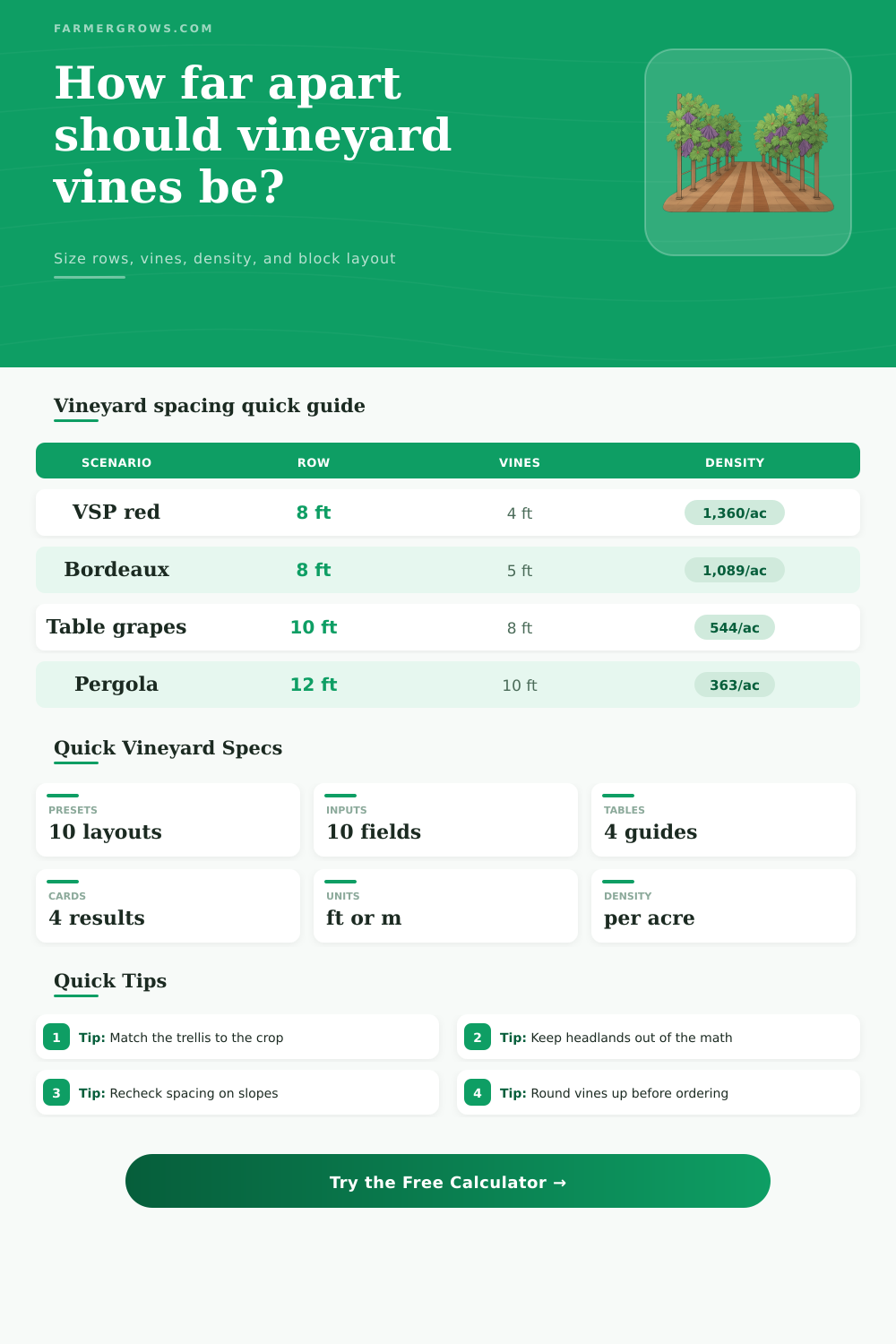
| Scenario | Row | Vines | Density |
|---|---|---|---|
| VSP red | 8 ft | 4 ft | 1,360/ac |
| Bordeaux | 8 ft | 5 ft | 1,089/ac |
| Table grapes | 10 ft | 8 ft | 544/ac |
| Pergola | 12 ft | 10 ft | 363/ac |
| Type | Row | Vine | Use |
|---|---|---|---|
| VSP | 1.00x | 0.95x | Tight |
| Lyre | 1.08x | 1.00x | Split |
| GDC | 1.12x | 1.04x | Wide |
| Pergola | 1.16x | 1.10x | Shade |
| Style | Row | Vine | Fit |
|---|---|---|---|
| Spur | 1.00x | 1.00x | Clean |
| Cane | 1.02x | 1.03x | Wood |
| Machine | 1.05x | 0.98x | Turn |
| Hand | 0.98x | 1.02x | Tight |
| Item | Feet | Meters | Use |
|---|---|---|---|
| 1 ft | 1.00 ft | 0.30 m | Length |
| 1 m | 3.28 ft | 1.00 m | Length |
| 1 ac | 43,560 ft2 | 0.4047 ha | Area |
| 1 ha | 107,639 ft2 | 2.47 ac | Area |
The reference charts are planning guides. Final row spacing should follow variety, trellis hardware, harvest method, and local site conditions.
When you plan to establish a vineyard, you must decide on a spacing between the rows of vines and the spacing between the individual vines within each row. The spacing between the rows of vines and the vines within each row will determine both how many vines will grow within the block of the vineyard and how much fruit each individual vine will produces. If the vineyard is too closely planted, the vines will become too crowded with each other.
As a result, the vines may not be able to adequately air around each other, and they may develop disease due to the lack of air for each vine. In contrast, if the vines are too widely spaced within each row, there will be fewer vines within the entire vineyard block, and there will be less total yields of grapes from the entire block. Row spacing is the distance between the rows of vines that run the length of the vineyard.
How to Space Vines and Rows in a Vineyard
The distance between these rows will depend upon the type of trellis system that will be used within the vineyard. For instance, a vertical shoot positioning (VSP) trellis system allows for vines to grow vertically upwards from the trellis system, and vines used within such a system will have a much closer row spacing than a pergola trellis system. Within a pergola trellis system, the vines will grow as a canopy that covers the area overhead of the trellis system.
Consequently, the distance between the rows must be greater in order to allow the vines to grow in this manner. Additionally, the row spacing will also relate to the vigor of the vines. Vines with high vigor will grow more strongly than vines with low vigor, and so the row spacing should be more widespread for high-vigor vines to avoid becoming a tangled mess of growing vines.
Vine spacing is the distance between each individual vine within a row. The spacing between the vines will relate to the type of grapes that will be cultivated within the vineyard and the pruning methods that will be used to the vines. For instance, red grape varieties may use a vine spacing of four feet when using spur-pruned cordons.
This spacing of four feet allows the vines receive the sunlight needed to produce the grapes without the vines shading the other vines within that row. However, if cane pruning or machine harvesting will be used, the vine spacing will be five or six feet between each vine. Machine harvesters requires a certain amount of space between vines to effectively harvest the grapes with the machine.
Headlands are the area within the rows of vines that are established as a buffer zone around the vines. The growers create the headlands so that there is space for the equipment used within the vineyard to turn and walk within the row without destroying the grapes. The size of the headland will be larger within rolling terrain than flat terrain.
The total plantable area within the vineyard block is calculated by subtracting the size of the headland from the total area of the vineyard block. The size of headlands must be accounted for in the calculation of the number of rows and vines that will grow within the vineyard. If headlands are not established, the equipment may hit the vines at the end of each row or may drive over the fences that contains the vines.
The density of the planted vines is calculated as the number of vines within the acre of land. Approximately 1,300 vines within an acre of land is a tight planting of vines that is established for the production of premium wines. Conversely, if there are fewer than 500 vines within an acre, it is considered to be a low-density planting of vines.
Low-density vineyards often produce berries with more intense flavors due to the spacing between each vine. These values can be calculated in a vineyard planner using prespecified settings within the calculator for the type of vines that will be planted into the acre. For instance, a vineyard planner may have a preset for a Cabernet VSP vineyard block or a pergola shade block.
In addition to the spacing of the rows and the vines within the rows, you must plan for the placement of the support posts for the vines. The support posts for the rows of vines should be placed every ten feet within each row. The total number of support posts can be calculated by multiplying the number of support posts per row by the total number of rows within the vineyard block.
If there are not enough support posts placed within the row, the wires of the trellis system may sag with the weight of the fruit of the vines. In addition to the spacing of the vines within the rows, the type of soil within which the vines will be planted and the slope of the land within which the vines will be planted should also be considered. For instance, vines may be planted into shallow soil with a wider spacing between each vine to allow for the vigor of each vine.
Additionally, steep slopes may require larger headlands to prevent erosion of the soil within the vineyard. Finally, the rows of vines should be aligned along the longest dimension of the vineyard block to be established. Aligning the rows along the length of the block will reduce the number of turns that vineyard workers and equipment must make when moving within the vines.