DEF Fertilizer Ratio Calculator
Plan agricultural urea solution dilution, finished nitrogen concentration, fertigation application rate, and crop nitrogen target fit before a tank or injector run.
This planner is for crop and fertigation math, not vehicle service. Automotive DEF purity standards, crop fertilizer labels, injector compatibility, and local nutrient rules are different, so confirm the actual product before applying it to fields.
Useful as a concentration reference for urea solution math. Use only crop-appropriate material and keep vehicle DEF separate.
Moderate stock solution for drip or nursery injection when lower salt load and simpler handling are priorities.
Compact nitrogen storage, but crystallization risk rises as temperature drops and agitation gets more important.
UAN includes nitrate and ammonium forms, so do not enter its grade as pure urea unless you are only comparing N gallons.
Urea Solution Plan
Results use urea nitrogen mass, source density, finished solution weight, application rate, and crop target comparison.
| Urea solution | N by weight | Approx lb N/gal | Approx kg N/L | Planning note |
|---|---|---|---|---|
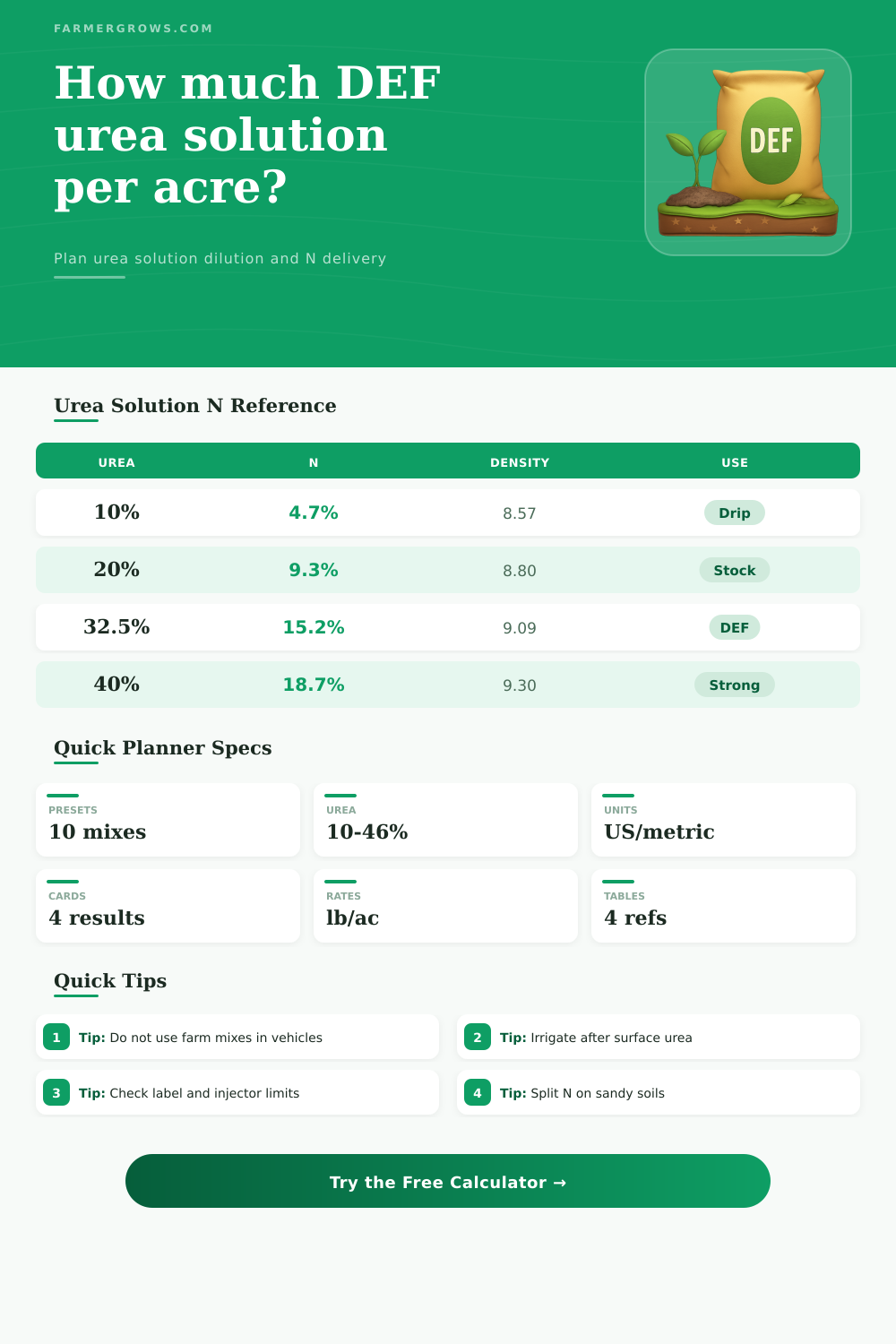
| 10% urea solution | 4.67% N | 0.40 lb/gal | 0.048 kg/L | Low-strength stock for tender fertigation programs |
| 20% urea solution | 9.33% N | 0.82 lb/gal | 0.098 kg/L | Useful farm stock when crystallization risk matters |
| 32.5% urea solution | 15.16% N | 1.38 lb/gal | 0.165 kg/L | DEF-grade concentration reference, not a vehicle-use recommendation |
| 40% urea solution | 18.66% N | 1.74 lb/gal | 0.208 kg/L | Concentrated stock; keep warm and agitated |
| 46% urea slurry or hot stock | 21.46% N | 2.03 lb/gal | 0.243 kg/L | High risk of salt-out unless temperature and mixing are managed |
| Urea by weight | Approx density | Metric density | Salt-out caution | Handling note |
|---|---|---|---|---|
| 0% water reference | 8.34 lb/gal | 1.000 kg/L | None | Use clean water compatible with the injector and crop |
| 10% urea | 8.57 lb/gal | 1.027 kg/L | Low | Good for small tanks and drip feed blending |
| 20% urea | 8.80 lb/gal | 1.055 kg/L | Low to moderate | Practical stock strength for many farm mixes |
| 32.5% urea | 9.09 lb/gal | 1.089 kg/L | Moderate | Store away from heat, dirt, metals, and vehicle DEF tanks |
| 40% urea | 9.30 lb/gal | 1.115 kg/L | High in cool weather | Confirm full dissolution before injection |
| Finished N concentration | At 1,000 gal/ac | At 5,000 gal/ac | At 10,000 gal/ac | Field use |
|---|---|---|---|---|
| 50 ppm N | 0.42 lb N/ac | 2.09 lb N/ac | 4.17 lb N/ac | Seedling or sensitive drip feed |
| 100 ppm N | 0.83 lb N/ac | 4.17 lb N/ac | 8.35 lb N/ac | Light maintenance fertigation |
| 250 ppm N | 2.09 lb N/ac | 10.43 lb N/ac | 20.86 lb N/ac | Moderate vegetative feeding |
| 500 ppm N | 4.17 lb N/ac | 20.86 lb N/ac | 41.73 lb N/ac | Strong fertigation, verify crop tolerance |
| 1,000 ppm N | 8.35 lb N/ac | 41.73 lb N/ac | 83.45 lb N/ac | High N delivery, usually split or diluted |
| Crop or block | Season N target | Typical split | Fertigation caution | Planning note |
|---|---|---|---|---|
| Sweet corn | 120 to 180 lb N/ac | Starter plus sidedress | Avoid heavy early salt load | Match timing to rapid vegetative demand |
| Tomatoes or peppers | 100 to 180 lb N/ac | Small weekly feeds | Too much N can delay fruiting | Adjust with tissue and soil nitrate tests |
| Leafy greens | 60 to 120 lb N/ac | Frequent light feeds | Watch nitrate accumulation | Keep rates modest near harvest |
| Hay or pasture | 40 to 100 lb N/ac | After cutting or grazing | Surface urea needs rain or irrigation | Split by yield goal and stand makeup |
| Orchard maintenance | 30 to 80 lb N/ac | Spring and post-fruit set | Avoid late lush growth | Use leaf analysis before large changes |
DEF caveat: Do not pour fertilizer blends, farm-mixed urea solution, or contaminated agricultural tanks into vehicle SCR systems. This calculator is only for crop nutrient planning.
Before injecting: Jar-test the water, confirm label permission, strain undissolved solids, and check injector seals, filters, crop salt tolerance, and backflow protection.
That equation is simplified when using a urea solution since fraction of nitrogen remains constant after determining its initial concentration. With those three variables, the concentration of your source, the amount of finished solution, and the desired nitrogen concentration, all you have to do is use the calculator above. You just plug it in and let it do the work.
But in real life, knowing what goes into each number matter. Source percentage indicate how many percent of liquid is actualy urea. Density take into account the fact that stronger solutions is heavier than weaker ones, meaning there’s less of them per gallon. And desired concentration is simply the number you want in the water you irrigate with (expressed either as a percent by weight or as parts per million). It’s the combination of those three figure that determines how much concentrate you’ll need and how much plain water will be added.
Why Real-Life Math Is Different
Next comes field math: How big is the field? What’s the application rate? That will tell you if you should of do it in one tank or multiple tanks. Compare the target for crop. Then you can see just how close you are to hitting your full-season target. And then you’ll know if you need to go heavier with your mix or apply more frequently. Or maybe not; because if it’s over, you can back off before you start the injector running.
They present it in the form of a table of reference on page showing the strength of various stocks commonly available; how much nitrogen they contain per gallon (which is important if you’re wondering whether to maintain a 20 percent stock in your tank or whether a 32.5 percent solution saves you mixing time at the cost of tighter temperature control); and how density increases as the percentage of urea goes up. It reminds you that storing anything over 40 percent significantly raises risk of crystallization. Because of this, most grower stick with less concentrated solutions (stocks), even if space is limited.
The calculator doesn’t account for real fields which have other variables. Urea dissolves faster or slower depending on water temperature. Injector limits and filter screens can alters the maximum flow rate of pushing a batch through the system. Crop stage is important as well, as young transplants cannot take as much salt than an established corn plant might. Finally, late-season tissue tests will let you know to back off even if season total was still looking OK on paper.
So the practical thing is this: Run the numbers but do a jar-test of real mix before applying the entire tank. Most surprises gets caught in that one extra step. And it creates a record for future adjustments when the same field arise again. Little corrections over a season will add up to more consistant delivery of nitrogen and less scrambling at the very last minute.