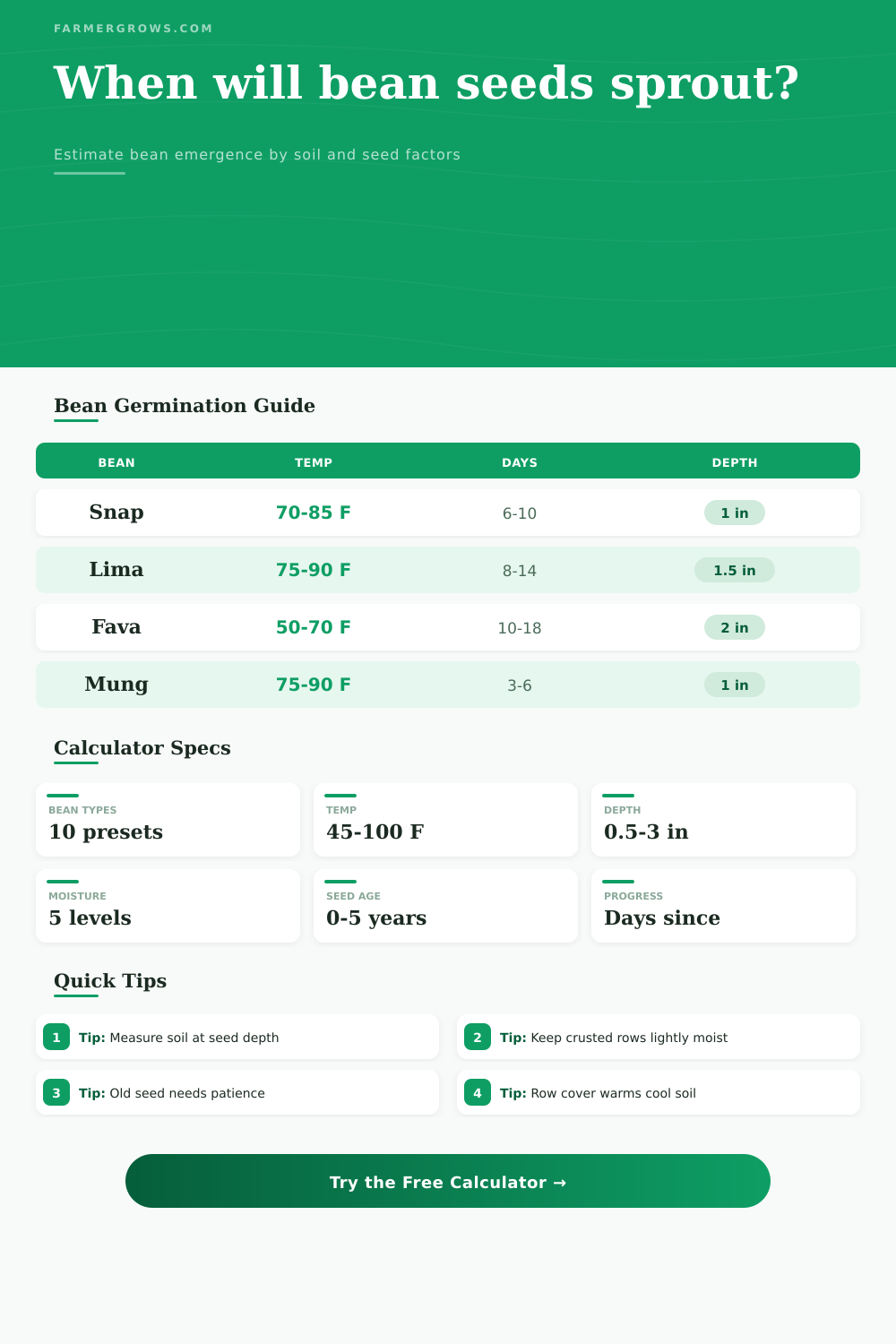
Bean Seed Germination Time Calculator
Estimate when bean seeds should emerge by bean type, soil temperature, planting depth, moisture, seed age, seed treatment, crusting risk, germination percentage, row cover, and days since planting.
Pick the closest bean planting situation, then fine tune the actual soil temperature, depth, moisture, seed condition, and days since planting for your row or bed.
Bean Germination Estimate
Your bean emergence estimate will appear here after calculation.
Use these cards as a quick check before changing the calculator. Warm-season beans slow sharply in cool soil, while fava beans are the major cool-soil exception.
Reliable garden bean in warm, loose, evenly moist soil near 70 to 85°F.
Similar to bush beans, often planted a little deeper beside trellis supports.
Needs warmer soil than snap beans and can rot in cold, wet seedbeds.
Tolerates mild conditions, but still emerges more evenly once soil is warm.
Cool-season bean for early spring or fall planting in moist, workable soil.
Fast in warm garden beds, slower if planted before steady spring warmth.
Handles heat well and usually emerges quickly in warm summer soil.
Small, quick seed that likes warm soil and shallow, steady moisture.
Common dry beans follow snap bean timing when seed is fresh and soil is warm.
A common bean type that dislikes cold, sealed, or saturated surface soil.
These tables summarize common emergence ranges. Local soil texture, seed lot quality, irrigation, and spring weather can move actual timing by several days.
| Bean type | Minimum soil temp | Preferred range | Typical emergence | Common depth |
|---|---|---|---|---|
| Bush snap bean | 60°F | 70-85°F | 6-10 days | 1 to 1.5 inches |
| Pole snap bean | 60°F | 70-85°F | 7-11 days | 1 to 1.5 inches |
| Lima bean | 65°F | 75-90°F | 8-14 days | 1 to 1.5 inches |
| Runner bean | 55°F | 65-80°F | 8-13 days | 1 to 2 inches |
| Fava bean | 40°F | 50-70°F | 10-18 days | 1.5 to 2.5 inches |
| Soybean or edamame | 55°F | 70-85°F | 5-9 days | 1 to 1.5 inches |
| Cowpea or southern pea | 65°F | 75-95°F | 4-8 days | 1 to 1.5 inches |
| Mung bean | 65°F | 75-90°F | 3-6 days | 0.75 to 1.25 inches |
| Soil temperature | Warm beans | Fava beans | Expected effect | Planting note |
|---|---|---|---|---|
| Below 50°F | Very slow or risky | Slow but possible | Long delay, higher rot risk | Wait for warmth except favas |
| 50-59°F | Slow and uneven | Good cool range | Several extra days | Use fresh seed and avoid wet soil |
| 60-69°F | Acceptable start | Moderate | Normal to slightly slow | Row cover can help cool beds |
| 70-85°F | Best range for many beans | Can be warm | Fastest uniform emergence | Keep moisture steady |
| 86-95°F | Fast if moist | Too warm for favas | Heat stress if dry | Water lightly before crusting |
| Above 95°F | Heat risk | Not ideal | Reduced stand potential | Shade, mulch, or wait |
| Planting depth | Best use | Speed effect | Stand risk | Adjustment idea |
|---|---|---|---|---|
| 0.5 inch | Small beans, damp soil | Fast if moisture holds | Drying or exposure | Firm soil gently after sowing |
| 1 inch | Most garden beans | Fast normal range | Low in loose soil | Keep surface evenly moist |
| 1.5 inches | Warm dry topsoil | Slightly slower | Low to moderate | Useful when top half inch dries |
| 2 inches | Fava or sandy soil | Slower emergence | Crust and energy loss | Avoid deep planting in heavy clay |
| Over 2.5 inches | Rare bean situations | Often delayed | High for small seed | Recheck depth before replanting |
| Condition | Timing impact | Stand impact | Watch for | Field response |
|---|---|---|---|---|
| Evenly moist soil | Baseline | Best potential | Normal swelling and cracking | Maintain gentle moisture |
| Dry seed zone | Delayed start | Patchy stand | Seeds not swollen | Irrigate lightly and evenly |
| Saturated soil | Slow or stalled | Rot risk | Sour smell, soft seed | Wait before disturbing rows |
| Surface crust | Visible delay | Bent or trapped seedlings | Cracking but no emergence | Soften crust carefully |
| Old seed | One to several extra days | Lower final stand | Uneven sprouting | Test germination before sowing |
Measure the seed zone: A surface thermometer can mislead. Push the probe to actual planting depth in the morning for a better germination estimate.
Check before replanting: If the calculator says sprouts are overdue, gently uncover a few seeds before starting over. Swollen firm seeds may still emerge.
Waiting for your beans to germinate makes you anxious. So you sprinkle seed on, then douse it gently with water. And wait. Days go by as you stare at soil in front of you, hoping something might happen. But the weather gets rainy (or cool) and you start to fret. Is anything going on? Have all seeds been destroyed?
The bean counter eases some of this angst. It transform your fuzzy guesswork into an educated approximation. By taking factors you can influence, and turning them into predictions about exactly when those beans should appear, The most important factor is soil temperature.
How to Predict When Beans Will Grow
And it is the one we guess wrong most frequent. What’s the air temperature? Well, it’s what your thermometer reads in the top inch or two of soil. It is not what seed itself feels. What’s the temperature where the seed is nestled? That’s right. Down deep, as measured by a thermometer inserted exactly where the seed will be.
Snap beans, lima beans, other warm-season types requires warmth. They need heat to start growing. If the soil is under sixty degrees, nothing happens; they just sits there in a state of suspended animation. The why behind the tool that asks for temperature at seed depth: Because you must measure what matters, which isn’t the air temperature, but the temperature down where the seeds are going to rest.
The other key is depth. Too much, and you waste energy; the seedling grows upward without recieveing any sunlight. Too little and you risk having your seed dry out, and it can even be washed away by rains. One to one and a half inches deep is ideal for most bean variety you grow in the garden; that’s a sweet spot where moisture is usually consistent, but the journey to the surface remains short.
That’s what the calculator factors into its guess, knowing that another half inch will mean days longer then normal in hard clay soils. It’s moisture madness. Don’t drown it; don’t dry out the process. Wet, cool soil is a no-no for beans. The calculator cautions you if your soil is soaked. Stand potential decreases.
Speed matters, but life matters too. The seed need oxygen to respire as it swells. Replace that air? With water-logged soil. That seed you thought was fine in the bag could of been mushy underground. Check the temperature, yes. But also check the moisture setting.
And the math gets trickier when saving older seeds. A season of seed-saving means seed’s strength declines. Does it go dead? No. Does it just take longer to sprout, and perhaps even sprout less evenly? Yes. The tool factored in seed age. Three-year-old seed will be slower than fresh seed. That can help you know what to expect when you save heirlooms.
With bulk purchases stashed away. More may emerge over time. Sprouts will occur over more days, and not all at once.
Physical barriers include soil crusts and row covers. That has to be figured into the math. Soil that’s been subjected to a hard rain (on sandy or silty soil) forms a crust, akin to a lid of concrete. That’s where the soil might have sprouted but now it can’t penetrate it. Or a light fabric warms the ground a few degrees. A frost cloth warms. It tricks the calendar effectivly.
The calculator takes all this into consideration, crust risk. And shows you a more realistic picture of when green will appear. It is not necessarily when it germinated. These are not always the same thing.
The tool turns waiting into a strategy. It’s no longer guesswork. It’s planning. It’s knowing when to get out there and check that soil. You will know when you should be concerned. You need to know when to step back and let biology do what it does.
This isn’t about speeding nature up. This is about learning her rhythm. It is about understanding why those first little loops appear on the surface and why they show up when they do.