Maize Seed Germination Time Calculator
Estimate maize emergence timing from seed type, seed-zone soil temperature, planting depth, moisture, treatment, seed age, residue cover, crusting risk, germination percentage, and days since planting.
Choose a common maize planting situation, then fine tune the measured soil temperature, depth, tag germination, and field surface conditions for your actual seedbed.
Maize Germination Estimate
Your estimated maize emergence timing will appear here after calculation.
Adapted field hybrids normally emerge predictably when planted into 55°F or warmer soil with adequate moisture.
Selected vigor helps early planting, but cold wet soil can still stretch emergence and reduce uniformity.
Emergence is close to dent corn; planting depth and residue management often drive the difference.
Normal sugary sweet corn is workable in moderate soils, but cool seedbeds still slow stand establishment.
Supersweet kernels are often more sensitive to cool wet soils, so warm planting conditions matter more.
Popcorn may be slightly slower where seed placement is deep or crusting creates mechanical resistance.
Most waxy types track field corn closely when seed quality and planter depth are consistent.
Tropical material generally prefers warmer soils and can lag in cool spring planting windows.
| Seed-zone soil temperature | Typical emergence time | Maize response | Field check |
|---|---|---|---|
| Below 50°F (below 10°C) | Very slow or paused | Imbibition may occur, but growth is limited and stress risk rises. | Delay planting when possible; dig seeds carefully if already planted. |
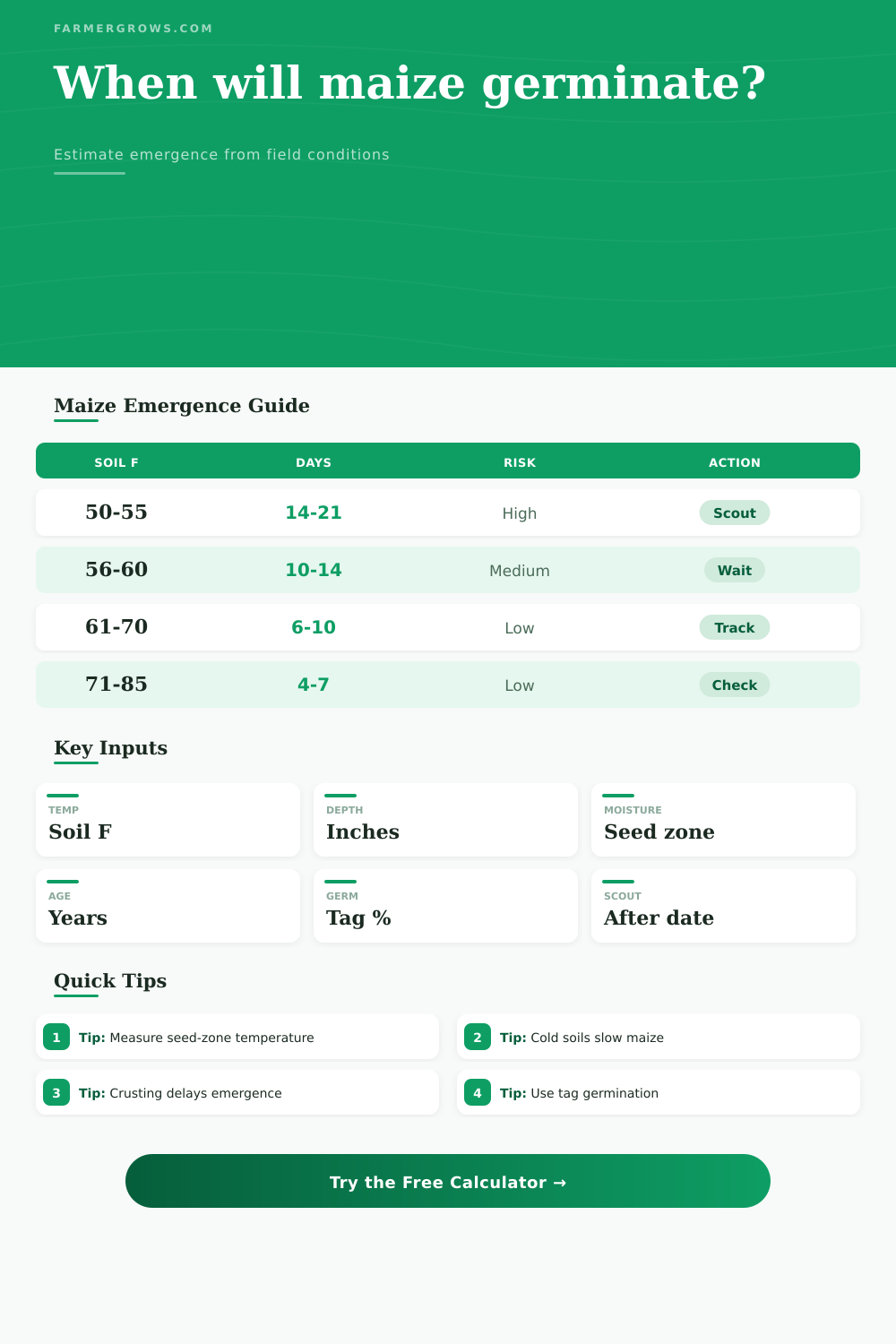
| 50 to 55°F (10 to 13°C) | 14 to 21 days | Slow emergence with greater disease and uneven stand risk. | Scout patiently and check for firm swollen kernels before replant decisions. |
| 56 to 60°F (13 to 16°C) | 10 to 14 days | Acceptable but not fast; cool rain can stretch the calendar. | Start checking rows near the expected emergence date. |
| 61 to 70°F (16 to 21°C) | 6 to 10 days | Good maize germination speed when moisture and depth are right. | Scout for uniform spikes and shallow crusting. |
| 71 to 85°F (22 to 29°C) | 4 to 7 days | Fast emergence if the seed zone remains moist. | Watch dry seedbeds because fast heat can remove surface moisture. |
| Above 86°F (above 30°C) | 4 to 6 days | Warm enough for fast growth, but dry soil can interrupt germination. | Confirm moisture at seed depth, not only on the soil surface. |
| Planting depth | Expected timing effect | Best use | Caution |
|---|---|---|---|
| 0.75 to 1.25 inches | Can be quick in warm moist soil | Fine-textured moist seedbeds with little drying risk. | Too shallow can leave seed in dry soil or herbicide stress zones. |
| 1.5 to 2.0 inches | Baseline timing | Most field maize planting when moisture is available. | Keep planter units steady so depth is uniform across rows. |
| 2.1 to 2.5 inches | Adds about 0.5 to 1.5 days | Dryer surfaces where deeper moisture is reliable. | Cool heavy soils can slow coleoptile emergence noticeably. |
| 2.6 to 3.0 inches | Adds about 1.5 to 3 days | Only when needed to reach consistent moisture. | Seedling energy, crusting, and uneven emergence become bigger concerns. |
| Over 3.0 inches | Often delayed | Rare emergency use in very dry topsoil. | High risk of uneven stands, especially with cool soil or older seed. |
| Field condition | Time modifier | Stand risk | Scouting focus |
|---|---|---|---|
| Firm and moist seed zone | Little or no delay | Low when seed quality is strong. | Check for even spikes across rows. |
| Dry or uneven moisture | Moderate to large delay | Uneven emergence and skipped plants. | Dig both emerged and bare spots to compare seed condition. |
| Wet, cold, saturated soil | Large delay | Seedling disease and oxygen stress. | Inspect seed firmness, radicle color, and decay. |
| Heavy row residue | Small to moderate delay | Cooler soil and wet surface layers. | Compare residue-covered rows with warmer bare strips. |
| Crusted surface after rain | Delay after germination | Leafing underground or trapped shoots. | Look for coleoptiles pushing below a sealed surface. |
| Days since planting | If soil is cool | If soil is warm | What to do |
|---|---|---|---|
| 0 to 3 days | Usually too early to judge. | Kernels may be swelling and radicles starting. | Confirm seed-zone moisture and avoid disturbing many seeds. |
| 4 to 7 days | Early root growth may be visible. | Emergence may begin in warm fields. | Dig a few rows and look for healthy white shoots. |
| 8 to 12 days | Normal waiting period for 55 to 60°F soil. | Warm fields should show clear emergence. | Count emerged plants and inspect missing spaces. |
| 13 to 18 days | Still possible in cold soils. | Delayed for warm soil unless moisture or crusting interfered. | Split kernels and examine shoot health before decisions. |
| 19+ days | Scout closely and compare to heat accumulation. | Investigate stand loss, crusting, disease, or dry seed. | Use stand counts and local agronomy guidance for replant calls. |
Measure where the seed sits. A 2-inch thermometer reading is more useful than air temperature because maize germination responds to the seed-zone environment.
Scout before assuming failure. Cold maize can sit for days, then emerge quickly after warming; dig seeds to check radicles, shoots, odor, and firmness.
Estimating germination time for maize isn’t about calendar dates; it’s more about how soil physics work. And that’s not determined by the calendar but by how the soil physics works.
You’ve got the seed sown, and all you can do is wait till it emerge. The answer lies in physical conditions of the seed zone where maize has to respond, and we have an online calculator that figure out the timing for you given your conditions. No guesswork required. It does the math based off moisture coefficient and heat units.
How to Guess When Maize Will Grow
What makes seeds work: Most importantly, it’s temperature (it’s not air temperature, though; it’s the soil temperature right around where the seed itself are located). It might be sunny out, so the top of soil feels warmer, but underneath there could still be chilly soil… Colder by an inch or two. For maize, a consistent minimum of about 50 degrees F is needed before any meaningful activity will get started. If it’s colder, yes, the seed might take up moisture (but biological action slow to a halt). That’s why seeds planted when soil is cool emerge fitfully, as if you’d had great-looking weather on top but not underfoot. Check thermometer that matters: where the seed resides.
The timing of when seeds will actualy emerge changes greatly with depth. In a dry year, planting deeper than normal may be beneficial as the seed can seek out some moisture further down, though it now has further to go up to light once emerging. Each additional inch of soil require the seedling to use more energy (and time). Cool, heavy soils is not likely to allow emergence if the seed has far to travel. Enter your planting depth into the calculator to see how long it will take your seed to find moisture.
Germination requires not only right moisture, but also proper soil temperature. The problem with cold soil and excess moisture is that it limit oxygen exchange, stressing the seed and making it more susceptible to disease. Dry spots in the area where seeds is germinating may delay or stop germination until the next time it rains. Even within one field, moisture content can be uneven from one side of the row to another. While one row has just-right moisture, the adjacent row may be in dry soil. That uneven emergence can make managing your stand difficult and make it hard to know when to apply herbicide.
Complicating this even more is managing residue, particularly in a no-tillage system. Residue will help hold moisture and also shade the ground, keeping it cool longer. That will delay the ground warming in the spring, which reduce how fast seeds germinate early on. Heavy rains followed by drying winds cause crusting that can become a mechanical barrier to emerging shoots. You might get right germination under the crust, but the shoots won’t break through. Can result in complete failure or leafing underground.
Storing seed also poses its own set of risks. Older seed stores in your seedbox will be less vigorous; they’re less tough against emerging-stage challenges. It is more important that seeds germinate at all than how quickly they do so, and fresh seed help this because the germination percentage is high. And again, cool, wet soil plus older seed means there is much less room for error. To include the effects of seed treatment level (or lack thereof) and seed age on stand confidence, the calculator includes these variables in its estimate.
So how do you know when to scout? And when should you plant, too? Better to dig up your seed and see what’s happening than guess at it on top of ground. Look for a healthy shoot, a radicle, and a firm kernel. Any sign of decay, softness or mold means something went wrong in the process of germinating.
Know the variables, and you’re no longer just sitting waiting, you’re managing. You’ll know the difference between a lost stand and a slow start so you can base your replant decision on information, not fear. The goal is uniform emergence. That sets the stage for a good season.