Hydroponic Nutrient Solution Calculator
Estimate how much concentrate to add after top-off, compare the result in EC and ppm, and keep reservoir pH targets tied to real hydroponic crop ranges.
Use clean water, a calibrated meter, and your nutrient label. This calculator estimates the concentrate dose needed to move from the current reading to the target after fresh-water top-off.
Large water volume buffers swings and works well for lettuce, spinach, and other greens.
Small film volume reacts quickly, so top-off and meter checks should be frequent.
Strong for tomatoes, peppers, and cucumbers when runoff returns to the reservoir.
Good for staged feeding where EC targets rise as fruit load increases.
Best with moderate EC because water level and nutrient strength drift together.
Reservoir Dose Estimate
Dose is based on top-off dilution, selected meter scale, and concentrate strength.
| Crop | Common system | Typical EC | 500-scale ppm | Notes |
|---|---|---|---|---|
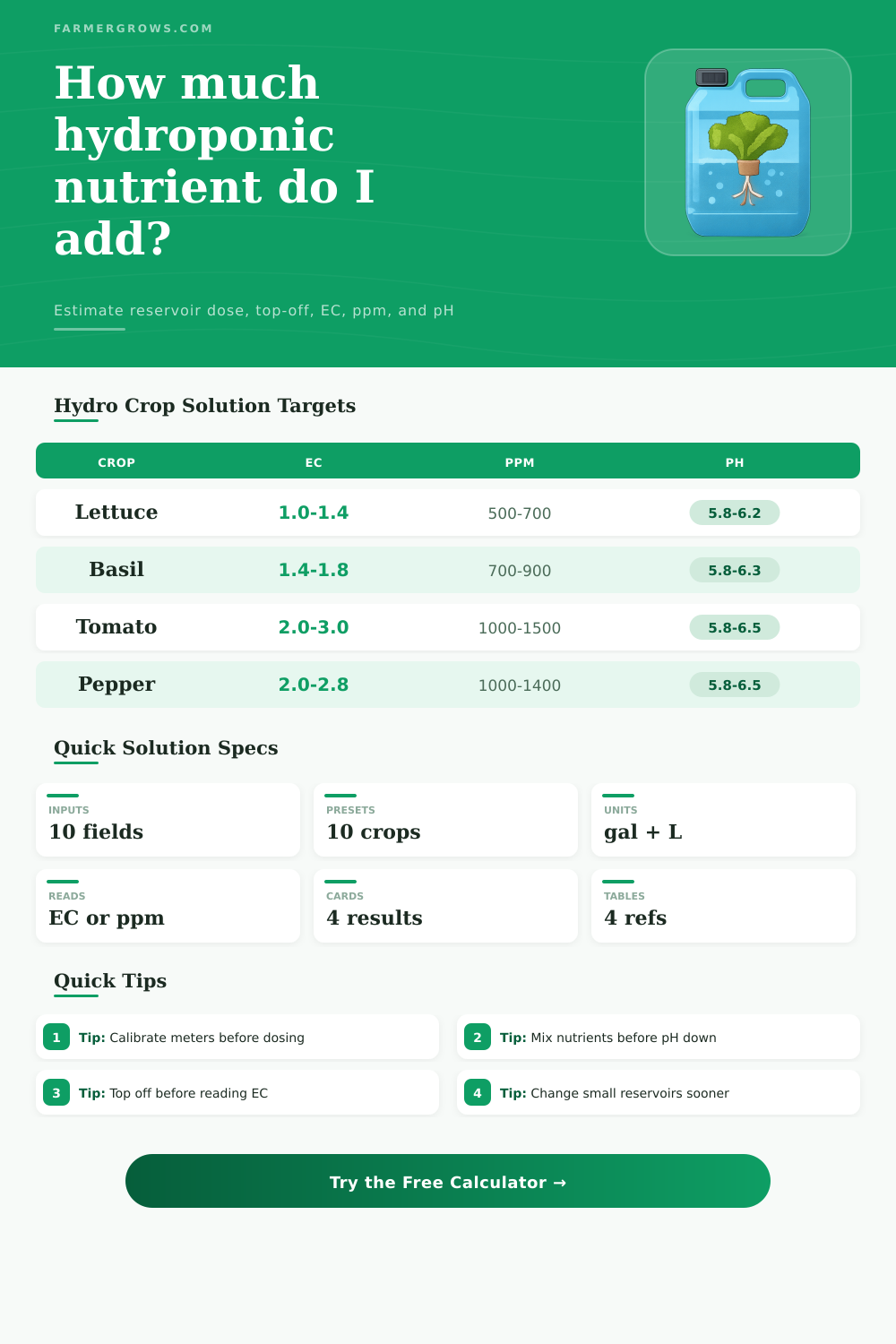
| Lettuce | DWC or raft | 1.0 to 1.4 | 500 to 700 | Lower EC reduces tip burn risk in warm rooms. |
| Basil | NFT or DWC | 1.4 to 1.8 | 700 to 900 | Holds flavor well with moderate conductivity. |
| Tomato | Dutch bucket | 2.0 to 3.0 | 1000 to 1500 | Fruit load usually pushes targets higher. |
| Cucumber | Bato or drip | 1.8 to 2.5 | 900 to 1250 | Watch rapid water uptake during hot days. |
| Strawberry | NFT or trough | 1.2 to 1.8 | 600 to 900 | Avoid high EC during transplant recovery. |
| Pepper | Drip bucket | 2.0 to 2.8 | 1000 to 1400 | Use stronger feed after fruit set. |
| Spinach | Floating raft | 1.3 to 1.8 | 650 to 900 | Cool water helps steady uptake. |
| Mixed herbs | Kratky tote | 1.2 to 1.8 | 600 to 900 | Start mild when species are mixed. |
| Crop group | Target pH | Alkalinity ppm CaCO3 | Drift behavior | Adjustment note |
|---|---|---|---|---|
| Leafy greens | 5.8 to 6.2 | 40 to 100 | Usually stable | Mix nutrients first, then adjust pH. |
| Herbs | 5.8 to 6.3 | 40 to 120 | Moderate rebound | Small tanks need slower pH changes. |
| Fruit crops | 5.8 to 6.5 | 60 to 140 | Daily swing common | Circulate the solution before retesting. |
| High alkalinity water | 5.7 to 6.2 | 140 plus | Strong rebound | Consider filtered water or acidified stock water. |
| Concentrate strength | To raise 0.5 EC | To raise 250 ppm | Best fit | Handling note |
|---|---|---|---|---|
| 0.10 EC per mL/gal | 5.0 mL/gal | 5.0 mL/gal | Mild one-part | Good for seedlings and herbs. |
| 0.15 EC per mL/gal | 3.3 mL/gal | 3.3 mL/gal | General feed | Common estimate for balanced concentrates. |
| 0.20 EC per mL/gal | 2.5 mL/gal | 2.5 mL/gal | Strong feed | Add slowly in small reservoirs. |
| 0.30 EC per mL/gal | 1.7 mL/gal | 1.7 mL/gal | Dense stock | Measure carefully to avoid overshoot. |
| System | Reservoir size | Top-off trigger | Full change interval | Watch item |
|---|---|---|---|---|
| Kratky tote | 5 to 20 gal | 25% drop | 7 to 14 days | Root air gap and rising EC. |
| NFT channel | 15 to 60 gal | 10% drop | 7 to 10 days | Small volume changes fast. |
| DWC or raft | 20 to 200 gal | 10% drop | 10 to 21 days | Water temperature and oxygen. |
| Dutch bucket | 30 to 150 gal | 10% drop | 7 to 14 days | Salt buildup during fruiting. |
| Drip slab return | 40 to 250 gal | 15% drop | 7 to 14 days | Runoff EC versus tank EC. |
Top-off order: Add plain water first, circulate for a few minutes, then read EC or ppm before adding nutrients.
pH order: Add nutrients before pH adjustment because concentrates often shift pH on their own.
If a hydroponic system is out of whack, it stays that way. Everything you do changes what goes into your plant, whether your system are balanced or not. Every time you add nutrients to reservoir, adjust pH, or read the meters, you change that input. Your plants will grow well or poorly depending on that nutrient balance. You won’t see the change until you see it in their leaves, or not.
That’s where the calculator on this page comes in. It does all of that math once you input information from your test kit. You will need to enter strength of your concentrate, your present and desired readings, how much you added to replace evaporation or water changes, and how much water is currenty in your tank. Why? Because if you add a bunch of freshwater, you dilute whatever was already there and you need to take that into account when figuring out what dose to administer. The strength number is what connects what’s on the bottle to what’s actualy in your test tube. The math becomes theoretical without it.
How the Calculator Helps You Balance Nutrients
The starting point for target is crop selection. Fruiting crops will be on high side of recommended scale because they need or can handle a saltier solution after flowering. Leafy greens are typicaly on the low end since salt damage to leaves shows up as burnt leaf edges, especially in warm rooms. The “stage” selector in the tool shifts that span appropriately: You don’t want to apply same target to the transplanted tomato reservoir that you do if it’s loaded with fruit.
That’s why there is also alkalinity and pH fields. Alkaline water doesn’t adjust downward easy, and adding nutrients change pH; what the outcome tells you is whether your intended target is achievable without acid additions. Top-off behavior is also easy to underestimate. Adding plain water first avoids one common mistake, dosing when you’ve let your tank go down part way and then overshooting it because you wait for your meter to catch up. That dilution becomes the starting point instead of the end point in calculation, so the end result is closer to where the crop should of been at the end.
There’s also that low-key factor of meter scale selection. You can’t use a 500 conversion with a 700 on the other line of nutrients. Switching between them in tool lets you see how the same physical strength will look as either one. This is useful if you switch from brand to brand or if a buddy emails you a recipe written based off the other scale.
Math is a simplification of real systems with variables you can’t includes in the math. For example, evaporation concentrates the tank between tests. Uptake rates depends on temperature fluctuations. How well your roots distribute solution to the leaves also matter. To be practical, use calculated dose as a starting point, circulate it a bit, re-test, and then adjust pH if needed. Small reservoir will drift quicker, making it more critical to make regular full changes rather than chasing precise daily doses. Aim isn’t perfect results on paper. It’s checking often enough to keep corrections small and keeping levels steady to match what the crop is using.