
Fruit trees is treated as loners by most home gardeners, as if they’ll be happy as long as you give them some sun and water. Not so with sweet cherries: They won’t set a single stone unless they has someone to pollinate their blossoms first. Your tree will bloom each spring in a cloud of white, then drop those blooms, all biological uselessness, though it must look like an abundant display. Unless you know the trick, you might never see more than naked branch. That’s what a properly matched mate would add: a harvest whose juice will stain your fingers red for weeks on end.
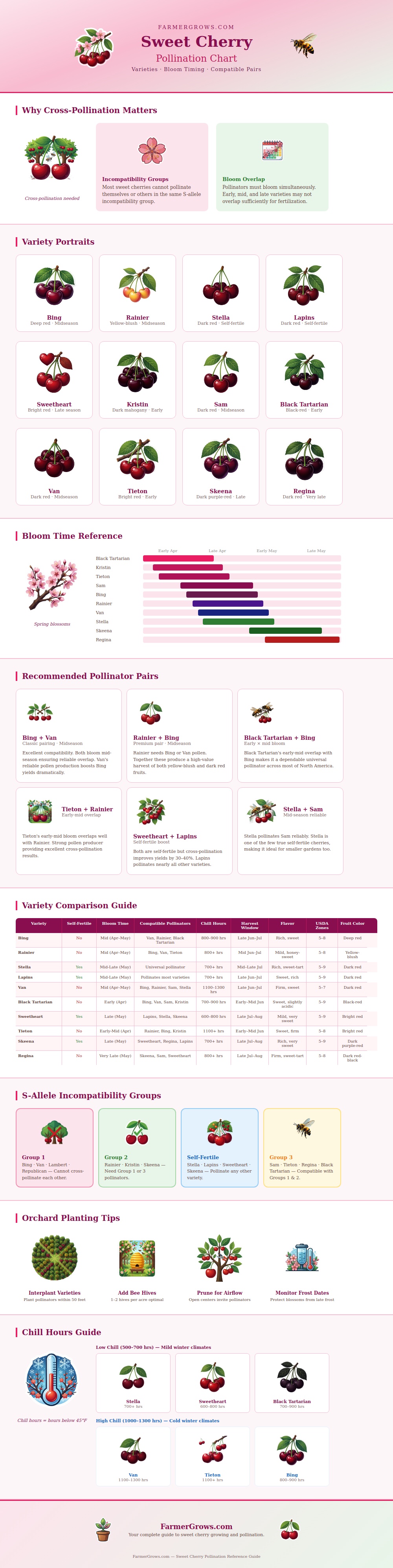
Geography isn’t really the issue; it’s genetics. Most sweet cherries is self-incompatible, meaning their own pollen cannot fertilize them. They require some level of genetic diversity for fruit to set. Here is how to visualize what kind are compatible (or incompatible) with which in the graphic up top. For example, though the Bing and Van trees are both popular midseason staples, they’re both Group S-allele on the chart, so putting them side by side would seem to make sense; but they can’t help one another. In fact, they talk right past each other in blossom time.
How Sweet Cherries Need Pollination
One cherry variety has to be paired with another in a different group… Group 1 with either 2 or 3. To achieve fruitful cross-pollination. And that’s where people go off the rails: thinking similarity means compatibility, when in fact in cherry country the only currency is differnce.
And then there’s timing. Even when two trees are compatible at the genetic level, they still has to bloom around the same time. A tree that blooms early (like Black Tartarian) will be finished by the time one that blooms late (like Regina) starts opening its buds. Here, the chart makes it easy: From earliest bloom in early April through May, all different types stage a staggered show. You want a partner whose bloom cycle overlaps yours; ideally right in the middle of your main variety. The mid-season bloom of Rainier matches up exactly with Bing or Van. Plant them out of whack in terms of calendar dates and the bees don’t have anything to carry back and forth. It’s a practical puzzle where biology sets the rules, and you’re left holding the pieces.
If you’re short of room or not sure what to pair with, there are self-fertile varieties like Stella, Lapins, and Sweetheart that will produce fruit alone. This seems great, but even self-fertile trees does better with friends. In fact, cross-pollination increases the number of cherries harvested by thirty to forty percent in most instances. Meaning: Planting just one Lapins tree gets you cherries; but planting one and a suitable companion turns a decent snack into a respectable crop. Not because you must, but because you want to: optimizing.
In fact, neither of these choices will be possible in your yard unless climate has provided the needed number of “chill hours” (below 45 degrees F) each winter to break their dormancy properly. Trees like Van and Tieton needs more than 1,100 chill hours. This is not possible in areas with mild southern winters, which may prevent the trees from blooming at all. The opposite is true of Stella and Sweetheart: They’re adapted to lower chill demands, doing well in warmer areas where other types couldn’t cope. As with pairing with a pollinator, you need to match the tree to its location history of weather. If one won’t wake up from winter, no matter how well matched, there’ll be no fruits to share.
In the context of an orchard, bees aren’t long-distance fliers: They’re interested in physical location, more so than many planting guides might lead you to believe. To help efficient pollen transfer, keep your compatible trees within fifty feet of one another. An open center also makes sense (pruning helps), improving air flow while making it easier on pollinators to reach those inner blossoms where the fruit will set. Additional assurance that no flower goes unvisited comes from having some hives nearby at bloom time. It is a system made for cooperation.
It’s all worth it in the end, though, because as any person who has had a bite of sweet cherry knows, they’re just about unbeatable in flavor: from the honey-sweetness of a Rainier to the richness of a tart Bing variety. And while their sweetness may seem like an accident, it comes from paying attention to bloom times, picking compatible partners, and understanding the genetics behind each one. Once you know how your trees are talking to one another (via pollen), you should of given up trying to fight nature, and instead begin to work with it. The flowers will still drop. This time, however, some of those blossoms will become fruit.