Turkey Brine Calculator
Size wet brine volume, salt, sugar, ice, and safe brining time from your turkey weight, cut, salt type, and target strength.
🦃Named Turkey Brine Presets
⚖Brine Inputs
Food safety check: wet brine and turkey should stay at or below 40°F / 4°C throughout brining.
Your Brine Plan
🧂Salt Density Reference
📊Reference Tables
| Brine strength | Salt per quart | Salt per liter | Best turkey use |
|---|---|---|---|
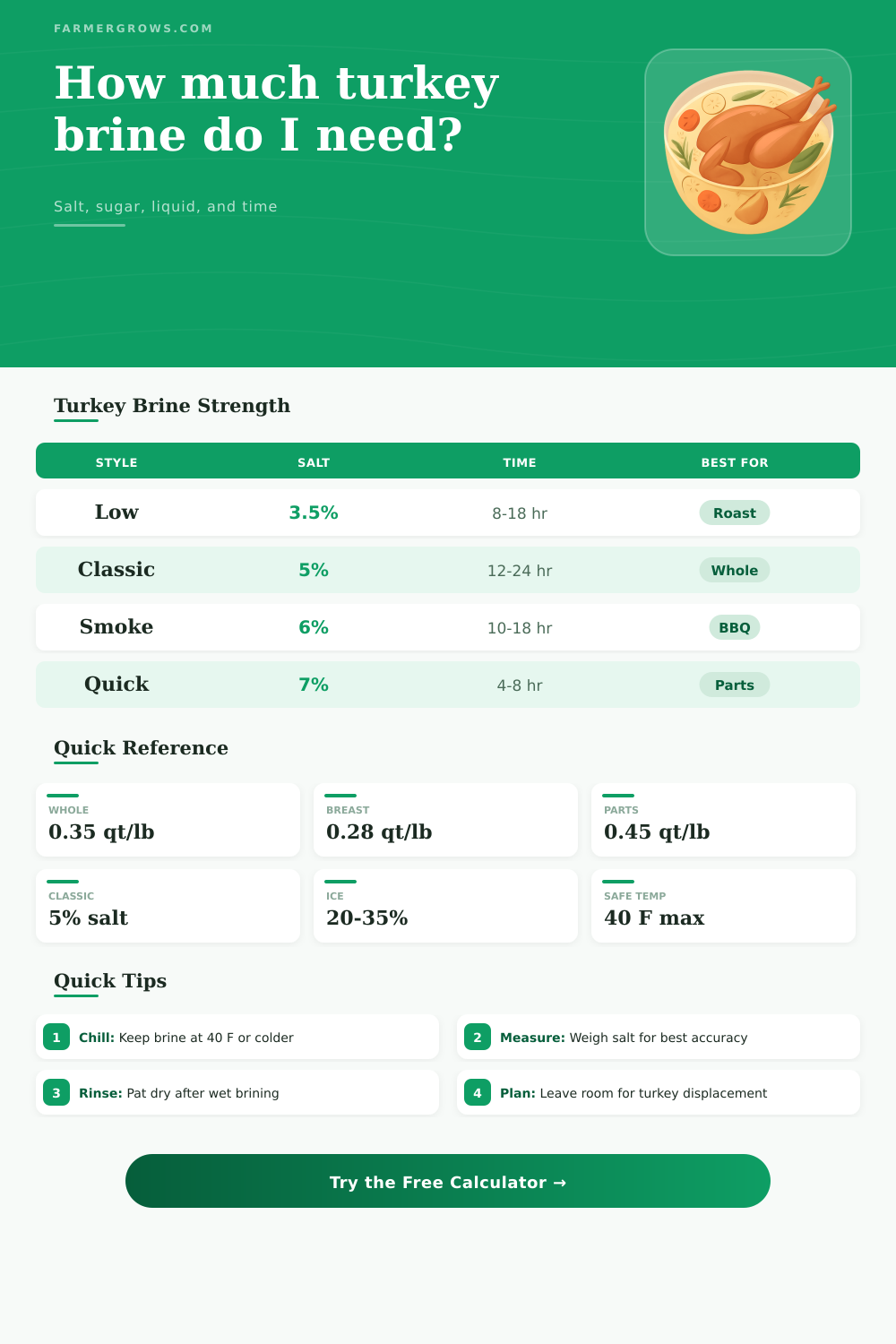
| 3.5% low-sodium | 33 g | 35 g | Long roast brines and naturally salty birds |
| 5% classic | 47 g | 50 g | Whole turkey, 12 to 24 hours |
| 6% smoked | 57 g | 60 g | Smoked turkey with stronger seasoning |
| 7% quick | 66 g | 70 g | Parts, wings, legs, and short brines |
| Turkey form | Liquid ratio | Time range | Notes |
|---|---|---|---|
| Whole turkey | 0.35 qt/lb | 12 to 24 hr | Use a snug pot, brining bag, or food-safe bucket |
| Heritage turkey | 0.33 qt/lb | 10 to 18 hr | Lean meat seasons faster than broad-breasted birds |
| Spatchcocked turkey | 0.30 qt/lb | 8 to 16 hr | Flatter shape needs less liquid depth |
| Turkey breast | 0.28 qt/lb | 6 to 12 hr | Stop early to avoid a cured texture |
| Turkey parts | 0.45 qt/lb | 2 to 8 hr | Small pieces season rapidly |
| Common turkey | Classic liquid | Salt at 5% | Suggested time |
|---|---|---|---|
| 8 lb parts or small bird | 2.8 qt / 2.6 L | 132 g | 4 to 10 hr |
| 12 lb spatchcock | 3.6 qt / 3.4 L | 170 g | 8 to 16 hr |
| 14 lb whole turkey | 4.9 qt / 4.6 L | 232 g | 12 to 24 hr |
| 18 lb whole turkey | 6.3 qt / 6.0 L | 298 g | 14 to 24 hr |
| Salt type | Grams per cup | Tablespoons per 100 g | Why it matters |
|---|---|---|---|
| Diamond Crystal kosher | 135 g | 11.9 tbsp | Large flakes measure much lighter by volume |
| Morton kosher | 256 g | 6.3 tbsp | Denser kosher crystals need fewer tablespoons |
| Table salt | 288 g | 5.6 tbsp | Fine grains pack tightly in measuring cups |
| Fine sea salt | 292 g | 5.5 tbsp | Similar to table salt for volume conversion |
🧪Brine Style Comparison
Low-Sodium Roast
3.5% salt keeps seasoning gentle for long brines, injected birds, or smaller holiday ovens with slow cook schedules.
Classic Wet Brine
5% salt is the standard balance for whole turkey moisture, seasoning, and predictable overnight timing.
Smoked Turkey
6% salt stands up to smoke, pepper, citrus peel, bay, and long low-temperature cooking.
Quick Parts
7% salt works for wings, legs, thighs, and small pieces when the brine window is short.
✅Brining Notes
A turkey brine is a liquid solution that is use to season and add moisture to a turkey that is being prepared for cooking. To brine a turkey, you prepare the solution of liquid in advance, and the turkey will become more seasoned and moist as a result of the brining process. For individuals who are uncertain about the proper measurement for the brining solution, a calculator can help to determine the amount of liquid, the amount of salt, and the proper time for brining the turkey.
The amount of liquid that are required to brine a turkey can vary depending upon the cut of the turkey that will be brined. For instance, a whole turkey will require more liquid than a turkey breast portion due to the different size and shape of each type of turkey. The cut of turkey must be chose in the calculator to determine the coverage ratio for the turkey.
How to Brine a Turkey Using a Calculator
If you use a wide stockpot instead of a brining bag, extra liquid will be required to cover the turkey, and the calculator can account for that extra amount of liquid. Salt is an ingredient in the brining solution, and the strength of the salt will impact the amount of seasonings that the turkey will develop. A lower percentage of salt will create a brining solution that seasons the turkey more gentle, which is useful for turkeys that will be soaked for long periods of time.
A higher percentage of salt will season the turkey more rapidly, which is useful if using strong aromatics in the brining solution. Both preset and custom salt selection can be made in the calculator. Different brands of salt can contain different amounts of weight per cup of salt.
Weighing the salt prior to adding it to the brining solution will ensure accuracy, but the calculator will also provide the amount of cup of the chosen salt brand that will be needed. Sugar is another ingredient to the brining solution. Sugar helps the turkey skin to brown during cooking.
The amount of sugar to be use is generally a fraction of the weight of the salt. If a sweet flavoring is not desired for the turkey, the sugar may be left out of the brining solution altogether. The calculator can calculate the amount of sugar that will be needed by multiplying the percentage of sugar by the weight of the salt.
Additionally, using ice to chill the brining solution will also change the amount of liquid to be use. Some of the liquid will be ice instead of liquid, and the calculator will indicate the amount of liquid and ice that will be needed. The time that the turkey is to be soaked in the brining solution is another variable in the brining solution.
If the turkey is soaked for too short of a time, the seasoning will not fully penetrate the turkey. If the turkey is soaked in the brining solution for too long, though, the texture of the turkey may become similar to deli meat. The calculator will indicate the amount of time required for brining the turkey based off the cut of turkey that is to be used.
The hours that are entered into the calculator can be compare to the recommended hours for brining. In order to properly brine the turkey, certain habits should be followed. The brining solution should always be kept at a cold temperature.
If the brining solution is warmer than the refrigerator temperature, it isnt safe to use, and the process will not function as it should. The cook should weigh the turkey after it has been thawed. Additionally, when the turkey is removed from the brining solution, it should be rinse and dried so that the skin can crisp when the turkey is roasted.
Regardless of the size of the turkey, the logic of the brining solution is the same. The decision about how much liquid the turkey will need, how much salt the liquid will contain, and for how long the turkey will need to soak in the liquid will be the same variable in both large and small turkeys. The calculator performs the calculations for these variables to the turkey briner.
The temperature of the turkey and the brining solution is the most important variable to maintain for safety. As long as both the turkey and the brining solution are at or below 40 degree, the turkey brining process is safe. While other variables will impact the flavor of the turkey, salt type, sugar amount, and soaking time are all choices for the briner, temperature is a necessity for the brining process to remain safe to eat.
Additionally, if the turkey brining process is performed often with the calculator, the briner will discover that different types of turkey will react different to the brining solution. For example, a whole turkey can be brined overnight in a mild brine solution, but smaller portions of turkey will only need to be soaked in a strong brine solution for a few hours. The result of brining a turkey will allow the meat of the turkey to remain moist and flavor evenly throughout the turkey.
Because the seasoning will move into the turkeys meat, every slice of turkey will taste seasoned. This even distribution of seasoning is the primary reason for brining a turkey prior to roasting it.