Square Feet to Cubic Yards Converter
Convert a landscape area and depth into cubic yards, cubic feet, bag counts, bulk loads, and estimated material weight for mulch, soil, compost, sand, and stone.
Use the custom area option when you already know the square footage, or pick a shape to calculate it from field measurements. The converter adds compaction and overage after the base square-feet-to-cubic-yards conversion.
Light to handle, good at 2 to 3 inches, and usually ordered by the cubic yard for large beds.
Bulkier than bark and useful where a deeper layer is acceptable around paths or tree areas.
Denser than mulch, so weight and delivery access matter once the estimate passes one yard.
Often spread thinner than mulch; one cubic yard covers a wide area at 1 to 2 inches.
Heavy and compactable, so the compaction setting should be higher than for organic mulch.
Best estimated with a compaction allowance because angular stone settles when tamped.
Use a shallow depth for leveling layers and keep the weight estimate in mind for hauling.
Needs more depth than garden mulch, so the cubic yard total rises quickly with area.
Landscape Material Estimate
The result applies shape area, depth, compaction allowance, and overage before rounding bags and bulk loads.
| Depth | 1 cubic yard covers | 1 cubic meter covers | 2 cu ft bag covers | Typical landscape use |
|---|---|---|---|---|
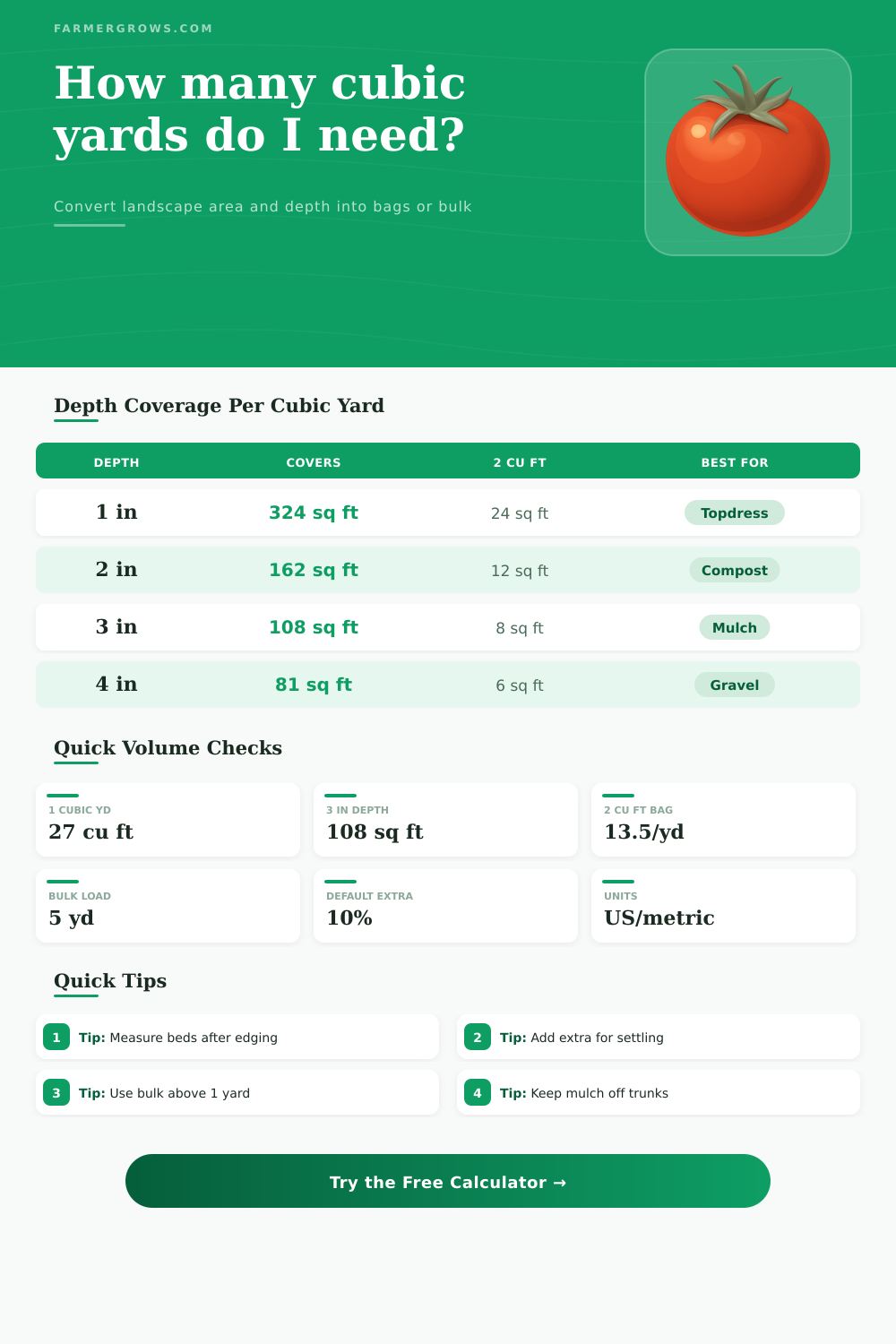
| 1 in | 324 sq ft | 39.4 sq m at 2.5 cm | 24 sq ft | Compost topdress, soil amendment, light refresh |
| 2 in | 162 sq ft | 19.7 sq m at 5 cm | 12 sq ft | Light mulch layer, annual bed compost |
| 3 in | 108 sq ft | 13.1 sq m at 7.6 cm | 8 sq ft | Common bark mulch depth around beds |
| 4 in | 81 sq ft | 9.8 sq m at 10 cm | 6 sq ft | Decorative gravel, deeper wood chips |
| 6 in | 54 sq ft | 6.6 sq m at 15 cm | 4 sq ft | Raised bed fill, heavy soil repair |
| 9 in | 36 sq ft | 4.4 sq m at 23 cm | 2.7 sq ft | Playground safety mulch planning |
| Material | Typical lb per cubic yard | Approx kg per cubic meter | Good compaction setting | Planning note |
|---|---|---|---|---|
| Shredded bark mulch | 500 to 800 | 300 to 475 | 5% light settling | Density varies with moisture and bark size |
| Wood chips | 400 to 700 | 240 to 415 | 5% light settling | Large chips bridge and fluff more than bark |
| Screened topsoil | 2,000 to 2,700 | 1,185 to 1,600 | 12% tamped soil | Wet soil can be much heavier than dry soil |
| Compost blend | 1,000 to 1,600 | 595 to 950 | 5% light settling | Often sold screened and moderately moist |
| Pea gravel | 2,400 to 2,900 | 1,425 to 1,720 | 20% gravel base | Heavy loads need suitable trailer or delivery |
| Crushed stone | 2,600 to 3,200 | 1,540 to 1,900 | 20% gravel base | Angular stone locks down when compacted |
| Masonry sand | 2,300 to 2,900 | 1,365 to 1,720 | 12% tamped soil | Use shallow lifts for leveling and bedding |
| Playground safety mulch | 350 to 650 | 210 to 385 | 12% tamped soil | Depth usually matters more than weight |
| Package or load | Volume | Needed for 1 yd³ | Covers at 3 in | Best use |
|---|---|---|---|---|
| Small bag | 0.5 cu ft | 54 bags | 2 sq ft | Tiny pots, repairs, and spot fills |
| Standard bag | 1 cu ft | 27 bags | 4 sq ft | Small beds where hauling bulk is awkward |
| Common mulch bag | 2 cu ft | 13.5 bags | 8 sq ft | Weekend mulch jobs and curbside pickup |
| Large bag | 3 cu ft | 9 bags | 12 sq ft | Medium projects before bulk delivery |
| Half-yard tote | 13.5 cu ft | 2 totes | 54 sq ft | Dense urban sites or limited storage |
| Bulk cubic yard | 27 cu ft | 1 yard | 108 sq ft | Most efficient for larger bed areas |
| Pickup load | 1 to 1.5 yd³ | 1 load | 108 to 162 sq ft | Light materials only unless rated for weight |
| Small dump load | 3 to 5 yd³ | 1 load | 324 to 540 sq ft | Large mulch refresh or gravel delivery |
| Project | Area | Depth | Base cubic yards | 2 cu ft bags before extra |
|---|---|---|---|---|
| Tree ring, 8 ft diameter | 50 sq ft | 3 in | 0.46 yd³ | 7 bags |
| Small front bed, 4 x 25 ft | 100 sq ft | 3 in | 0.93 yd³ | 13 bags |
| Raised bed, 8 x 4 ft | 32 sq ft | 6 in | 0.59 yd³ | 8 bags |
| Pea gravel walk, 3 x 40 ft | 120 sq ft | 4 in | 1.48 yd³ | 20 bags |
| Play area, 18 x 16 ft | 288 sq ft | 9 in | 8.00 yd³ | 108 bags |
| Lawn compost, 30 x 45 ft | 1,350 sq ft | 1 in | 4.17 yd³ | 57 bags |
Before ordering: Measure the finished bed edge, not the rough planting area. Curves, flare-outs, and tree rings usually add more square footage than they appear to from the driveway.
Before hauling: Check the weight estimate against the truck, trailer, gate, and driveway. A yard of gravel can weigh several times more than a yard of dry mulch.
The space between a delivery truck’s cubic yard and your garden bed’s square foot can be bridged by this thing called a converter. When you know how it works, its easy: Plug in the numbers. But plugging them in isn’t the hard part, it’s figuring out what depth and what shape to plug in beforehand.
First, consider the area. Draw a triangle where two paths intersect; draw a rectangle; trace a circle around a tree. Every shape alters your surface coverage, and multiplies it quickly by depth, small edge variations accumulates fast. The calculator do that math for you. It prevents you from underestimating what those little curves look like after edging is done.
How to Convert Soil Measurements for Your Garden
Next is depth. It varies, but unlike you might think, it really does matter. Six inches of soil in your raised bed versus three inches of bark or an inch of compost look different. Plus each material have its own density factor. Dry wood chips weigh several times less than gravel and sand. So before ordering, be sure to check what weight range the mulch will have. Otherwise it may crack your driveway (or strain your trailer).
Overage and compaction matter too. Gravel gets locked in place when tamped; mulch settles after a rain. That means your nice, tidy volume on paper won’t match the actualy stuff showing up onsite. Plan for a little bit more to allow for things that compress under their own weight or dissapears into the low spots. The tool adds those percentages to the end total of yards so you don’t come up short on the last corner of the bed.
We also find this with bags versus a load of bulk. Bags is usually easier below a cubic yard, though they cost more per unit. Once you get above that, it’s mathematically the opposite. But if a truck won’t deliver to your location, what size bag will fit? How do I convert? That’s where the converter comes in. We show you the answer in bags or cubic yards. You can choose based off whether your storage area or your access makes a difference for you.
The page has reference tables to sanity check your results. You can see how many square yards 1 yard of topsoil will cover at varying depths so that you can know if their quote make sense. The same applies with density cards, where maybe volume doesn’t matter as much than weight. In other words, are they quoting you for a thinner layer then you intended?
The trick with measuring soil comes back around to most people messing up by measuring their rough planting bed rather than a completed bed. Also, they don’t account for how much heavier the compost or soil will be once wet. A few tiny errors make this an hour-long job rather than an additional trek out to the yard.
After you’ve got area, depth and material determined, adjusting for settlement is simple. Knowing what adjustment to make in what situation and leaving others at zero are the trick. In the end, the conversion is from one description of a pile of something to another description of that same pile. The truck speaks in cubic yards; the ground speaks in square feet. Getting those two images to line up makes your rough guess turn into a precise load that falls right where you want it.