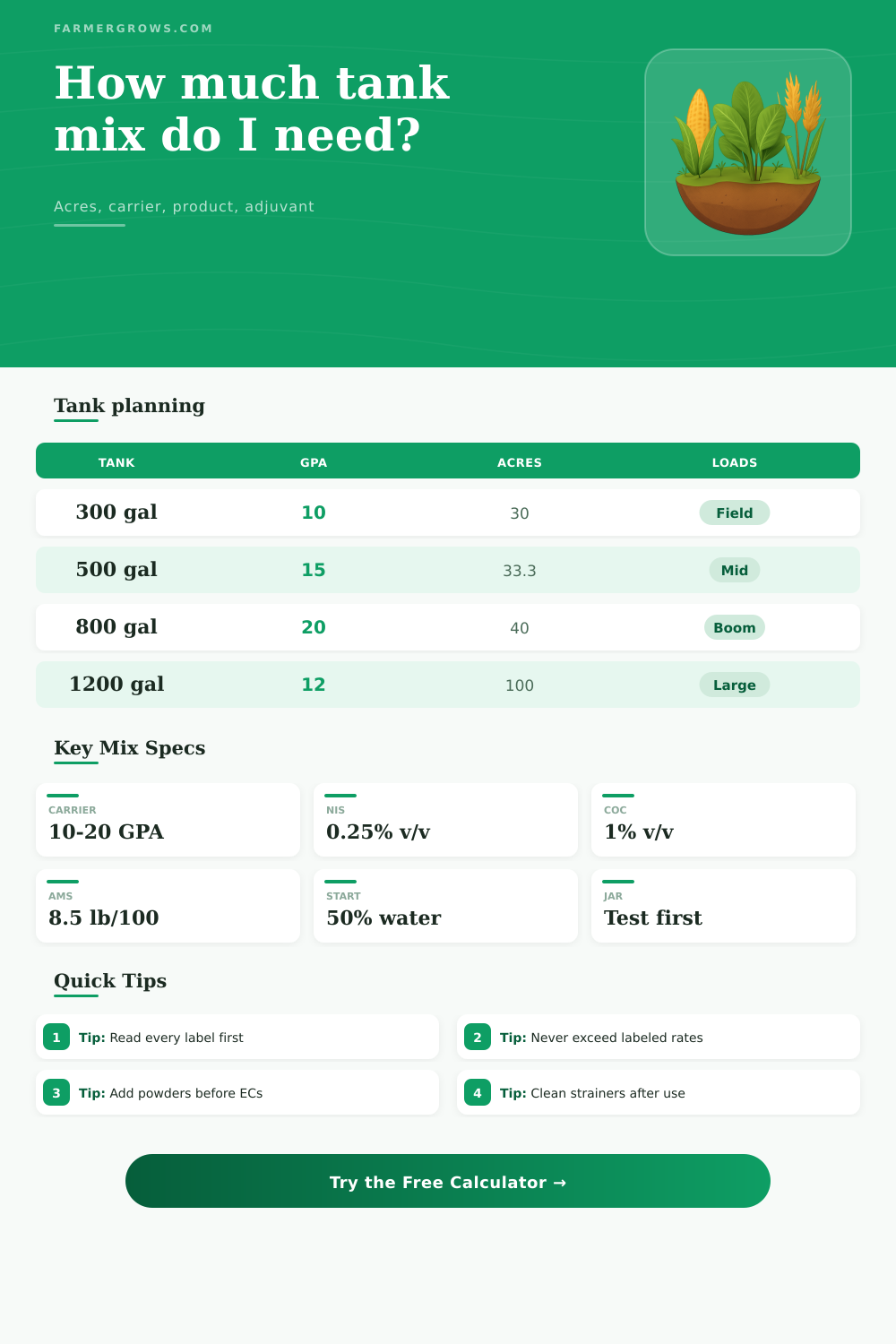
Tank Mix Calculator
Plan a spray load from field acres, tank size, carrier GPA, product rates, adjuvant rates, and water conditioner needs. Use it to estimate acres per tank, full and partial loads, product per batch, and a practical mixing order.
Choose a starting point, then adjust rates to the product label. Presets set field acres, tank size, GPA, product classes, rates, adjuvant style, conditioner, overage, and leftover spray credit.
Tank Mix Output
Amounts below are planning estimates based on your carrier volume, rates, fill percentage, overage, and any usable spray already in the tank.
| Working tank gallons | 10 GPA | 12 GPA | 15 GPA | 20 GPA | 30 GPA |
|---|---|---|---|---|---|
| 200 gal | 20.0 ac | 16.7 ac | 13.3 ac | 10.0 ac | 6.7 ac |
| 300 gal | 30.0 ac | 25.0 ac | 20.0 ac | 15.0 ac | 10.0 ac |
| 500 gal | 50.0 ac | 41.7 ac | 33.3 ac | 25.0 ac | 16.7 ac |
| 800 gal | 80.0 ac | 66.7 ac | 53.3 ac | 40.0 ac | 26.7 ac |
| 1200 gal | 120.0 ac | 100.0 ac | 80.0 ac | 60.0 ac | 40.0 ac |
| Application situation | Common carrier range | Why it matters | Planning caution |
|---|---|---|---|
| Broadcast burndown herbicide | 10 to 15 GPA | Efficient coverage on small weeds and residue | Use label minimums when coverage is hard |
| Residual pre-emerge herbicide | 10 to 20 GPA | Even soil coverage helps activation | Avoid skips, surging, and unagitated loads |
| Post herbicide in crop canopy | 15 to 20 GPA | More droplets improve leaf contact | Watch drift rules and crop stage limits |
| Fungicide or insecticide in canopy | 15 to 30 GPA | Canopy penetration and coverage are critical | Match nozzles to label droplet guidance |
| Orchard or vineyard airblast | 30 to 100+ GPA | Tree or vine size drives carrier need | Calibrate by canopy and runoff risk |
| Rate basis | Conversion used | Example for 100 acres or 100 gal | Best use |
|---|---|---|---|
| fl oz/ac | 128 fl oz = 1 gal | 16 fl oz/ac = 12.5 gal/100 ac | Most liquid herbicides and micronutrients |
| pt/ac or qt/ac | 2 pt = 1 qt, 4 qt = 1 gal | 1 qt/ac = 25 gal/100 ac | High-use liquids and crop oils |
| lb/ac or oz wt/ac | 16 oz wt = 1 lb | 1.5 lb/ac = 150 lb/100 ac | Dry products and soluble fertilizers |
| percent v/v | 1% v/v = 1 gal per 100 gal spray | 0.25% = 1 qt/100 gal | NIS, COC, MSO when label gives percent |
| AMS lb/100 gal | Rate x spray gallons / 100 | 8.5 lb/100 gal = 8.5 lb per 100 gal | Hard-water conditioning where labeled |
| Step | Typical action | Compatibility check | Do not skip when |
|---|---|---|---|
| 1. Water and conditioner | Fill tank 1/3 to 1/2 with clean water; add AMS or buffer first when required | Check pH, hardness, and temperature | Water is hard, cold, muddy, or high pH |
| 2. Dry products | Add WDG, DF, WP, and soluble packets after they disperse in the jar test | Look for clumps, flakes, heat, or settling | Dry product is mixed with fertilizer or EC |
| 3. Flowables and liquids | Add SC, F, SL, then EC products with agitation running | Watch for sludge, separation, or oily layers | More than two pesticide products are combined |
| 4. Adjuvants last | Add NIS, COC, MSO, drift agents, and oils near the end unless label says otherwise | Confirm final mixture stays uniform for 15 to 30 minutes | Using oil, high salt fertilizer, or low water volume |
Before you even mix anything, your first step is to avoid mistakes: You run the numbers on a calculator. If your carrier volume isn’t right, you waste product or cause streaking. Adding too small of an amount of adjuvant mean the active ingredient won’t adhere well. And rushing through the mixing sequence can lead to tank clogs.
For that reason, most growers employ some sort of planning tool prior to pulling out bags and measuring jug. Your daily sprayer decisions are reflected in the calculator’s inputs. Target is field acres. Actual working volume are tank size and fill percent. Carrier gallons per acre determines acres covered by a single load. Product class and rate choice reflects how solvent-based (emulsifiable concentrates), dilute (soluble liquids), and dry (dry flowables) products is handled differently in water. Add-on ingredients for improved control (adjuvants and water conditioners), are captured in those two fields.
Use a Calculator to Plan Mixing
When you punch in those numbers, the calculator do the math for you. It’ll convert your per-acre rates into total pounds or ounces needed for the job. Then it breaks down that total between partial and full loads. And then it displays how many carriers you will need based off overlap buffer and existing spray in the tank. This means you won’t overestimate the gallons needed just because of what the tank’s nameplate says.
Gallons per acre is what is used to determine how many acres are covered with each load. This table provide that reference. Do you want to know if one load covers an acre? Three? Six? You’ll find it there at a glance. The tables also remind you of which range of liquid amounts is common for various applications such as canopy, residual and burndown. Why these ranges? Less than recommended causes poor coverage on heavy residues. Greater than recommended heightens risk of drift or runoff.
“Poor habits mixed: Problem with mixing order. Wettable powders require time to spread before adding oils so the tool suggest a sequence by product class. Adding fertilizer carriers raises the stakes; salts may break the emulsion. Agitation setting adjusts the compatibility note appropriately. But your ultimate safeguard is the jar test you run the night before.”
Most growers have stories about the bad loads. Adjuvant was added by measuring it into the tank, rather then using the actual gallons in the tank. They also round up that final partial load to a full batch. Cold water cause the AMS to settle at the bottom of the inductor. Those are all reduced with the calculator.
It doesn’t eliminate the jar test or the label. But it takes away most of math that is typically done at dusk under a headlamp. It’s easy enough: Apply the proper quantity of the proper product to the proper number of acres. Use the proper quantity of adjuvant and carriers. Mix them in the right order to keep them suspended all the way into the crop canopy and out through the nozzles. Get those ducks lined up and you get through field with no surprises. You might have a few cleanup chores, but they become a routine part of the job rather than an unexpected task.