Sprayer Flow Rate Calculator
Calculate per-nozzle GPM, total boom flow, application rate, operating pressure, field speed, tank coverage, and pump reserve for broadcast field sprayers.
1Real sprayer and nozzle presets
Use a preset as a realistic starting point, then adjust speed, spacing, pressure, pump flow, and calibration catch data for your sprayer.
2Sprayer inputs
Sprayer flow results
Enter your sprayer details and calculate.
Full calculation breakdown
3Selected nozzle and pump comparison
4Total boom flow table
| Boom width | Spacing | Nozzles | 0.20 GPM tips | 0.30 GPM tips | 0.40 GPM tips |
|---|---|---|---|---|---|
| 30 ft | 20 in | 18 | 3.6 GPM | 5.4 GPM | 7.2 GPM |
| 45 ft | 20 in | 27 | 5.4 GPM | 8.1 GPM | 10.8 GPM |
| 60 ft | 20 in | 36 | 7.2 GPM | 10.8 GPM | 14.4 GPM |
| 80 ft | 20 in | 48 | 9.6 GPM | 14.4 GPM | 19.2 GPM |
| 90 ft | 20 in | 54 | 10.8 GPM | 16.2 GPM | 21.6 GPM |
| 120 ft | 20 in | 72 | 14.4 GPM | 21.6 GPM | 28.8 GPM |
5Per-nozzle flow, speed, GPA, and spacing table
| Target rate | Speed | Spacing | Needed GPM/nozzle | Closest ISO tip at 40 psi |
|---|---|---|---|---|
| 10 GPA | 8 mph | 20 in | 0.269 GPM | 03 blue, lower pressure |
| 12 GPA | 7 mph | 20 in | 0.283 GPM | 03 blue |
| 15 GPA | 6 mph | 20 in | 0.303 GPM | 03 blue |
| 15 GPA | 8 mph | 20 in | 0.404 GPM | 04 red |
| 20 GPA | 6 mph | 20 in | 0.404 GPM | 04 red |
| 20 GPA | 8 mph | 15 in | 0.404 GPM | 04 red |
6Pump capacity and pressure relationship
| Rule | Formula | Example | Use in the field |
|---|---|---|---|
| Nozzle flow change | GPM2 = GPM1 x sqrt(PSI2 / PSI1) | 0.30 at 40 psi becomes 0.37 at 60 psi | Pressure changes flow slowly. |
| Pressure needed | PSI2 = PSI1 x (GPM2 / GPM1)^2 | 0.30 to 0.40 GPM needs about 71 psi | Change tip size when pressure gets high. |
| Pump requirement | (boom GPM + agitation) x reserve factor | (14.4 + 5) x 1.15 = 22.3 GPM | Compare with pump flow at operating pressure. |
| Field capacity | ac/hr = width ft x mph / 8.25 | 60 ft at 7 mph = 50.9 ac/hr | Actual acres are lower after turns and fills. |
7Nozzle pressure reference table
| ISO size | 30 psi | 40 psi rated | 60 psi | 80 psi |
|---|---|---|---|---|
| 02 yellow | 0.17 GPM | 0.20 GPM | 0.24 GPM | 0.28 GPM |
| 025 lilac | 0.22 GPM | 0.25 GPM | 0.31 GPM | 0.35 GPM |
| 03 blue | 0.26 GPM | 0.30 GPM | 0.37 GPM | 0.42 GPM |
| 04 red | 0.35 GPM | 0.40 GPM | 0.49 GPM | 0.57 GPM |
| 05 brown | 0.43 GPM | 0.50 GPM | 0.61 GPM | 0.71 GPM |
| 06 gray | 0.52 GPM | 0.60 GPM | 0.73 GPM | 0.85 GPM |
8Calibration and safety notes
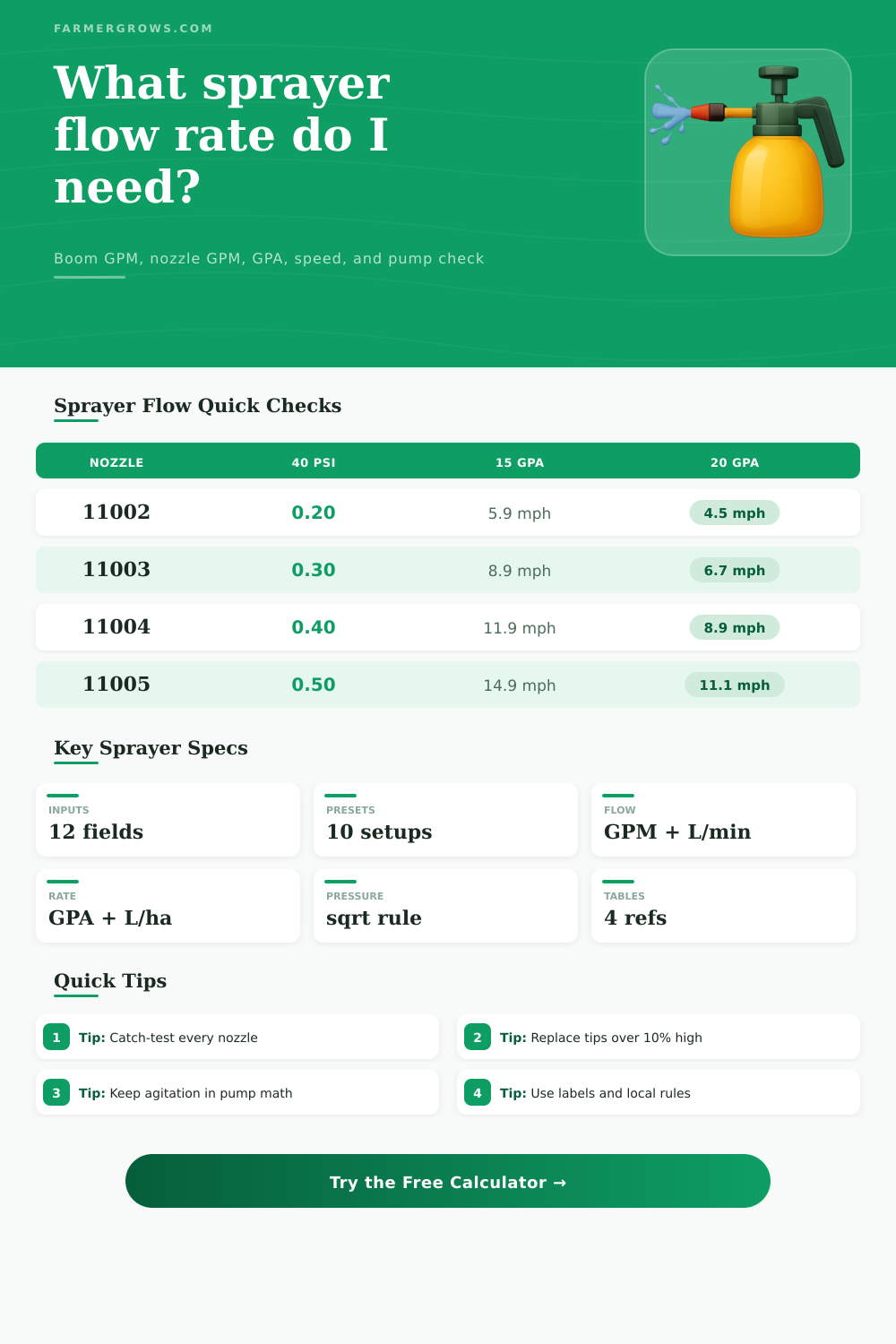
Calibration tip: Catch-test clean water from several nozzles at the same pressure, height, screen condition, and boom section layout used in the field. Replace tips that vary more than about 10% from the average or manufacturer chart.
Safety caveat: This calculator supports planning only. Always follow the product label, nozzle manufacturer chart, local pesticide rules, PPE requirements, wind limits, drift restrictions, and your sprayer manual before applying any chemical.
The volume from each nozzle are the key to getting good spray coverage, and it is only one number that impacts every other decision out in field. It determines how fast you’ll have to go, what pump size you need, what operating pressure you’ll use, and how many gallons of product will be applied to an acre. Get that wrong and you waste money by over-applying or under-applying product, as the clock ticks toward a closed weather window.
Three practical variables vary from job to job; the desired rate (how many gallons per acre you are targeting), application speed (how fast you’re moving sprayer) and nozzle spacing (how far apart nozzles is mounted on boom). Those three can be plugged into this simple relationship, which provide an answer to exactly how much should come out of any given tip.
Why Nozzle Flow Matters
If you know how much should come out of one nozzle, all else follows, since total boom flow equals that times the number of nozzle. Adding pump size includes a safety margin plus agitation, ensuring it won’t starve when pressure increase or a section goes offline. Tank coverage just requires dividing real-world rate per acre into tank volume.
Then there’s pressure: Nozzle flow isn’t directly proportional to pressure; doubling the pressure increases flow by only about forty percent. And operators will commonly increase pressure different than switching tips as needed… Which is typically the wrong move; match your nozzle size to your desired speed and rate before you start adjusting pressure (within that nozzle’s rated range) to fine tune it, since running too high risks increased drift and shortened nozzle tip life, whereas poor pattern formation occur if you run too low.
Math becomes reality in calibration, when a few catches in clear water show if the nozzles is still giving according to chart promise. Screens get plugged up; tips become worn differently, so we know it’s always safer to trust measured output over side-of-the-tip label. Pressure gauges also drift, and most operators will change nozzle where flow has exceeded the new-tip average by about ten percent.
Those same inputs also tell you how much ground you will cover in terms of acreage if you change routes or add a nurse tank. They also show how far along trip you will be before needing another refill. This helps you decide if you should of modify your route or add a nurse tank to minimize fill-ups. And they also show whether the current pump has enough reserve after accounting for losses due to line and agitation.
Ultimately, it’s not so much about seeking one magic number. Instead, it is about having a clear understanding of the trade-offs in your head before heading out into the yard. When you understand variables like speed, nozzle size, spacing, pressure, and your desired spray rate, everything just falls into place. Then, the rest of day goes a little better.