Pure Live Seed Calculator
Turn seed tag germination, purity, hard or dormant seed, coating, emergence loss, acres, and target PLS into the bulk seed rate and total pounds to order.
Use the seed tag for purity, germination, and hard or dormant seed. The coating field is an optional deduction when coated seed adds non-seed weight that is not already reflected in purity.
Seed lot result
PLS, bulk rate, total seed, and field-adjusted live seed are calculated from the current seed lot.
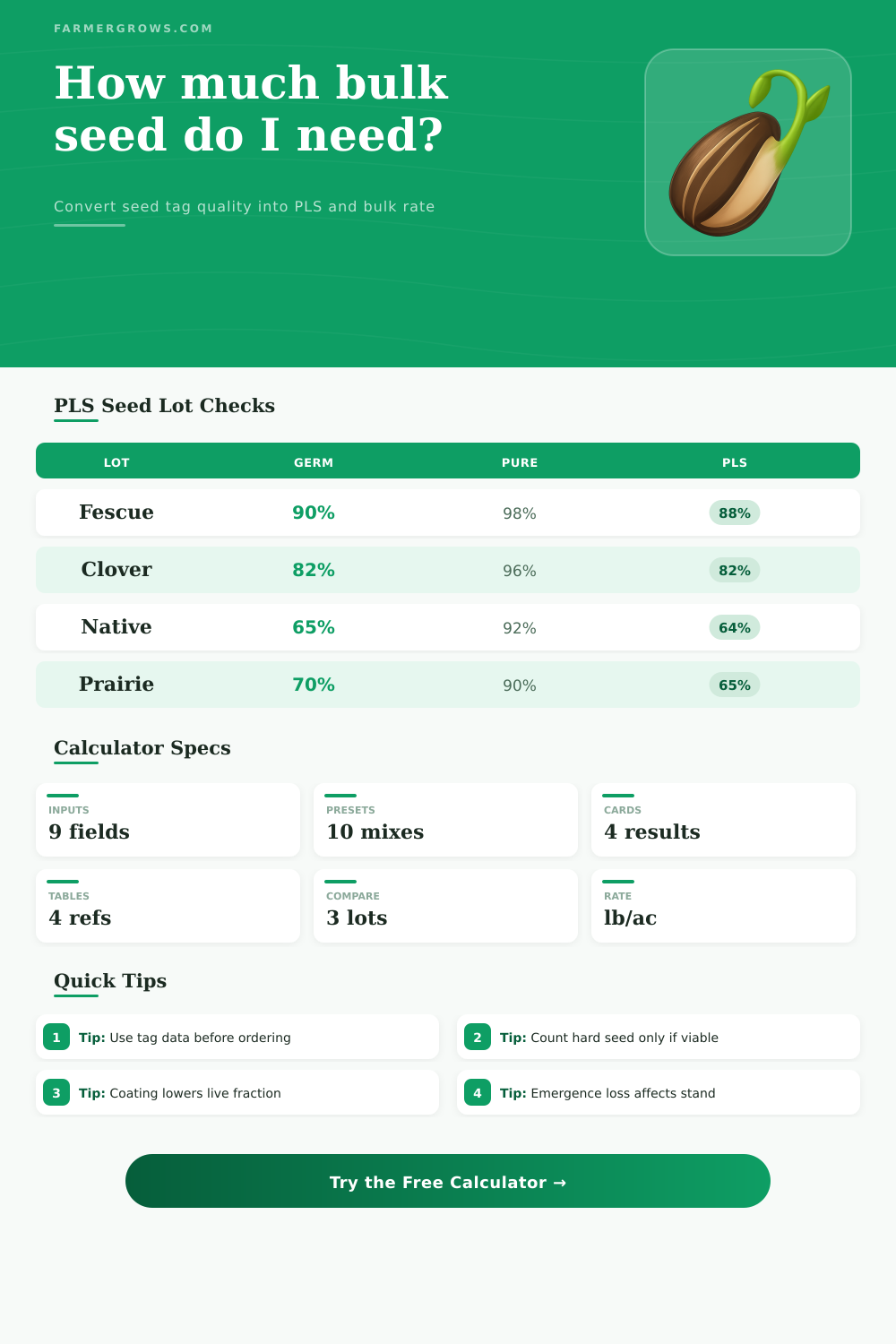
Compare three candidate lots with the same target PLS rate. The grid shows each lot's PLS percent and the bulk seed rate needed before field emergence loss.
Lot A
Lot B
Lot C
| Formula step | What it uses | Why it matters | Field note |
|---|---|---|---|
| Viable seed | Germination + hard seed | Shows seed that can produce seedlings | Do not count hard seed if the label or species guidance says it will not break dormancy in the planting window. |
| PLS fraction | Purity x viable seed | Removes inert matter and dead seed | A 90% germination lot at 98% purity is 88.2% PLS before coating adjustment. |
| Coating adjustment | PLS x seed weight share | Accounts for non-seed coating weight | Use only when coating is not already represented in purity or inert matter. |
| Bulk rate | Target PLS / PLS fraction | Converts live seed target to actual pounds | Lower PLS always raises the bulk pounds per acre. |
| Field adjustment | Bulk rate / emergence factor | Offsets expected stand loss | Use this when the target is an emerged stand rather than seed tag PLS only. |
| Pasture or native mix | Target PLS range | Typical seed lot quality | Planning note |
|---|---|---|---|
| Tall fescue renovation | 15 to 25 lb/ac | High purity, strong germination | Most clean grass lots need only a modest PLS correction. |
| Orchardgrass mix | 8 to 15 lb/ac | Medium to high PLS | Use the blend label when orchardgrass is mixed with legumes. |
| White clover frost seed | 2 to 4 lb/ac | Hard seed may be listed | Small rate changes matter because the target pounds are low. |
| Native warm-season grass | 6 to 12 lb/ac | Lower PLS, more dormancy | Bulk weight can rise sharply when dormancy and chaff are high. |
| Pollinator prairie mix | 4 to 10 lb/ac | Varies by component | Use component-level PLS when the supplier gives it. |
| Hard or dormant seed entry | Common use | Include in PLS? | Practical caution |
|---|---|---|---|
| 0% | Annual ryegrass, most clean grasses | Usually yes, because none is listed | Leave blank or zero when no hard seed value appears on the tag. |
| 1 to 5% | Clover and alfalfa lots | Often included | Hard seed may germinate later than normal seedlings. |
| 5 to 15% | Native grasses and forbs | Depends on species | Check local seeding guidance before relying on dormant seed for first-year stand. |
| Over 15% | Restoration or dormant seed lots | Use carefully | Separate quick-establishment goals from long-term restoration goals. |
| Coating or emergence factor | Typical range | Calculator effect | When to use it |
|---|---|---|---|
| Uncoated seed | 0% | No coating deduction | Use for raw, clean seed or when coating is already in the purity line. |
| Light treatment | 2 to 8% | Small increase in bulk seed | Common for inoculated legumes or light seed treatment. |
| Heavy coating | 20 to 50% | Large increase in bulk seed | Use the supplier's coating percentage when pellet weight is substantial. |
| Good seedbed loss | 5 to 15% | Raises field-adjusted bulk rate | Use for firm seedbeds, proper depth, and timely moisture. |
| Risky seedbed loss | 20 to 40% | Raises field-adjusted bulk rate more | Use for broadcast seeding, dry soil, heavy residue, or erosion risk. |
Read the tag line by line: If the tag already lists PLS, avoid double-counting coating, inert matter, or hard seed. Use the calculator to mirror what the tag actually reports.
Separate tag quality from field risk: PLS tells you what is in the bag. Emergence loss estimates what survives the seedbed, weather, and planting method.
When you purchase pasture seed, you are purchasing the live plant that will grow into grass in your pastures. The total weight of the seed on the bag, however, is not necessarily the amount of live seed that will grow. The total weight of the seed bag often include percentages that indicate the germination rate, purity of the seed, amount of hard and dormant seed, and the weight of the seed coating.
Each of these percentage will rarely total to 100% of the total weight of the seed bag. This gap between the total weight of the bag and the live seed that will grow is often the reason that many people are disappointed with the amount of seed that grow in there pastures. The portion of the total weight that will germinate and produce seedlings under ideal condition is referred to as pure live seed.
How to Calculate Pure Live Seed
Germination is a percentage that indicates how many of the total weight of the bag is composed of live seed. The percentage of purity refers to how much of the bag are composed of non-weed seed, such as chaff. Hard and dormant seed may germinate if the conditions are correct and the season is the appropriate length for those type of seeds to germinate.
Coating is an additive that is placed on the seed that add to the total weight of the bag but is not seed itself. Because of this added weight, you must adjust the amount of bulk seed that is needed to reach the target rate according to the percentage of the bag that is coated. This calculator allow you to enter the values of the percentages on the seed tag to calculate the pure live seed without doing the math yourself.
Calculating the pure live seed will allow you to compare different lot of the same type of seed. For example, one bag of seed may have 90% germination and 98% purity, while another bag with the same type of seed may have a lower germination and purity rate but may also be sold at a lower price. If you do not calculate the pure live seed for the different lots, you cannot determine if the lower price is truly a discount or if you will need to purchase more pound of seed to reach your target rate.
In addition to calculating the pure live seed, you should also consider the percentage of the total weight that is coated. Coated seeds will germinate but will also have an increased weight that must be paid for. If the purity percentage of the tag reflects the weight of the coating, it should not be subtracted from the total weight of the bag a second time.
This calculator allows you to determine these factors for different lots of seed so that you can make an informed decision regarding whether or not the cost of the coated seed is worth the protection that the coating will provide the seed. The number of plant that germinate will also differ from the amount of seed that was planted into the field. Even if you use the best quality seeds, the germination of the plants may be lost due to soil crusting, birds, residue in the soil, or if the depth at which the seed is planted is not appropriate for germination.
This loss of the germinated plant is referred to as emergence loss. The percentage of emergence loss for a type of seed can increase or decrease according to the type of soil in which the seeds are planted, the method in which the seeds are planted into the soil, and the weather in which the field is planted. For instance, if the soil in which the field is to be planted has firm soil and moisture, there may be a low emergence loss of the planted seeds.
However, if the seeds are to be broadcast into dry land, there may be a higher emergence loss of the planted seeds. Because of the potential loss of these plant, it is important to adjust the amount of seed that is planted into the field according to how many plant will emerge from the field. This adjustment for emergence loss will allow you to adjust the amount of seed that you purchase to the risk of emergence loss of the planted seeds within your field.
Native mixes and warm-season grass seeds will require some of these adjustments to be made to calculate how much seed should be planted into the field. The reason for these adjustments is that native mixes and warm-season grass seeds often have lower purity rates. These types of seeds may contain more chaff and unfilled florets, and they may contain high levels of dormancy within the seed.
If you simply use the total weight of the bag to calculate how many pounds of seed should be planted into the field, you will find that you are under-seeding the field. However, if you make adjustments to the amount of seed needed to compensate for emergence loss to such an extent that you are purchasing more seed than is required to cover your field, you will end up spending more moneys on the pasture seed than is necessary. You must determine which emergence loss rate are realistic for your specific field to find a middle ground between under-seeding the field and over-spending on pasture seed.
Many people make mistakes when calculating the amount of seed that should be planted into their field. Some individuals may make the mistake of reading the tag too quick to note that you should consider the percentage of hard and dormant seeds in their calculations of how many pounds of seed are needed to cover the field. Some people may make the mistake of ignoring the weight of the coating of the seeds even though the weight of the coating may be listed separately on the tag.
These people will end up with thin stand of grass in their planted fields. Finally, some individuals may use the same emergence loss percentage when planting seeds into different field within the same pasture. Emergence loss may have to be adjusted according to the type of tillage that is used in planting the seeds and how much residue is present in the soil.
These mistake will result in the stand of grass that emerges from the field differing from the stand of grass that the individual purchasing the pasture seed targeted. The calculator allows individuals to compare three different lot of seed at the same time while maintaining a target rate for the amount of grass that emerges from the field. This ability to compare the different lots allows individuals to decide between purchasing the premium seeds that are clean and high quality but cost more, or purchasing the less costly regional blend of seed.
The calculator will allow individuals to decide if purchasing the grass seed with a late-season discount due to storage of the seed will result in the purchase of bulk grass seed at a lower price than other lots. By working with the concept of pure live seed, you will be able to view the tag of the seed as a contract between the purchaser and the manufacturer of the grass seed. By calculating the pure live seed, you will be able to identify if the manufacturer listed the percentage of hard and dormant seed separately on the tag, the percentage of the total weight that is coated with another material, and if the percentage of germination is low enough to desired level.