
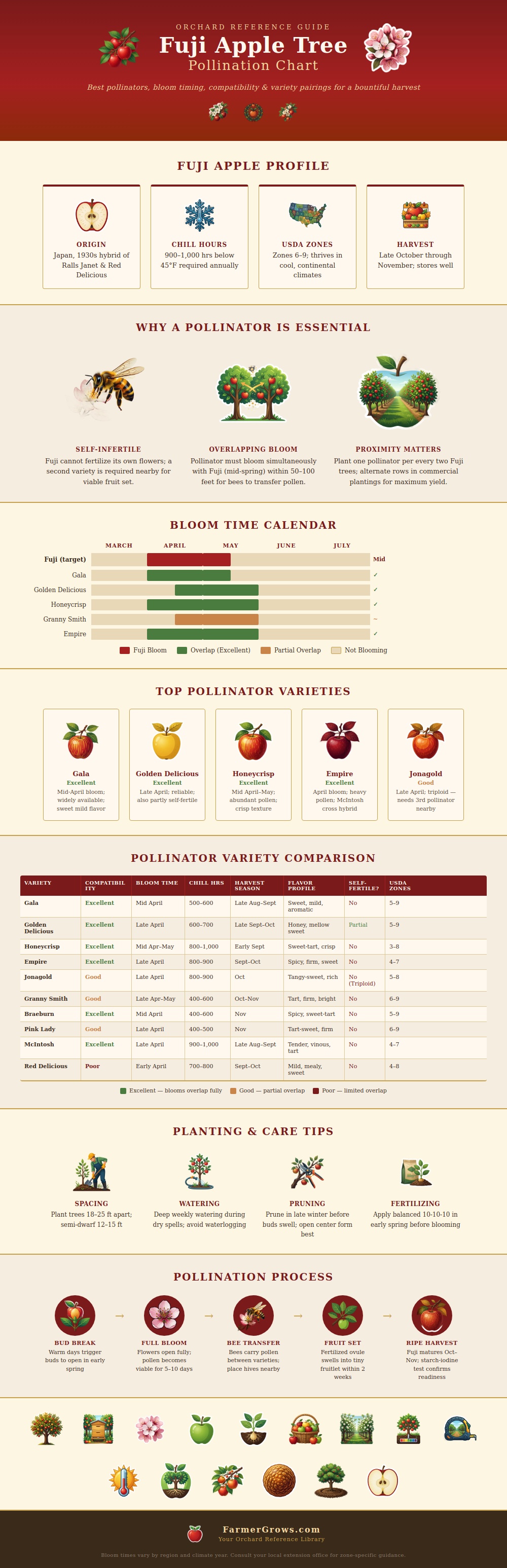
Water it well; put it in good soil; watch it grow…get some leaves…but no apples? That’s because apples don’t just appear by magic. They require a very particular kind of connection, the sort that happens when two distinct varieties cross-pollinate within a small window of opportunity. The most common error made by home gardeners are assuming that the beloved Fuji variety will be able to do it all on its own. In fact, tree is literally self-sterile (meaning that its own pollen won’t fertilize its flowers). To have fruit you must have another tree (ideally a neighbor) to pollinate it. If nothing compatible bloom at the same time as yours, then your orchard will be barren.
How does it all line up? Look at your chart (above). Which other varieties flower right around the same time as the Fuji, a mid-spring bloom period? That’s key: Two weeks either side of that date and bees will not have time to connect those dots between one tree and another. Good partners include ones whose flowers coincide nearly exactly with Fuji’s, such as Gala, Honeycrisp, and Empire. You can see they are incompatible by looking at the timeline above. For example, Red Delicious is another cousin of the Fuji, but it bloom earlier. That is no good.
How to Grow Fuji Apples Successfully
Also keep in mind the chill hours. To break dormancy successfully, Fuji requires roughly nine hundred to one thousand chill hours each year (meaning hours below 45 degrees F). That puts it squarely within USDA zones six through nine. Depending on whether you live north or south of that zone, you might want a variety more tolerant of extreme cold. Conversely, a warmer zone with less winter chill would make it difficult for the Fuji tree to leaf out reliable at all. The climate boundary is clearly marked in the infographic because a stressed tree yields fewer flowers; even with the correct partner nearby, fewer flowers mean lower odds of successful pollination.
Just as with choosing varieties, how you place things matter, too. While bees are efficient creatures, they’re no marathon runners. They like to ferry pollen from tree to tree, and they do it most efficiently when those trees is fairly near one another. The further apart you plant a pollinator, the less likely it will be to cause any cross-pollination. This is fine if you’re only planting one tree. However, if you have a small yard where you probably has space for two or three dwarf or semi-dwarf trees, chances are you can fit them all within about twenty-five feet of one another. Doing this will produce a concentration of compatible pollen, a cloud of it, really, that the bees can shuttle back and forth efficient during those precious couple of days in early May or even into April.
And when choosing your second tree, consider: How do I want different flavors? The Gala will help pollinate the Fuji (which sets fruit best with another apple nearby) and give you an earlier crop of something slightly different than the soft Fuji. Then, the Honeycrisp offers a tart, extra-crisp option that doesn’t get as soft over time as the Fuji. That’s turning a biological must-have into a culinary plus. One little plot of land yields more than one kind of taste and more than one harvest window. Make the most of each square foot of garden real estate, smart orcharding.
Pollination occur quickly. The flower opens in a matter of days after the buds break in early spring. There are only about five to ten days of viable pollen before its petals drop to the ground. Dry weather is ideal; rain at this time can ground the bees or wipe away pollen from the anthers. Check if it was cool and wet in spring when you have heavy bloom but not much fruit set later in the season, often that’s why.
Tree care is typical. Prune in late winter to maintain an open center form. Water deeply once a week when dry. Feed with a balanced fertilizer in early spring before buds swell, as the tree need all its resources to bloom. The rest is just dressing up. But it’s the prelude to the main attraction. So when you notice that first hint of blush on a Fuji apple in October, think about how it started with a single bee visit weeks ago. To know that every bit of care went into compatible genetics, proper planting distances, and careful management to produce that piece of fruit for your enjoyment.
It’s not just a tree you planted; it’s an entire ecosystem that you crafted in your back yard. And that’s what sets a grower (one who actualy puts food into his or her pantry) apart from someone who gardens as a hobby: care and attention to detail. Pick the right partner to start with, and everything else falls into place.