PPM to mL Converter
Convert a hydroponic ppm increase into milliliters of liquid nutrient using reservoir volume, product strength, density, element basis, stock dilution, and meter scale.
Use this as a dosing estimator for hydroponic reservoirs, fertigated seedlings, and recirculating systems. Always use the guaranteed analysis from the label and confirm with an EC or ppm meter after mixing.
Best when the product is sold as a complete A/B or one-part feed and the goal is a total ppm rise.
Common for vegetative correction. Keep ammonium-heavy products modest in warm reservoirs.
Labels often show P2O5, not elemental P. Match the target basis to the selected label basis.
Used for fruiting crops. Potassium products can push EC quickly in smaller reservoirs.
Add calcium concentrates separately from phosphate or sulfate concentrates to avoid precipitation.
Micronutrients dose in small ppm increments, so density, percent strength, and dilution matter a lot.
Hydroponic Dose Result
The result converts the ppm gap into milligrams in the reservoir, then into liquid milliliters from percent strength and density.
| PPM change | mg/L equivalent | 20 gal reservoir | 100 L reservoir |
|---|---|---|---|
| 25 ppm | 25 mg/L | 1.89 g nutrient | 2.50 g nutrient |
| 50 ppm | 50 mg/L | 3.79 g nutrient | 5.00 g nutrient |
| 100 ppm | 100 mg/L | 7.57 g nutrient | 10.00 g nutrient |
| 250 ppm | 250 mg/L | 18.93 g nutrient | 25.00 g nutrient |
| 500 ppm | 500 mg/L | 37.85 g nutrient | 50.00 g nutrient |
| Label strength | Active per g product | At 1.20 g/mL | Typical use |
|---|---|---|---|
| 0.5% | 5 mg/g | 6 mg active/mL | Iron and trace concentrates |
| 2% | 20 mg/g | 24 mg active/mL | Cal-mag correction products |
| 5% | 50 mg/g | 60 mg active/mL | Liquid calcium or magnesium |
| 8% | 80 mg/g | 96 mg active/mL | Common base nutrient part |
| 20% | 200 mg/g | 240 mg active/mL | Strong stock solution |
| Reservoir | Liters | 50 ppm mass | 100 ppm mass |
|---|---|---|---|
| 5 gal bucket | 18.9 L | 0.95 g | 1.89 g |
| 10 gal tote | 37.9 L | 1.89 g | 3.79 g |
| 20 gal reservoir | 75.7 L | 3.79 g | 7.57 g |
| 40 gal bench tank | 151.4 L | 7.57 g | 15.14 g |
| 100 L metric tank | 100.0 L | 5.00 g | 10.00 g |
| Crop or stage | EC range | 500 scale ppm | Notes |
|---|---|---|---|
| Seedlings and clones | 0.4-0.8 | 200-400 ppm | Start mild; roots burn easily. |
| Lettuce and leafy greens | 0.8-1.4 | 400-700 ppm | Cool water keeps uptake steady. |
| Basil and herbs | 1.0-1.6 | 500-800 ppm | Avoid high EC in hot weather. |
| Strawberry | 1.2-1.8 | 600-900 ppm | Watch calcium and potassium balance. |
| Tomato, pepper, cucumber | 1.8-2.8 | 900-1400 ppm | Raise gradually during fruiting. |
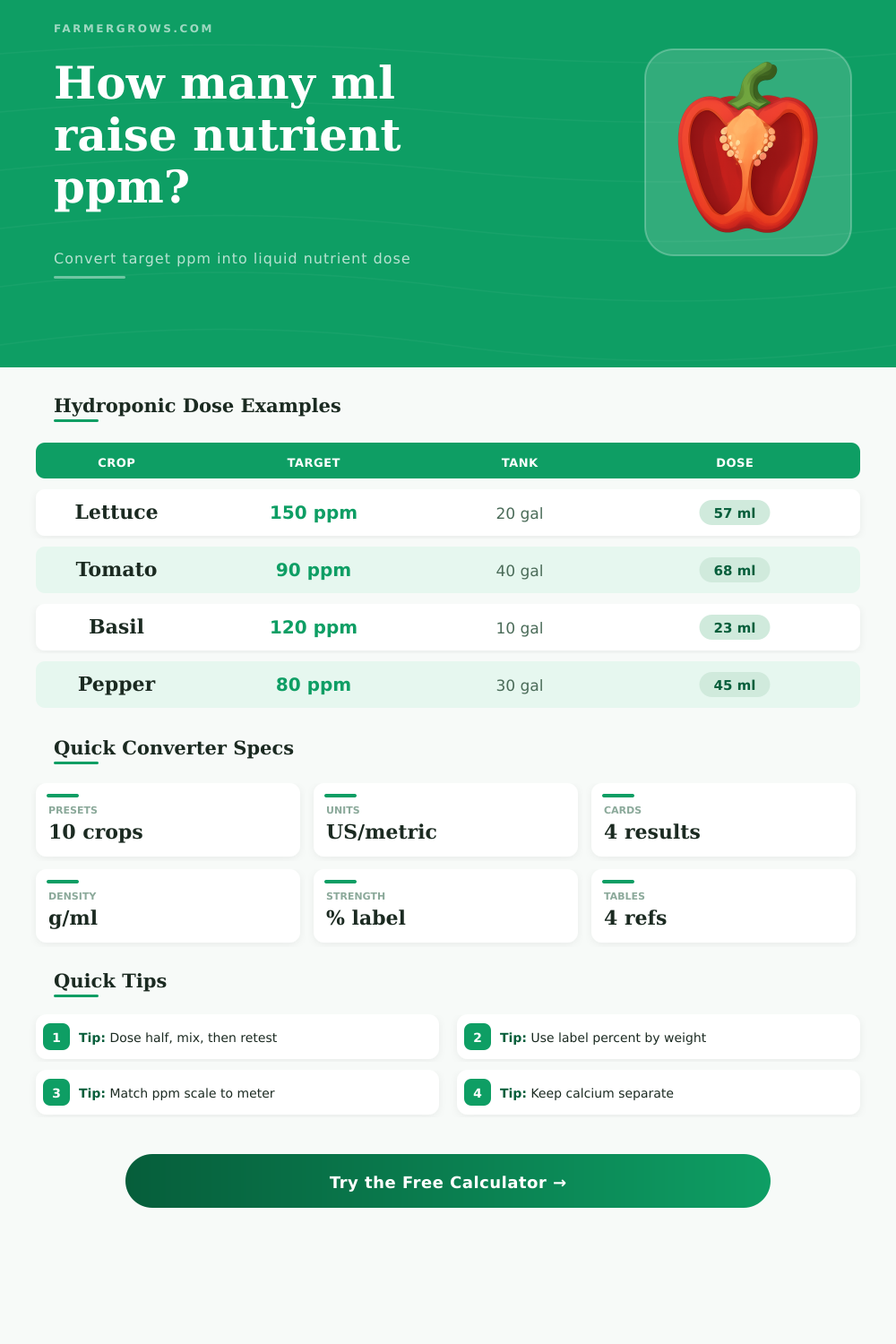
Mixing tip: Add half the calculated dose first, circulate for 10 to 20 minutes, then retest ppm before adding the remainder.
Label tip: Keep calcium stock away from phosphate and sulfate concentrates until they are diluted in the reservoir water.
To put it another way, when using hydroponics, knowing the number you need (ppm) isnt enough, you have to turn that reading into an actual volume of liquid you can pour. How much do you need? Subtract the ppm value where you are from the ppm value you want to be at. Then, you multiply that difference by strength, divide it by density and adjust for any previous dilutions of the stock. That’s what this calculator does. Enter some numbers about what you’ve got and what you’d like and go.
We’re all used to seeing ppm, and we all measure in ppm (mostly). However, the ppm on the meter show dissolved salts compared to that specific meter’s scale; a 1000 scale is different than a 200 scale. A 700 scale treats the same EC as seven hundred ppm, while a 500 scale treat that same EC as five hundred ppm. If you switch scales, then adjust your targets, you’ve just set yourself up to have a mismatch between what you think you’re applying and what the meter say they recieved. The converter knows that and adjusts accordingly so you calculate dose based off the meter you rely upon.
How To Use The Calculator
The other thing that matters is strength percentage on label. That’s the fraction of product that is your desired nutrient, expressed as a decimal. So an eight percent base nutrient contains eighty milligrams of whatever it is per gram and a five percent calcium product have fifty. Since the label gives you the value in terms of grams, density becomes the bridge from grams to milliliters, which you can actualy see with your own eyes using something like a graduated cylinder or syringe. And the calculator incorporates this density into the conversion for you without making you do the math yourself.
That last figure depends on size of your reservoir too. A 20 gallon tank needs half as much product as a 40 gallon tank to achieve the same twenty-five ppm change. It’s a linear relationship, but because we’re talking about topping up something we’ve been using for weeks, it’s an easy one to underestimate. Any error in dilution or strength will also be exaggerated by small size of the reservoir. This is another reason the tool surfaces dose rate per gallon or per liter as a quick sanity check.
That’s not all; there’s also dilution. A lot of grower use a dilution of about one to ten or even one to twenty so they can dispense larger, more consistant amounts. You’ll be glad to know that the converter include a space for this factor. You can enter it so the recommended milliliters already include the diluted solution you will actually dispense. This is probably the most frequent cause of doses being either too strong or too weak… because people forget about diluting!
Note that calcium and phosphate are special cases due to their potential to combine into insoluble compounds when present in high concentrations together. To avoid this, always add one, wait till mixed, and then add the other. Even though the calculator will provide the proper amount for each, it does includes a warning message reminding you to space the addition of two in time. Add what you calculated, wait 10-20 minutes, then circulate and test again. If you are a little high on your scale or on the strength factor or density figure, or if the meter is just off a bit, you won’t overshoot. This is because you only add half of what it calculates and then test again. The more time you spend doing this with different crops, the more you learn how much they can take in one jump vs. Others that will handles only a small correction.
So what you started with is not necessarily an end number but a starting point. In reality, a converter is only worth its salt if it takes away the arithmetic wall between what’s in your hand (milliliters) and what’s on the meter (number). Without the wall, you can start to pay attention to what the number says. You can see how fast the plant is growing, what the leaves look like, and whether the roots is healthy. This helps you stop second guessing the math.