Netafim Drip Line Calculator
Plan dripline length, emitter count, zone flow, pressure-adjusted water output, runtime, and applied depth for vegetable beds, berries, vines, orchards, and high tunnels.
Use this as a planning worksheet for Netafim-style inline dripline layouts. Confirm final choices against the actual product catalog, filter size, pressure regulator, pump curve, water quality, slope, and local irrigation advice.
Drip Line Results
Results update after you calculate the layout.
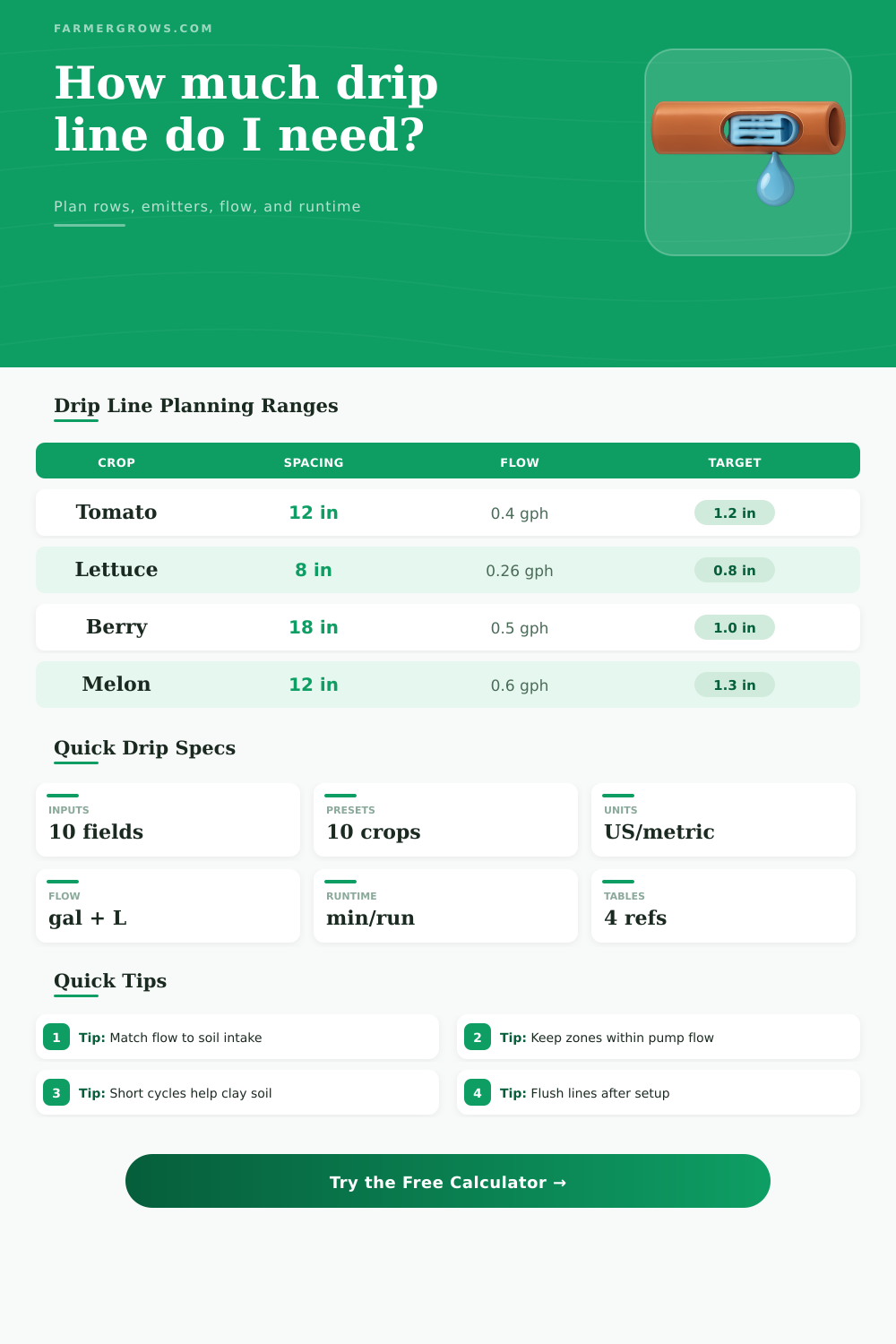
| Emitter spacing | Typical crop fit | Emitters per 100 ft | Planning note |
|---|---|---|---|
| 6 in / 15 cm | Leafy greens, nursery benches | 200 | High uniformity for close-rooted crops, higher zone flow. |
| 8 in / 20 cm | Strawberries, onions, greens | 150 | Good for dense beds and shallow root zones. |
| 12 in / 30 cm | Tomatoes, peppers, cucumbers | 100 | Common vegetable bed starting point. |
| 18 in / 45 cm | Berries, vines, shrubs | 67 | Works where roots can bridge wider wetting bulbs. |
| 24 in / 60 cm | Orchard, wider perennials | 50 | Check young plant establishment and soil wetting width. |
| Emitter flow | Metric flow | Best use | Runtime behavior |
|---|---|---|---|
| 0.16 gph | 0.6 L/hr | Clay, long runtime, low pump flow | Slow wetting with less runoff risk. |
| 0.26 gph | 1.0 L/hr | Greens, berries, careful scheduling | Moderate flow for fine-textured soils. |
| 0.40 gph | 1.5 L/hr | Vegetable beds and high tunnels | Balanced flow for many loam beds. |
| 0.53 gph | 2.0 L/hr | Deep-rooted annuals, sandy loam | Shorter runtime, watch clay intake. |
| 0.92 gph | 3.5 L/hr | Widely spaced perennials | Fast output for trees or coarse soils. |
| Soil type | Approx intake | Suggested pulse depth | Drip scheduling note |
|---|---|---|---|
| Sandy soil | 0.75 in/hr | 0.35 in | Water moves down quickly; split frequent events. |
| Sandy loam | 0.50 in/hr | 0.45 in | Good response to moderate flow and moderate runtime. |
| Loam | 0.35 in/hr | 0.55 in | Flexible soil for many crop bed layouts. |
| Silt loam | 0.25 in/hr | 0.45 in | Watch surface sealing and longer wetting time. |
| Clay loam | 0.18 in/hr | 0.35 in | Use slower emitters or more pulses. |
| Raised-bed mix | 0.55 in/hr | 0.40 in | Drains fast; verify with hand-feel and tensiometers. |
| Crop group | Typical peak need | Metric need | Planning note |
|---|---|---|---|
| Leafy greens | 0.7 to 1.0 in/week | 18 to 25 mm/week | Short roots prefer even, frequent moisture. |
| Tomatoes and peppers | 1.0 to 1.5 in/week | 25 to 38 mm/week | Avoid big swings during fruit sizing. |
| Cucumbers and melons | 1.2 to 1.8 in/week | 30 to 46 mm/week | Peak demand rises quickly in hot fruiting weather. |
| Strawberries | 0.8 to 1.3 in/week | 20 to 33 mm/week | Keep crowns moist without saturating beds. |
| Berries and vines | 0.8 to 1.5 in/week | 20 to 38 mm/week | Adjust for canopy, crop load, and mulch. |
| Young orchard trees | 1.0 to 2.0 in/week | 25 to 51 mm/week | Expand wetted area as root systems grow. |
Filter and flush: Match filtration to the emitter passage and install a flush point at the end of each lateral or submain. A clean hydraulic plan still needs clean water.
Split zones when needed: If the calculated flow is near pump capacity, divide the block by bed group, crop stage, slope, or soil texture before selecting the final manifold.
With drip, you have to know your soil capacity, and the needs of each plant. How far apart are emitters spaced? At what rate does it flow? What’s the pressure at the end of that row, to make sure roots gets equal moisture, and avoid creating dry spots?
Variables like those affect the efficiency of any drip system, and many growers creates a plan first (before installing tubing) using a tool like this one. All of those key parameters are led by the calculator (above). Total dripline is based off row length and lateral count. Emitter spacing reveals number of outlets that go in the ground. Line spacing lets you input a pattern so the tool can calculate area and convert from gallons applied per minute for each zone into an application rate in inches per hour. Then the tool compares this rate to soil type’s intake capacity to help you choose between running one long cycle or several shorter pulses.
Why You Need a Drip Irrigation Calculator
Nominal emitter flow rates changes with pressure zones. If you’re using a short lateral that only has to push water across a few feet of garden bed, it runs at 10 psi. Longer laterals on a slope require 15 or 25 psi to maintain flow in the last emitters. That’s where uniformity allowance comes into play. Rather than make an optimistic guess about what the final flow will be, you discount it, taking into account some partial clogging and pressure loss. Then, based on those numbers, the zone’s runtime field tell you how long it must run to achieve your desired depth.
Real-world conditions are never as perfect as textbook says. A slight hill up a row will create a little pressure drop, a dirty filter will reduce flow silently, and clay soil may take water at just 0.18 inch an hour, while sandier soil (sandy loam) takes it away fasterer. The calculator compares your soil’s intake rate with the emitter application rate, flagging mismatches. It also calculates how many cycle will keep each pulse below what the soil can handle.
The page also has reference tables that put some common options in perspective. One example is a table that includes emitter spacing recommendations (e.g., 6-inch spacing for leafy greens; 18 inches for blueberries). Another list shows emitter flows and notes which soils can handle higher output. The tables aren’t rules, but they offer something to help you choose between products that all claim to be right for your crop.
Drip irrigation can be set it and forget it…but that’s the largest planning error. Periodically checking filters and flushing well designed zone should remain part of the routine, as tree canopy change their water requirements over time. You are the eyes; the arithmetic gets done with a tool. Is the wetted band reaching outer roots? Is one side of the row bone-dry and the other side sodden?
A calculator helps turn those product specs into something you can actualy use. It creates a zone plan to show if the layout will work within your available space and with your particular combination of soil, pump, and watering window. It replaces guessing with data as a starting point that you can then refine after the lines go down.
You should of used it well.