How Much Sulfur to Lower Soil pH Calculator
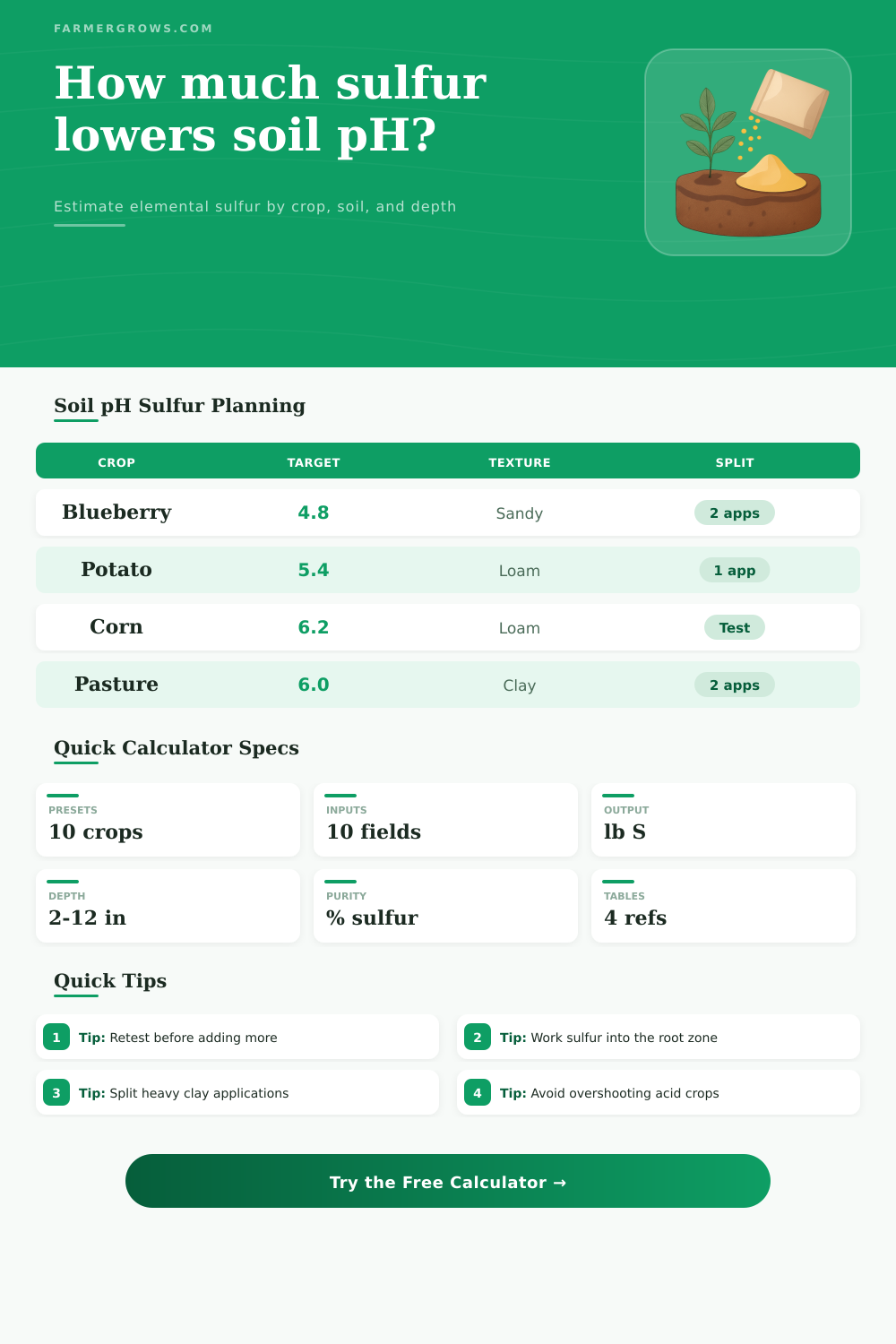
Estimate elemental sulfur and product pounds for lowering soil pH by crop target, soil texture, treatment area, mixing depth, organic matter, purity, and application split.
Sulfur reaction depends on warm soil, oxygen, moisture, and soil biology. Use this as a planning estimate, then confirm large pH changes with a local soil test, especially in calcareous soils or when treating perennial roots.
Sulfur Estimate
Results use a 6-inch elemental sulfur baseline adjusted for texture, target pH drop, depth, organic matter, product purity, and split limit.
| Crop or planting | Common target pH | Acidity sensitivity | Planning note |
|---|---|---|---|
| Blueberry | 4.5 to 5.2 | Needs acid soil | Lower before planting when possible; high pH causes iron chlorosis. |
| Azalea, rhododendron | 4.8 to 5.5 | Needs acid soil | Surface roots are sensitive, so split topdress applications. |
| Potato | 5.2 to 6.0 | Moderately acid | Lower pH can reduce common scab pressure in some fields. |
| Mixed vegetables | 6.2 to 6.8 | Moderate | Most vegetable beds should not be pushed below 6.0. |
| Corn and soybean | 6.0 to 6.8 | Moderate | Use sulfur for small corrections, not to replace liming decisions. |
| Pasture and alfalfa | 6.0 to 7.0 | Low acid tolerance | Legumes often decline if pH is driven too low. |
| Soil texture | Elemental S for 1 pH unit | Buffering level | Best use |
|---|---|---|---|
| Sand | 10 lb per 1,000 sq ft | Low | Small beds, rapid response, high overshoot risk |
| Loamy sand | 13 lb per 1,000 sq ft | Low to medium | Berry beds, turf root zones, vegetable rows |
| Sandy loam | 16 lb per 1,000 sq ft | Medium | Potato ground and general gardens |
| Loam | 22 lb per 1,000 sq ft | Medium | General field and garden planning baseline |
| Silt loam | 26 lb per 1,000 sq ft | Medium to high | Vegetable plots and orchard strips |
| Clay loam | 34 lb per 1,000 sq ft | High | Split applications and patient retesting |
| Silty clay or clay | 42 to 50 lb per 1,000 sq ft | Very high | Use soil-lab buffer pH when available |
| Application situation | Conservative single-application limit | Why it matters | Suggested interval |
|---|---|---|---|
| Garden bed or planting strip | 15 lb product per 1,000 sq ft | Reduces hot spots and root burn from over-application | 8 to 12 weeks between splits |
| Field broadcast | 300 lb product per acre | Keeps spreading practical and encourages retesting | One season between large corrections |
| Existing perennial roots | 8 lb product per 1,000 sq ft | Shallow roots can be injured by concentrated bands | 12 weeks or more between splits |
| Container or raised planter | 5 lb product per 1,000 sq ft equivalent | Low soil volume overshoots easily | Retest before each small adjustment |
| Crop group | Low pH tolerance | Sulfur caution | Field note |
|---|---|---|---|
| Acid-loving berries | High | Aim for range, not the lowest number | Iron availability improves, but manganese toxicity can appear if too low. |
| Potatoes | Medium to high | Do not sacrifice calcium and magnesium balance | Scab management also depends on variety, moisture, and rotation. |
| Vegetables and flowers | Medium | Many crops slow below pH 6.0 | Use crop-specific targets instead of one garden-wide acidification goal. |
| Legumes and hay | Low | Avoid acidifying unless a test supports it | Nodulation and molybdenum availability can decline in acid soil. |
| Turfgrass | Medium | Topdress lightly and water in | Iron products may green turf without changing pH much. |
Retest timing: Sulfur may need several warm months to show its full pH effect. Retest before repeating a heavy application, especially in sand or containers.
Placement matters: Broadcast sulfur changes the zone where it contacts soil. For new beds, mix it into the intended root depth instead of leaving all sulfur on the surface.
Elemental sulfur is an easy answer to lowering pH of beds for things that want more acidic soil (such as some potatoes, or any plants in the heath family: blueberries). But how do you know how much is needed for success, and not make thing worse?
The first clue is soil type, since clay will hold more buffering power than sand does. On sandy soil, perhaps a 10-pound application of sulfur would be sufficient to drop pH a bit, but maybe three or four times that on heavy clay.
How to Use Sulfur for Your Soil
The second clue is depth. Again, why? Because if sulfur is incorporate deeply, the impact are spread out through more volume, affecting rate equation. Sulfur must be mixed into the soil; otherwise, it won’t do anything or can absorbs with microbes to oxidize it.
Another important thing is that more organic matter mean one more hurdle. Even if your soil texture is light, meaning low in minerals, high levels of organic matter can make it act almost like clay again. So a soil that has had compost added year after year will likely require much greater amounts of sulfur per bed after several years.
In many situations, your actual limitation won’t be the overall sulfur requirement but instead how much you can safely apply at a single time. This is because of existing plant roots, especially since shallow-rooted vegetable can’t tolerate sulfur burn. Salt pockets might also form. No wonder planning tools shows split applications. On paper, one big dose seems like a good use of the product… But by spreading out total between two or three seasons, chemistry gradually works its way along. And you have time to retest before applying again.
All you have to do is plug in the product type, crop target, current pH, soil depth, texture, and organic matter class. This calc does the rest. It delivers not just pounds of actualy product but also pounds of elemental sulfur. It also alerts you if per-application rate falls within safe levels (there are such things).
Why? Because sulfur gets oxidized slowly and inconsistently. You might find yourself overshooting your target with a hefty one-time application in sand, or barely reaching there with that same amount applied on clay, which may continue to react a year later.
The other habit I mention here, the one that hardly appears in the formulas, is watching the calendar. The warm, moist, aerated soil are necessary for the bacteria that turn sulfur into sulfuric acid. When applied in a dry, cool period, or even better, late fall, all we get is delayed results; and that next soil test will throw us off.
You should of wait until end of first full growing season and retest. You’ll have a clearer picture than when chasing those last few tenths of a pH unit with more product. The low-low-low number on your meter isn’t what matters; rather it’s how well you match the soil to the plants you wish to grow, and balance rest of the system along the way.