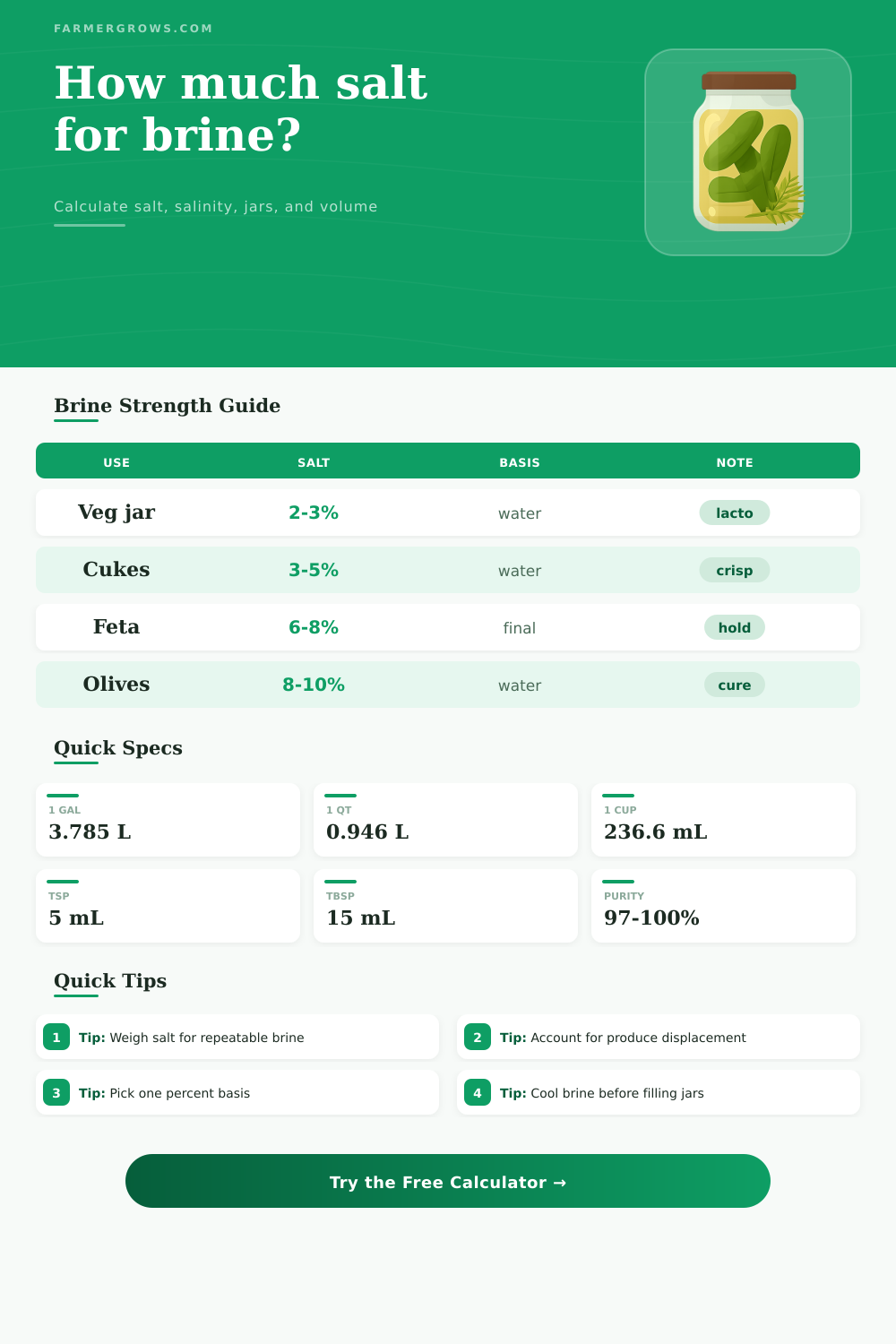
Brine Calculator
Calculate salt weight, working brine volume, salinity, spoon estimates, and container yield for produce ferments, cheese brines, olive cures, and farm kitchen batches.
Choose a preset or enter your own batch. The calculator separates three common brine definitions: salt as a percent of water weight, salt as a percent of final solution weight, and weight/volume grams per 100 mL.
★Brine presets
⚙Batch inputs
Brine result
Your calculated salt, volume, salinity, and container yield will appear below.
Formula breakdown
🧂Salt texture reference
📘Percent basis comparison
Most simple produce brine recipes mean grams of salt divided by grams of water. A 3% brine uses 30 g salt for each 1,000 g water before purity adjustment.
Lab and dairy notes may define salt as part of the finished solution. A 10% final solution needs 111.1 g salt per 1,000 g water before purity adjustment.
Common kitchen shorthand means grams of salt per 100 mL of water volume. A 5% w/v brine is 50 g salt per liter, adjusted for purity and starting salinity.
📊Reference tables
| Brine use | Typical strength | Common basis | Salt per liter |
|---|---|---|---|
| Low-salt vegetable ferment | 1.5% to 2.0% | water weight | 15 to 20 g/L |
| General lacto vegetable jar | 2.0% to 3.0% | water weight | 20 to 30 g/L |
| Cucumber pickle crock | 3.0% to 5.0% | water weight | 30 to 50 g/L |
| Feta or fresh cheese holding brine | 6.0% to 8.0% | final solution | 64 to 87 g/L water |
| Olive curing brine | 8.0% to 10.0% | water weight | 80 to 100 g/L |
| Seed float sorting brine | 10.0% to 12.0% | water weight | 100 to 120 g/L |
| Volume unit | Metric volume | Water mass | 3% water-weight salt |
|---|---|---|---|
| 1 cup | 236.6 mL | 236.6 g | 7.1 g |
| 1 quart | 946.4 mL | 946.4 g | 28.4 g |
| 1 gallon | 3.785 L | 3,785 g | 113.6 g |
| 1 liter | 1,000 mL | 1,000 g | 30.0 g |
| 5 gallons | 18.927 L | 18,927 g | 567.8 g |
| Container plan | Headspace | Displacement | Brine to mix |
|---|---|---|---|
| Quart jar, loose-packed vegetables | 8% | 35% | 0.57 qt |
| Quart jar, tight-packed kraut | 10% | 55% | 0.41 qt |
| Gallon crock, cucumbers and weights | 8% | 45% | 0.51 gal |
| 2 gallon cheese tub | 5% | 35% | 1.24 gal |
| 5 gallon olive bucket | 6% | 50% | 2.35 gal |
| Check point | Formula | Metric conversion | Use in calculator |
|---|---|---|---|
| Water-weight salt | water g x percent | 1 L water approx 1,000 g | produce brines |
| Final-solution salt | water g x p / (100 - p) | p is percent salinity | cheese and lab brines |
| Weight/volume salt | percent x 10 x liters | 1% w/v = 10 g/L | quick kitchen batches |
| Starting salt credit | mg/L x liters / 1,000 | subtract as grams | well or softened water |
| Purity adjustment | pure salt / purity | 99.5% = divide by 0.995 | weighing amount |
✓Brine calculation tips
This calculator sizes salt and liquid only. For shelf-stable processing, curing, fermentation, or dairy storage, pair the result with a tested recipe and appropriate temperature control.
Determining the amount of salts needed for the brine is another necessary part of the fermentation process. Using an incorrect amount of salt in the brine may result in vegetable that are too soft or too salty. To determine the amount of salt needed, one must take into account the total weight of the water that will be used in the brine and the total volume of the container.
For most vegetable ferments, a salt concentration of between 2 and 5 percent are used. Such a low concentration will result in vegetables that have a mild texture when consume, while the higher percentages will lead to vegetables that maintains their texture and have fewer microbes growing on their surfaces. High salt percentages is used in products like cheese or olives, as these food are stored for long periods.
How to Calculate Salt for Brine
The salt percentage will affect the behavior of the food in the container. The salt percentage can be represented in three differents ways. The most common is the water weight percent, which calculates the weight of the salt divided by the weight of the water.
The final solution percent calculates the salt weight divided by the total weight of the brine solution. The third option is the weight per volume percent, which calculates the weight of the salt divided by the volume of the container. However, this value is only accurate for container with low salt concentrations.
One of these three parameter should be chosen, and it should be used for each batch of brined food. The size and shape of the container will impact the amount of brine needed. The headspace is the empty portion of the container for weight to sit in.
Additionally, the amount of space taken up by the vegetables or cheese is called the displacement. If the calculation of the amount of brine needed does not account for the displacement of the vegetables, there may be too much brine to be made, leading to waste brine. The cook can alter the displacement if the vegetables are to be packed very tight or if very heavy weights will be used to ensure that the brine fully covers the vegetables.
The water used to make the brine is not always free of minerals. For instance, water from a well or softened water may have a starting salinity. In these case, the salt calculator will account for the starting salinity of the water, as an excess amount of salt would make the brine too strong.
This factor is small if using municipal water, but important if using well water or wanting to make a product with a low percentage of salt. The salt used may not be the same weight as the volume of the salt measured. For instance, fine pickling salt is more denser than flake kosher salt or coarse sea salt.
In this case, the best would be to use a scale to measure the weight of the salt; however, if using a spoon, it is only necessary to do so for small batch of brined foods. The purity field can be used to account for any moisture or anticaking agent that may be contained in the salt. The temperature at which the brine is prepared will effect the salinity of the brine.
If a hydrometer is used to measure the salinity of the brine, the temperature of the brine will effect the hydrometer reading. The salt percentage calculator will account for this effect of temperature on the hydrometer reading. Salinity measurements should be performed at room temperature, as this is the most convenient and accurate method to do so.
It is natural to want to treat all salt recipes the same. A three percent water weight salt brine will not have the same effect on the food as a three percent final solution salt brine. Each recipe will ask for a specific method to prepare the brine.
Additionally, it is easy to become accustomed to measuring the total volume of the jar without accounting for the headspace and the displacement of the food to be brined. This will result in too much brine for the container. While the salt percentage calculator will give a starting point for creating a brine with the desired salt percentage, there are other factor that will impact the fermentation of the vegetables.
The freshness of the vegetables, the ambient temperature in which the brined product is stored, and the tightness with which the container is packed will all have an impact on the end result. Additionally, you’ll need to observe the brine after a few days of brining. Finally, each batch of brined food should be documented.
It is not enough to remember the percentage of salt used in the brine. The mathematical basis for the salt percentage and the calculated displacement of the vegetables from the container should be noted in writing. Notating the mathematical basis and displacement ensures that the batches of food that succeed with a given recipe can be recreated in the future.