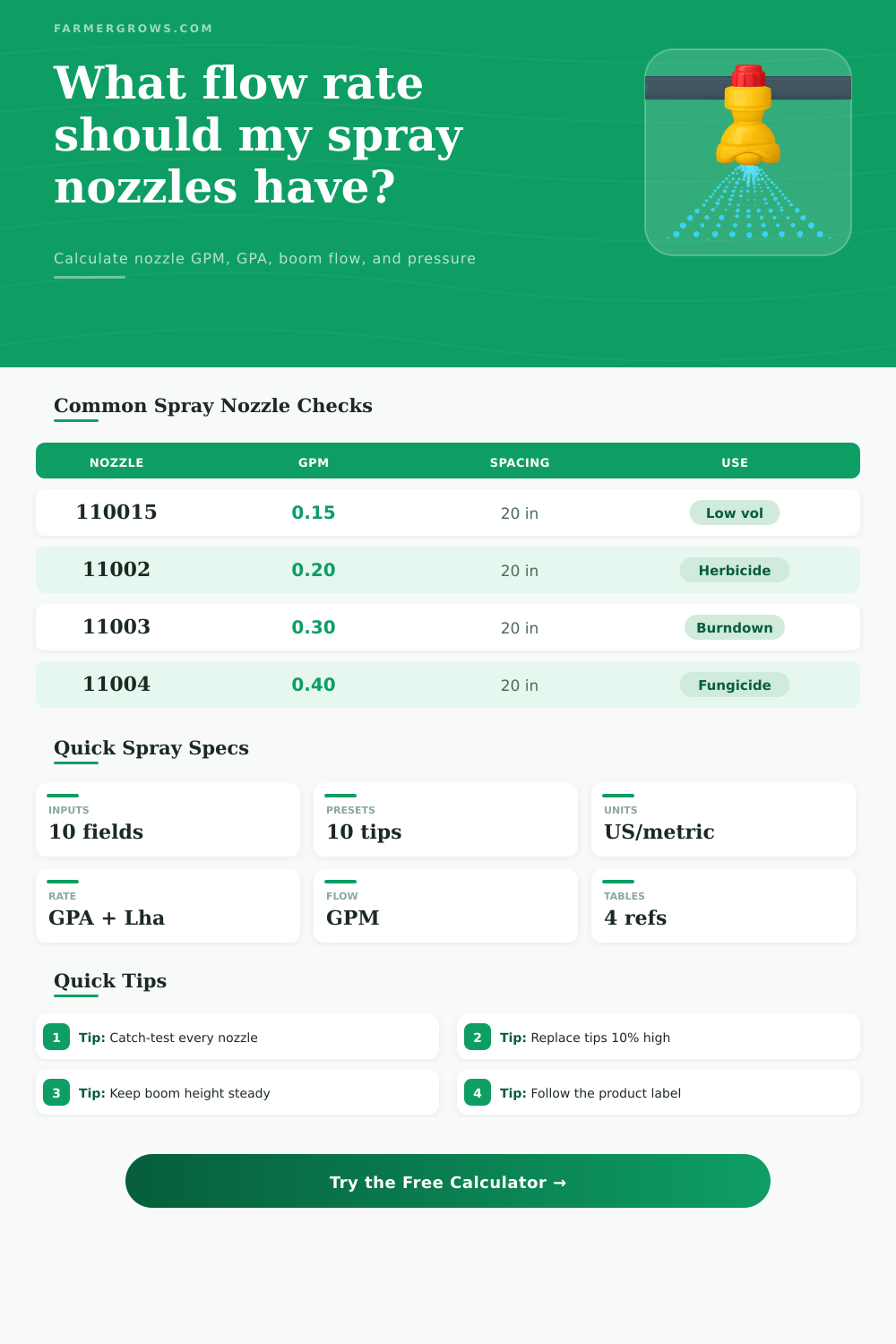
Spray Nozzle Flow Rate Calculator
Estimate per-nozzle flow, boom flow, application rate, pressure change, and tank coverage for field sprayers, orchard rigs, pasture booms, and small farm spray jobs.
Use the calculator for setup math before calibration. Always verify with a timed catch test, inspect screens and check valves, and follow pesticide labels, local rules, PPE requirements, buffer zones, wind limits, and drift guidance before spraying.
Spray Flow Results
Results compare the required nozzle output for the target rate with the selected nozzle's pressure-adjusted flow.
| Broadcast setup | Spacing / boom | Speed | Rate | Flow per nozzle |
|---|---|---|---|---|
| Small pasture boom | 20 in / 30 ft | 5 mph | 10 GPA | 0.168 GPM |
| Standard field boom | 20 in / 60 ft | 6 mph | 15 GPA | 0.303 GPM |
| High-volume coverage | 20 in / 90 ft | 8 mph | 20 GPA | 0.539 GPM |
| Metric broadacre | 50 cm / 18 m | 8 km/h | 150 L/ha | 1.00 L/min |
| Metric high volume | 50 cm / 36 m | 10 km/h | 200 L/ha | 1.67 L/min |
| ISO nozzle size | Color | Flow at 40 psi | Flow at 60 psi | Good starting use |
|---|---|---|---|---|
| 110015 | Green | 0.15 GPM / 0.57 L/min | 0.18 GPM / 0.70 L/min | Low-volume contact work, small booms |
| 11002 | Yellow | 0.20 GPM / 0.76 L/min | 0.24 GPM / 0.93 L/min | 10 to 12 GPA herbicide at moderate speeds |
| 11003 | Blue | 0.30 GPM / 1.14 L/min | 0.37 GPM / 1.39 L/min | 15 GPA around 6 mph on 20 in spacing |
| 11004 | Red | 0.40 GPM / 1.51 L/min | 0.49 GPM / 1.85 L/min | Higher carrier volumes and coverage sprays |
| 11006 | Gray | 0.60 GPM / 2.27 L/min | 0.73 GPM / 2.78 L/min | High-volume soil-applied or pasture work |
| Pressure change | Flow change rule | Example | Rate effect | Field note |
|---|---|---|---|---|
| 40 to 30 psi | Flow x sqrt(30/40) | 0.30 to 0.26 GPM | About 13% lower | Droplets usually get coarser |
| 40 to 60 psi | Flow x sqrt(60/40) | 0.30 to 0.37 GPM | About 22% higher | More drift risk on fine fans |
| 40 to 80 psi | Flow x sqrt(80/40) | 0.30 to 0.42 GPM | About 41% higher | Do not exceed nozzle rating |
| Need 25% more flow | Pressure x 1.25² | 40 to 62.5 psi | Same speed and spacing | Often better to change nozzle size |
| Need 25% less flow | Pressure x 0.75² | 40 to 22.5 psi | Same speed and spacing | Pattern may collapse too low |
| Droplet class | Typical nozzle family | Pressure tendency | Coverage strength | Drift caution |
|---|---|---|---|---|
| Fine | Flat fan at higher pressure | Higher pressure makes finer spray | Excellent leaf coverage | High drift risk; avoid wind and heat |
| Medium | Flat fan or turbo fan | Common broadacre range | Good balance for many labels | Watch boom height and gusts |
| Coarse | Turbo or air-induction | Often used for systemic products | Good deposition, less fine mist | Coverage can fall on dense canopies |
| Very coarse | Air-induction, flood, fertilizer | Lower drift emphasis | Best for soil or systemic work | Not ideal for contact fungicide coverage |
| Extremely coarse | Fertilizer stream nozzles | Used for liquid nutrients | Minimal leaf coverage | Confirm burn risk and row placement |
Catch-test note: Collect each nozzle for the same timed interval at operating pressure. Replace any tip more than 10% above the boom average or catalog flow.
Safety note: This calculator does not override product labels. Use required PPE, avoid temperature inversions and unsafe wind, and confirm droplet class and rate are label-legal.
The spray nozzle flow rate are the heart of all your sprayer decisions. It makes the difference between hitting your target or having product drift off-target.
While there is several simple elements involved (nozzle size, pressure, speed, spacing, target rate, tank volume, and field area), understanding how they relates to each other through some basic math take the guesswork out of it so you don’t have to assume that the same combination of settings work for everything in every single field… it doesn’t.
How Spray Nozzle Flow Rate Works
Every one of those inputs corresponds to an actual choice you can manage every day out there in the field. How fast do you travel? That control the volume delivered by each nozzle during its passage across a plant. How far apart are the nozzles spaced? Changing from banded application to broadcast application adjust the width of treated strip produced by each tip. What target rate are you looking for (i.e., what amount is on the label)? Operating pressure tell you how much flow occurs after pump turns on. And tank volume and field area converts that per-nozzle flow into how long each tank lasts and how many loads you’ll need. Those aren’t abstract fields; they’re the choices you make as soon as you get ready to load up the rig.
Pressure and nozzle size interact in ways that surprise people. You raise pressure for more flow, but it will alters droplet size and sometimes push you past rated range of the tip. With this calculator, you can see how much pressure you’ll need to achieve your desired flow with the nozzle you’re using, then determine if you just need to adjust the pressure or go all-in and swap out the tip altogether.
Some nozzles starts getting too finicky at low pressures, and some won’t maintain a good pattern without going beyond a certain level. Tables provided with the tool aren’t meant as a definitive answer, but more as a point of reference. They is there to illustrate how nozzle size behave at different pressures, and what nozzle family does to your droplet class. This enables you to see if the nozzle you intend to operate is even going to achieve the drift or coverage objective stated on product label. And they demonstrates when adjusting spacing or speed may be easier then dialing-in pressure.
A timed catch test with each nozzle are still required for real calibration. Manufacturing tolerances, along with the wear and condition of the screens, will affects what comes out of the nozzle tips. Operators go by the 10-percent rule… If any nozzle is more than 10 percent over the mean of the boom, it gets replaced. This one check prevent streaks and uneven dosing from appearing weeks later when the crop response are uneven.
The real-world reward is tank refill and coverage numbers. Find the number of gallons per acre for your selected speed and pressure with nozzle. Divide that into your tank capacity to find out how many acres it covers per fill. Apply your intended loss or overlap percent and then decide if you’ll be out of gas mid-headland, or make it all the way across final tank. Those figures becomes part of your water mixing/staging plan on a big job.
That brings us back around to our original point: Flow rate is not simply a line item on a chart. It’s where the conditions of field meet the requirements of product and the settings on equipment used. With the calculator above, you plug your numbers in and it does the math for you… No more guessing at conversions or coefficients. All that leaves you with is the judgment call on whether what comes out matches job you actualy need to do.