💧 Boomless Sprayer Calibration Calculator
Calculate application rate (GPA or L/ha), acres per tank, and coverage per hour for boomless nozzle sprayers used on pastures, fence lines, and roadsides.
✅ Boomless Calibration Results
Your boomless sprayer calibration results are shown below.
📋 Calculation Breakdown
| Nozzle Type | Swath Width | Flow Rate | Best Use | Notes |
|---|---|---|---|---|
| Single Flat Deflector | 20–30 ft | 1–3 GPM | Pasture spraying | Common single-nozzle setup; moderate coverage |
| Double Deflector | 40–60 ft | 2–6 GPM | Large open areas | Two deflectors; wide swath for big fields |
| Flood Jet | 15–20 ft | 1–4 GPM | Broadcast application | Lower swath; consistent flat fan pattern |
| High-Volume Flood | 30–50 ft | 4–10 GPM | Heavy application | High flow; used for renovation & weed control |
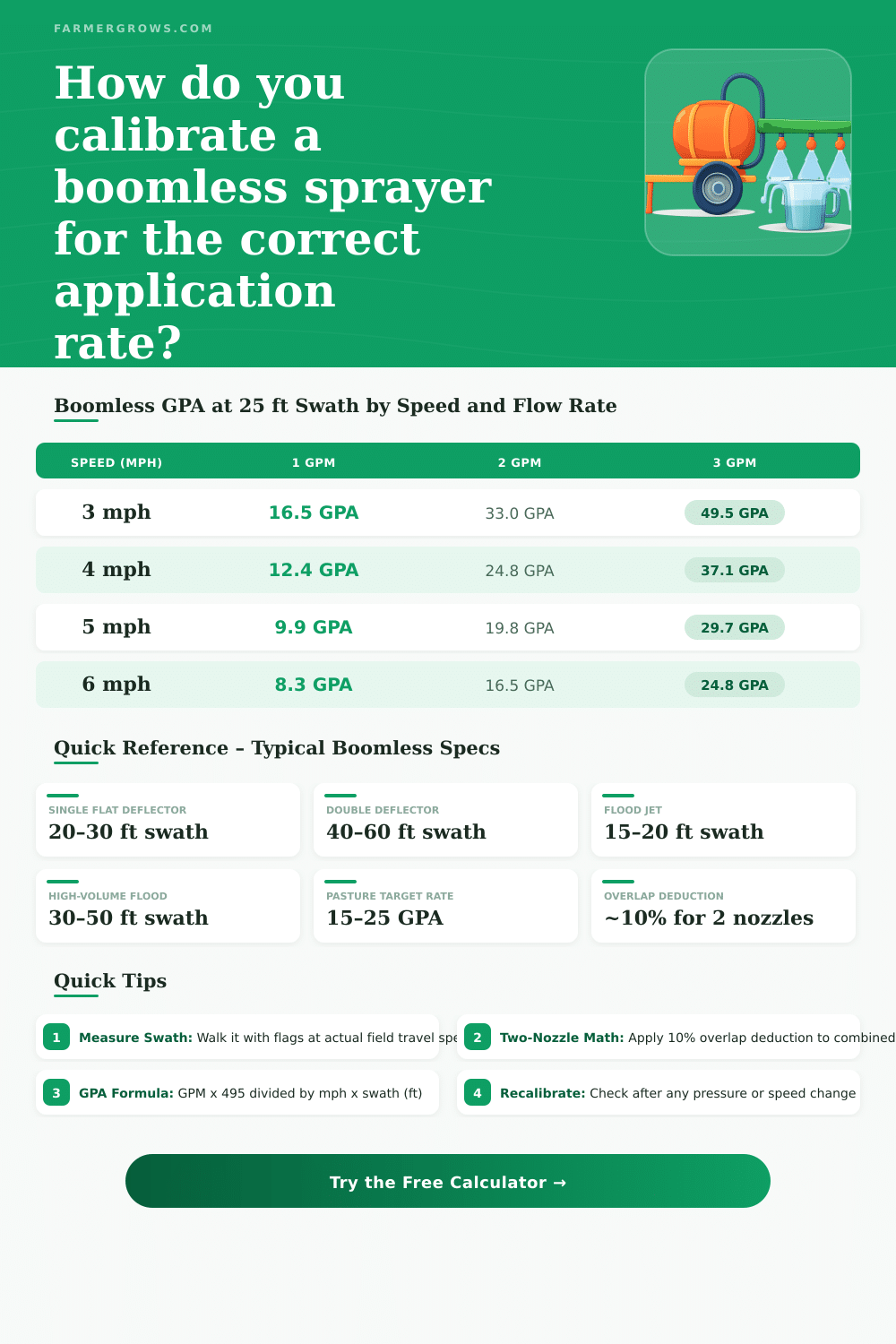
| Speed (mph) | 1 GPM | 2 GPM | 3 GPM | 4 GPM |
|---|---|---|---|---|
| 3 mph | 16.5 GPA | 33.0 GPA | 49.5 GPA | 66.0 GPA |
| 4 mph | 12.4 GPA | 24.8 GPA | 37.1 GPA | 49.5 GPA |
| 5 mph | 9.9 GPA | 19.8 GPA | 29.7 GPA | 39.6 GPA |
| 6 mph | 8.3 GPA | 16.5 GPA | 24.8 GPA | 33.0 GPA |
| 7 mph | 7.1 GPA | 14.1 GPA | 21.2 GPA | 28.3 GPA |
| 8 mph | 6.2 GPA | 12.4 GPA | 18.6 GPA | 24.8 GPA |
| Feature | Boomless Sprayer | Boom Sprayer | Best Application | Terrain |
|---|---|---|---|---|
| Swath Width | 20–60 ft (1–2 nozzles) | 20–120 ft (many nozzles) | Boomless: rough ground | Uneven, hilly |
| Application Accuracy | Moderate | High | Boom: precision crops | Flat, cultivated |
| Nozzle Count | 1–2 nozzles | 10–60+ nozzles | Boomless: fence lines | Narrow/obstructed |
| Damage Risk | Low (no extended boom) | Higher (boom damage) | Boomless: roadsides | Brush, rough edges |
| Uniformity | Lower | Higher | Boom: row crops | Smooth field |
Sprayer calibration boils down to one thing: make sure that your gear actually puts out the right amount of liquid in the right pattern for any field where you work Every drop of fertilizer, insecticide or herbicide that reaches your crops is there for a reason, and right calibration makes the difference between hitting it and wasting product. Or even worse, damaging the crop. Whether you use a big agricultural sprayer or only a hand sprayer, right calibration guarantees that your crops receive exactly what they need, nothing more, nothing less.
Choose the right type and size of nozzle based on the needed flow. Flat-fan nozzles work well for broadcast spraying when you use most herbicides and some insecticides that require medium size drops. Here what I would do: take the output of every nozzle and compare it with the info in the nozzle catalog for the same pressure.
How to Calibrate Your Sprayer
If some nozzle puts out more than 10 % differently than a new one, swpap it. After that you can move on with the calibration.
To do that, you need three basics: a measuring tape, a stopwatch and a graduated measuring cup. The nozzles, pumps and other parts wear out over time and can need replacing. First figure out the length of your calibration course.
Fill the tank with water, start the pump and, attention, keep the rpm steady during calibration, because they will be steady in the field.
Mark and measure the calibration coarse according to the spacing of your nozzles. Choose soil like that that you actually will spray, because a tractor goes faster on pavement than through sod, which changes your application rate. Drive the course in the same speed, gear and rpm that you will use for real.
Time it in seconds, do it twice for an average. When you stop, leave the pump running in that same speed. Gather the output of one nozzle in the measuring cup for exactly that same time that took the run.
A reliable method uses a calibration course of 1/128 acre. Because a gallon breaks down into 128 ounces, the gathered ounces of some nozzle matches gallons per acre. For broadcast spraying the spacing of nozzles decides the distance for calibration.
If you calibrate with water, but plan to use something heavier or lighter than water (8.3 pounds per gallon), use a conversion factor. For instance for 28%-0-0 it is 1.13. So if your target is 20 gallons per acre of that 28 %, you must use 22.6 gallons per acre of water.
Want to increase the rate? Slow down or raise the pressure. Good sprayer calibration is not rocket science, but ignore it and itcost real money.