Pine Tree Spacing Calculator
Plan pine tree spacing by site shape, row pattern, setback, and mature spread. Estimate how many trees fit, how many rows you can plant, and how much canopy room remains.
Pick a real planting job to seed the calculator. Each preset sets species, shape, pattern, dimensions, spacing, setback, and buffer so you can compare layouts quickly.
Pine Spacing Output
Calculated from the selected species, site shape, row pattern, and usable planting area.
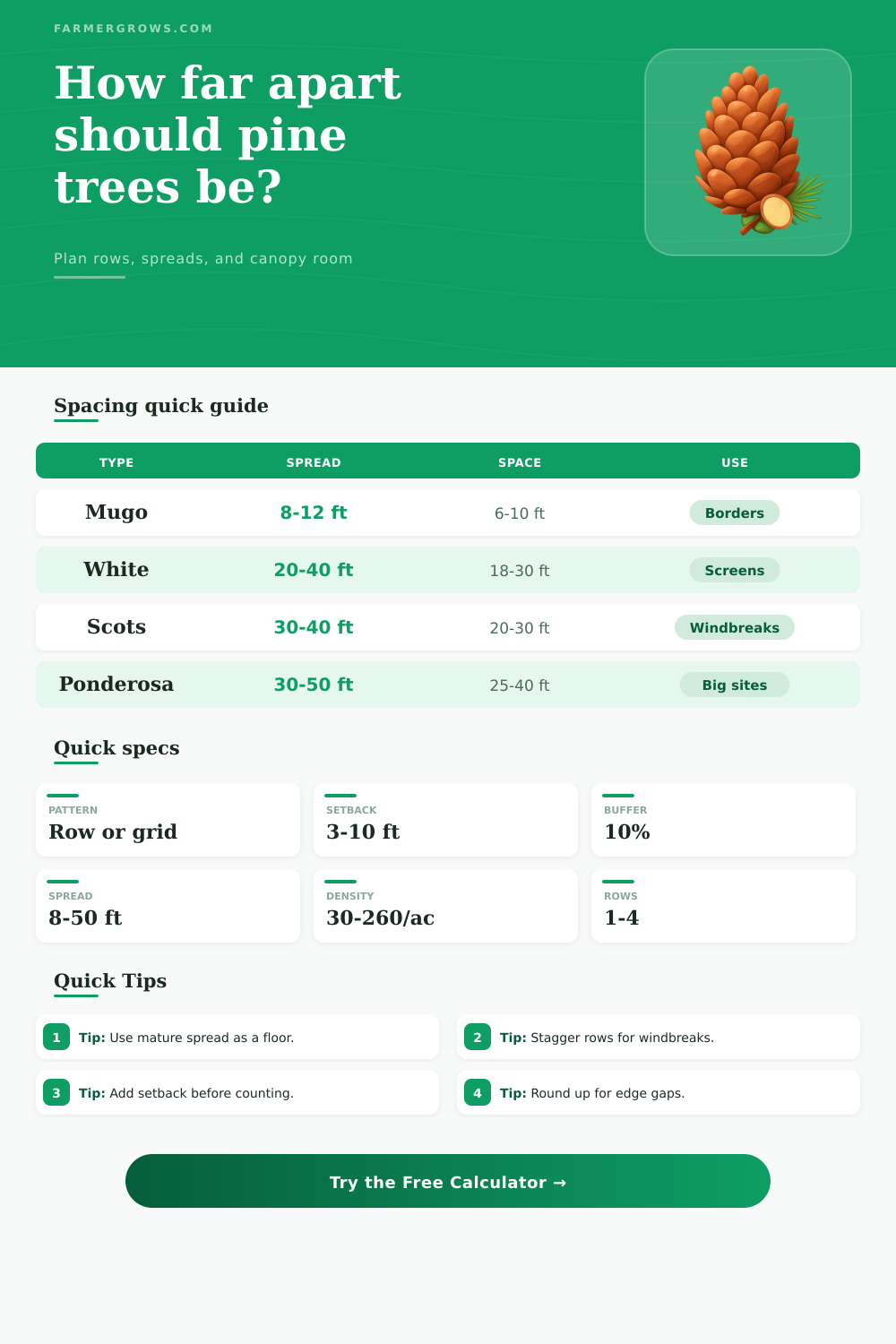
| Species | Spread | Common spacing | Good for |
|---|---|---|---|
| Mugo pine | 8-12 ft | 6-10 ft | Low border |
| Japanese black pine | 15-25 ft | 12-18 ft | Street row |
| Eastern white pine | 20-40 ft | 18-30 ft | Privacy line |
| Scots pine | 30-40 ft | 20-30 ft | Windbreak |
| Austrian pine | 35-50 ft | 25-40 ft | Shelter grove |
| Loblolly pine | 25-35 ft | 15-25 ft | Fast screen |
| Slash pine | 25-40 ft | 18-30 ft | Coastal belt |
| Longleaf pine | 20-30 ft | 15-25 ft | Open row |
| Ponderosa pine | 30-50 ft | 25-40 ft | Large lot |
| Virginia pine | 20-30 ft | 12-18 ft | Farm block |
| Spacing | Trees/ac | Trees/ha | Notes |
|---|---|---|---|
| 8 x 8 ft | 680 | 1,680 | Very tight |
| 10 x 10 ft | 436 | 1,076 | Dense screen |
| 12 x 12 ft | 302 | 746 | Farm block |
| 15 x 15 ft | 194 | 479 | Open row |
| 18 x 18 ft | 134 | 331 | Loose grove |
| 20 x 20 ft | 109 | 269 | Landscape tree |
| 24 x 24 ft | 76 | 188 | Wide canopy |
| 30 x 30 ft | 48 | 118 | Large pine |
| Pattern | Spacing logic | Best use | Density |
|---|---|---|---|
| Single row | One line only | Fence edge | Lowest |
| Staggered double row | Offset rows | Windbreak | Higher |
| Square grid | Even rows | Block planting | Balanced |
| Triangular grid | Offset every row | Tight grove | Highest |
| Project | Site size | Layout | Notes |
|---|---|---|---|
| Backyard privacy | 120 x 30 ft | Single row | Eastern white pine |
| Windbreak band | 180 x 50 ft | Double row | Scots pine |
| Farm planting | 100 x 60 ft | Square grid | Virginia pine |
| Open grove | 90 ft circle | Triangular | Ponderosa pine |
| Street buffer | 80 x 24 ft | Single row | Japanese black |
| Coastal belt | 150 x 60 ft | Double row | Slash pine |
When you plant pine tree, you must consider the future size of the trees because pine trees will grow more larger over time. Many people will purchase their pine trees too close together because they are only considering the size of the tree when they are young. If the pine trees is planted too close together, there will be competition between the trees for the soil and sunlight.
The competition for sunlight may cause the inner branch of the trees to die due to not recieve enough light. You must consider the canopy spread that the trees will create to allow for the pine trees to have enough room to grow. The canopy spread are the width that the tree will grow when it matures.
How to Space and Plant Pine Trees
For example, Ponderosa pines has a large canopy spread while Mugo pines have a small canopy spread. Use a spacing calculator to determine the distance that you should space the pine trees. The calculator will do the math for you.
The setback is the distance between the pine tree trunk and the boundary of the property. There must be a setback between the trees and your fence or neighbor’s property. Without a setback, the branches of the pine trees may lift your fence or go over your neighbors driveway.
A ten foot setback is suggested so that you make the maintenance of the fence and driveway easier and to avoid creating a nuisance for your neighbor. You must decide on the planting pattern that you would like to create for the pine trees that you will be planting. Many people choose to use a single row for their pine trees.
However, if one of the trees in that single row die, there will be a gap in the trees. A staggered double row create a better barrier of pine trees because the canopies of the trees will overlap. The staggered double rows of pine trees also provide enough room for the trunks of the pine trees so that they do not become too crowded with one another.
For plantings of a grove of pine trees, you can use either a square grid or a triangular layout for the grove. The advantage of using a square grid is that it is very orderly with the trees. The other benefit is that it is easy to mow the grass between the rows of pine trees.
A triangular layout may be more efficient with your grove of pine trees because it allow you to plant more trees with the same amount of area between each tree. Include a spacing buffer between each pine tree when you are planning your grove of pine trees. The spacing buffer is an additional distance that you can add to the distance between each pine tree.
Use a ten percent buffer between each tree because some pine trees will grow faster than others. Using this buffer will create room for the trees to grow without touch each other. When the branches of the trees do not touch each other, the air can easily move through the branches.
Air movement help to reduce the number of pests and diseases that may occur on the trees. When you use the calculation tool, there will be a number that indicates the canopy gap. The canopy gap is the amount of space between the pine trees’ canopies.
If the canopy gap is a negative number, it means that the canopies of the trees will overlap. Overlap may be desired if you are planting the trees to create a privacy screen for your yard. In the case of specimen trees, you will want to create a positive canopy gap to ensure that the trees will grow to the maximum potential while not become a narrow shape.
Use the reference tables to determine the common canopy spreads for the different types of pine trees that you would like to plant in your yard. The information in these tables can help to plan for the future size of the trees. However, keep in mind that the quality of the soil may impact the size that each pine tree can grow to.
A pine tree that is planted in moist soil will grow faster than one that is planted in dry soil. Therefore, if you are planting your pine trees in moist soil, they will require more space between each tree than pine trees that is planted in dry soil. It is easier to plan your pine tree planting now than to have to thin them out later.
When you thin out trees, you have to move them to other areas of your yard, and it is difficultly move these trees. In the worst case, you may kill the pine tree in the process. So ensure that there is enough space for each pine tree so that they will remain healthy.