Gravel Calculator for French Drain
Estimate clean drain stone volume after pipe displacement, fabric wrap area, slope drop, cleanout spacing, void storage, bag counts, tons, and excavated spoil for French drain trenches.
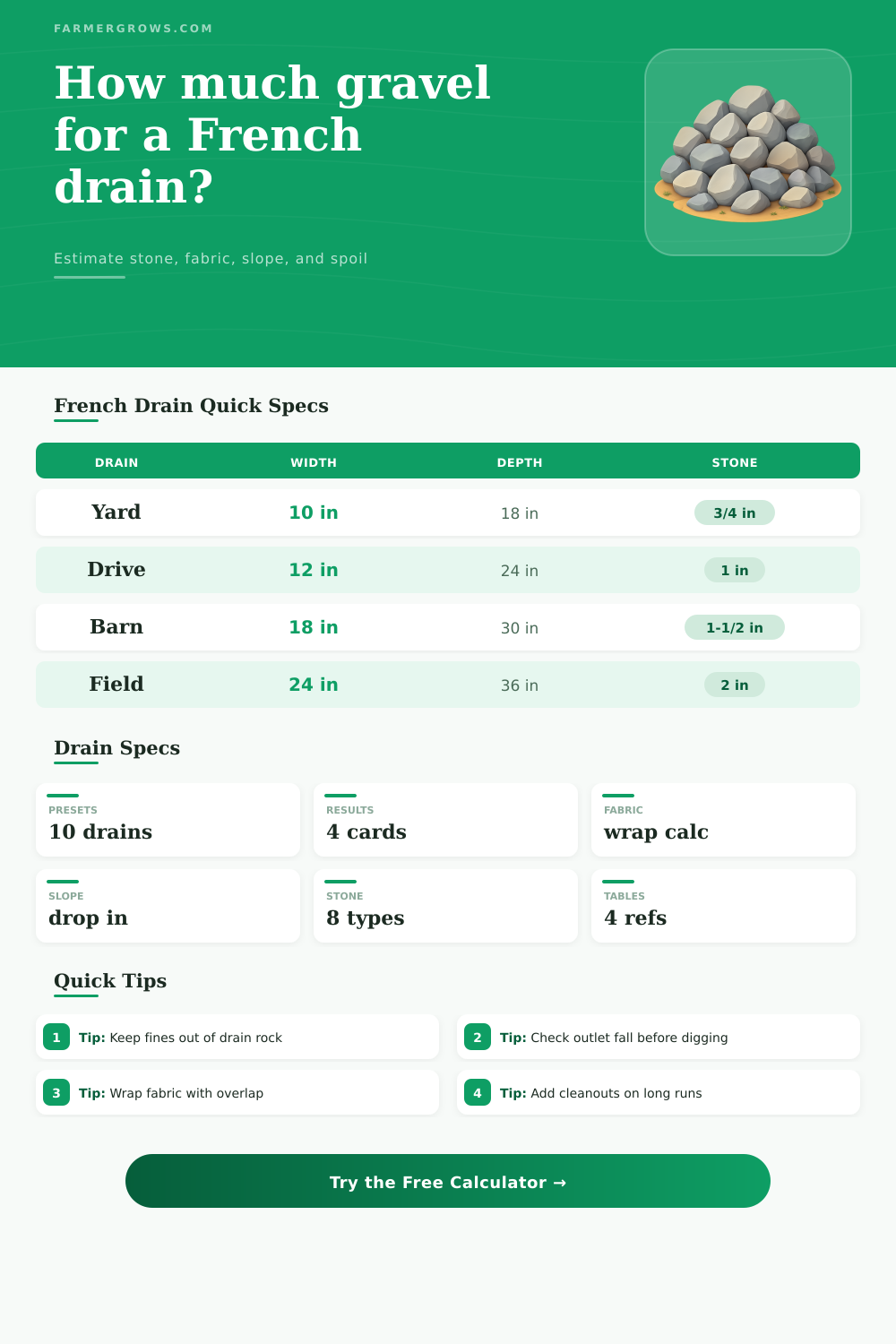
Choose a common drain layout, then adjust the trench, pipe, stone, overlap, slope, and cleanout spacing for the actual run.
French Drain Material Estimate
Stone, fabric, slope, and spoil results will appear here.
| Drain setting | Typical trench | Pipe size | Stone size | Planning note |
|---|---|---|---|---|
| Side yard surface water | 10 to 12 in wide, 16 to 24 in deep | 4 in perforated | 3/4 to 1 in clean | Good for shallow lawn and landscape drainage |
| Driveway edge | 12 to 18 in wide, 24 to 30 in deep | 4 to 6 in perforated | 1 to 1-1/2 in clean | Use stronger stone and protect from sediment |
| Foundation perimeter | 12 to 18 in wide, footing depth varies | 4 in perforated | 3/4 to 1 in clean | Outlet and code details matter before digging |
| Barn or equipment apron | 18 to 24 in wide, 24 to 36 in deep | 4 to 6 in perforated | 1-1/2 to 2 in clean | Plan spoil, traffic, and discharge location |
| Field edge collector | 18 to 30 in wide, 30 to 48 in deep | 6 in perforated | 1-1/2 to 2 in clean | Long runs benefit from cleanouts and survey fall |
| Envelope check | Common target | Why it matters | Calculator field |
|---|---|---|---|
| Stone under pipe | 3 to 6 in | Supports pipe and keeps perforations out of soil | Gravel below pipe |
| Stone above pipe | 4 to 8 in | Maintains a drainage zone before soil or cover | Gravel above pipe |
| Stone beside pipe | 3 to 6 in each side | Prevents a narrow pipe slot from clogging early | Side gravel each side |
| Fabric overlap | 8 to 18 in | Closes the wrap so fines cannot wash into stone | Fabric overlap |
| Outlet fall | 0.5% to 2% | Keeps pipe moving water without an impossible outlet | Pipe slope |
| Stone size | Typical void ratio | Drain behavior | Best use |
|---|---|---|---|
| 3/4 in clean angular | 35% to 40% | Good balance of support and open pore space | Most yard and foundation drains |
| 1 in clean stone | 38% to 42% | More open flow with enough pipe support | Drive edges and wet side yards |
| 1-1/2 in clean stone | 40% to 45% | Large voids but rougher around fabric | Barn aprons and long collectors |
| 2 in clean stone | 42% to 48% | High storage but harder to shape tightly | Heavy seepage and field edges |
| Pea gravel | 30% to 36% | Smooth, less locking, can move under flow | Light drains where specified locally |
| Run length | Slope at 0.5% | Slope at 1% | Cleanout idea | Field note |
|---|---|---|---|---|
| 40 ft | 2.4 in drop | 4.8 in drop | Ends only | Easy to check with a laser or string line |
| 80 ft | 4.8 in drop | 9.6 in drop | One middle access | Common residential run length |
| 120 ft | 7.2 in drop | 14.4 in drop | Every 60 to 80 ft | Check outlet elevation before trenching |
| 200 ft | 12 in drop | 24 in drop | Every 80 to 100 ft | Break into runs if the outlet is too shallow |
| 300 ft | 18 in drop | 36 in drop | At bends and long reaches | Survey grade and avoid buried utility conflicts |
The calculator treats the trench as a wrapped gravel envelope. If soil fines can enter the clean stone, the void storage and flow path shrink long before the pipe wears out.
Slope drop is calculated from the full run length. A deep trench with no lower outlet can hold water even when the stone and pipe quantities are correct.
A French drain is used to move water away from a specific area. A French drain work because water tends to move toward the path of least resistance. Many people will install a French drain if there property has a low spot that becomes wet, if their foundation is experiencing moisture issue, or if they have a driveway that collect water like a stream.
The purpose of the French drain is to move water away from the location where the water is not wanted before it can pool or seep into that area. In planning a French drain, there is several factors that must be considered, such as the amount of stone that will be required, the depth of the trench, and the slope of the pipe. Dimensions of the trench are important in relation to how many space will be provided for the pipe and the stone.
How to Plan a French Drain
If the trench is too narrow, the sides of the trench will make it difficult for the pipe to be installed into the trench, and the narrow space will prevent water from reach the perforations in the pipe. If the trench is too shallow, the pipe will be too close to the ground and frost heave or other moving traffic on the property is potentially likely to shift the shallow pipe. The calculator calculates the volume of the trench with a formula that takes into account the length, the width, and the depth of the trench.
The calculator also subtracts the volume of the pipe to ensure that it dont order more stone than can fit into the trench once the pipe is installed. Stone size and void space is related to one another and must be considered during the installation of the French drain. Large stones will create more voids between the stones than small stones, allowing the water to flow and to be stored within the French drain.
However, large stones will be more difficult to shape around the installation of the pipe. Small stones will allow the pipe to be better supported, but the closer proximity between the stones will slow the movement of water through the pipe. The void ratio field allows for an estimation of how much water will be held within the void spaces created by the stones; this is helpful in determining how the French drain will act as a detention area during periods of rainfall.
Fabric wrap is used to prevent soil from entering the void spaces between the stones. Fabric wrap will prevent the French drain from losing its capacity to allow water to pass through. The calculator includes a field that asks for the length of the overlap of the fabric wrap; the overlap must be provided to ensure that the fabric does not fray at the end of the pipe, but adding too much wrap to the ends of the fabric roll will increase the cost of the fabric without adding benefit to the function of the French drain.
Using too little fabric wrap will allow soil to pass through the fabric and potentially clog the French drains. Slope of the pipe and the number of cleanouts are two factors related to the long-term function of the French drain. A French drain should have a gentle slope to allow the water to pass through the pipe without requiring the outlet of the pipe to be very deep.
However, a gentle slope of the pipe allows any sediment that may accumulate within the pipe to potentially settle within the pipe. Access points into the pipe, known as cleanouts, allow a person to inspect the French drain or to flush the drain to remove sediment from the pipe. The calculator can determine the total drop that should be present along the entire length of the French drain, and it can also provide suggestions for the number of cleanouts that should be installed along the length of the French drain.
This information will be helpful for understanding the slope that the designer will have to create for the trench; slopes may be limited by the elevation of the ground along the trench. Spoil volume is the volume of soil that will be excavated from the trench. Many people will underestimate the volume of spoil that will be removed until they begin to move the soil onto the yard.
Soil expands when it is excavated. Clay and rocky soil tend to expand more than sandy loam soil. The swell factor in the calculator will help to calculate how many yards of soil will be removed from the trench, and this can assist in determining how much dirt will need to be hauled to dispose of the excavated soil.
Planning for the volume of spoil that will be removed is necessary to prevent becoming short of space in which to eliminate the excavated soil. The results from the calculator will provide a clear picture of the requirements of the planned French drain. The modest amount of stone and slope will allow for planning of the location of the French drain.
However, should the calculator determine the drop of the outlet be deeper than the depth of the trench, the designer will have to lower the outlet or the trench will have to be broken into shorter segment. This information will allow the designer to understand the requirements of the trench ahead of beginning to dig the trench.