Cabbage Growth Time Calculator
Estimate cabbage sowing, transplanting, harvest readiness, frost exposure, heat stress, spacing density, and head timing for spring, fall, storage, napa, savoy, and red cabbage crops.
Cabbage timing shifts with variety, transplant age, day length, heat, hardening, and local frost. Use the estimate to schedule work, then adjust for your seed packet and field conditions.
Cabbage Growth Time Results
Your cabbage crop timing will appear here after calculation.
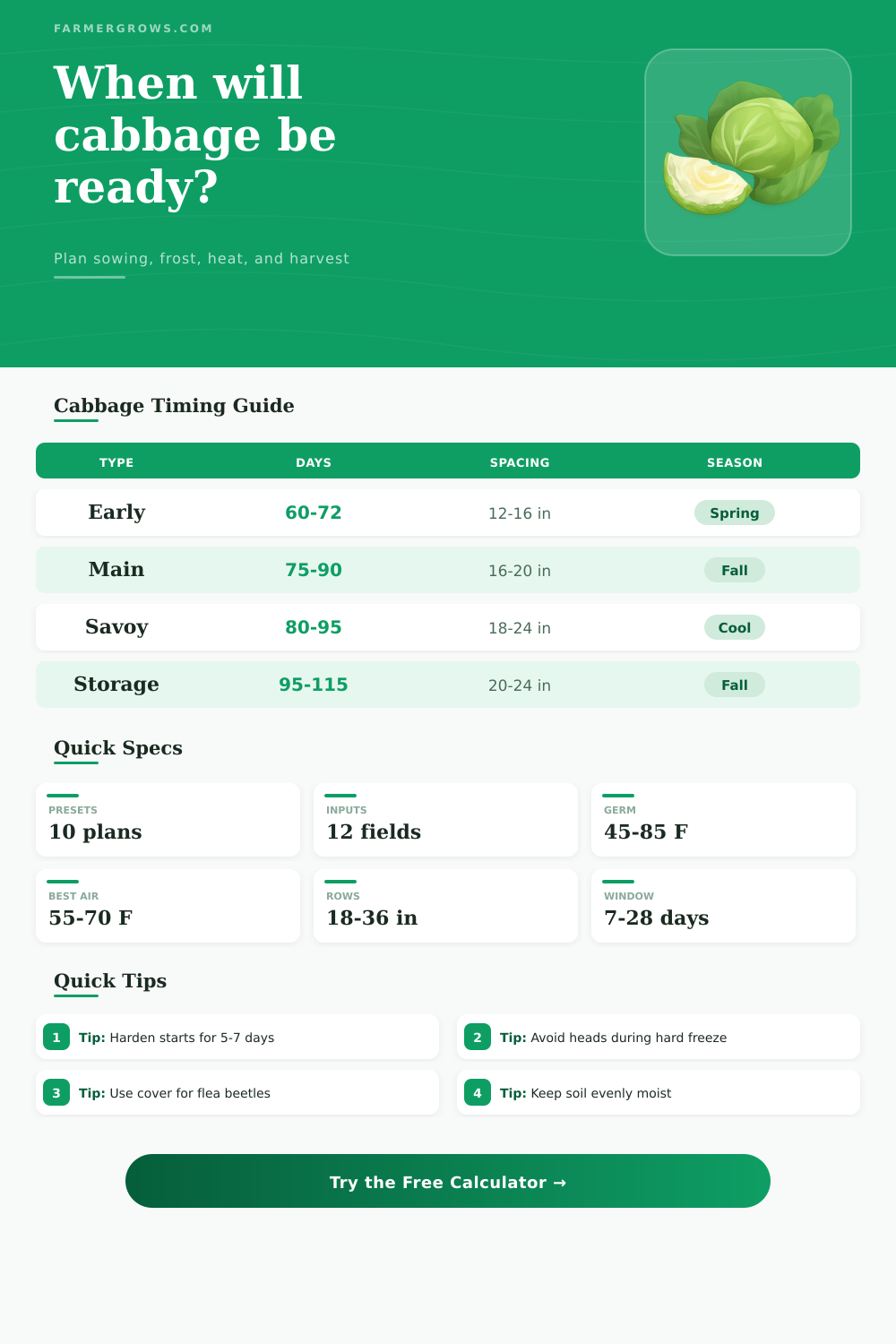
| Type | Typical maturity | Best season | Planning notes |
|---|---|---|---|
| Early round green | 58-72 days from transplant | Spring and early fall | Fast heads, tighter harvest window, good for close successions. |
| Main-season green | 75-90 days from transplant | Spring or fall | Balanced head size, good field reliability, common fresh-market type. |
| Mini cabbage | 45-60 days from transplant | Spring, fall, protected beds | Close spacing makes small dense heads for quick turns. |
| Red cabbage | 75-95 days from transplant | Cool spring or fall finish | Needs steady moisture and cooler finishing weather for color and density. |
| Savoy cabbage | 80-100 days from transplant | Fall or mild winter | Crinkled leaves tolerate cool weather and often improve after light frost. |
| Storage cabbage | 95-115 days from transplant | Fall finish | Large dense heads need generous spacing, fertility, and time before hard freeze. |
| Soil temperature | Expected germination | Seedling result | Management note |
|---|---|---|---|
| 40-44 F | Very slow, often 14+ days | Uneven stand | Use indoors, a heat mat, or wait for warmer soil. |
| 45-55 F | 7-12 days | Acceptable cool start | Good for hardened transplants and early protected beds. |
| 60-75 F | 3-6 days | Fast, uniform emergence | Ideal seed-starting range for most cabbage batches. |
| 76-85 F | 4-8 days | Possible stretch or stress | Provide bright light and move seedlings cooler after sprouting. |
| Above 85 F | Erratic | Poor stand risk | Shade trays, cool the medium, or sow for a later fall slot. |
| Goal | In-row spacing | Row spacing | Expected head |
|---|---|---|---|
| Mini or baby cabbage | 8-12 inches | 12-18 inches | 1-2 lb, quick harvest, close beds. |
| Early fresh cabbage | 12-16 inches | 18-24 inches | 2-3 lb heads with fast turnover. |
| Main-season heads | 16-20 inches | 24-30 inches | 3-5 lb heads with good uniformity. |
| Large storage heads | 20-24 inches | 30-36 inches | 5-8 lb heads with dense cores. |
| Napa cabbage | 12-18 inches | 18-30 inches | Elongated heads, fast fall crop. |
| Crop condition | Adjustment | Harvest window | What to watch |
|---|---|---|---|
| Cool steady weather | 0 to +3 days | 10-21 days | Heads fill evenly and hold without splitting. |
| Hot spell during heading | +5 to +16 days | 7-14 days | Loose heads, bitterness, bolting, or stalled sizing. |
| Light frost finish | 0 to +5 days | 14-28 days | Flavor improves, but harvest before repeated hard freezes. |
| Dry soil swings | +4 to +12 days | 5-12 days | Split heads after sudden rain or irrigation. |
| Heavy pest pressure | +5 to +10 days | Varies | Leaf loss delays sizing and lowers marketable yield. |
Start with the harvest date. For fall cabbage, count backward from your first frost by the variety maturity plus seedling age, then add a weather buffer for short days and late-season cooldowns.
Protect the early leaves. Row cover helps cabbage beat flea beetles and cabbage worms, but remove heavy fabric during warm heading weather so trapped heat does not delay dense head formation.
Timing your cabbage seed-sowing looks easy enough: Just match your calendar to frost. But then things get complicated when trying to find a date that works for both. First we have a seed packet and a general feeling that cabbage prefers cool conditions. Next thing we know, our early-planted cabbages bolted while still small, and our fall ones finished far past prime.
Between the weather and the calendar are where the real labor occurs, and that’s where the plan comes into play. Those are the real-world variables that influence number of days to harvest; they’re what the calculator captures. Base days to maturity is set by variety selection, but you may add (or subtract) another week or more depending on season, heat exposure and whether you plan to use row covers.
Tips for Planting Cabbage Seeds
If you grow a 105-day storage type in late August rather than early July, shorter days plus cooler nights mean faster development (and vice versa). Your frost dates is entered into the tool so it knows if your harvest time overlaps with any potential cold snaps that could harm outer leaves or slow down sizing. Heat stress selections adjusts the estimate based off when heat stalling delays heading and makes bitter or loose heads more likely.
Bed lengths (and thus spacings) also affect both how many plant will fit, as well as how large a head each one might get to be. Wider spacing gives storage varieties plenty of room to grow and reach their full size. Tighter spacing results in smaller heads sooner and is good for getting things going fast. However, it is not so great if you want to plant successions with time between them.
Those decisions translates into a harvest window and a risk score indicating what’s most likely to shift the dates: frost, heat, or spacing? Even with the best-laid calendar, heading time can change. Cabbages is particularly picky about changes in temperature and moisture levels while they’re heading. These changes can cause heads that appeared flawless last week to split open from sudden showers after a dry period.
Light frosts enhance the flavor of storage and savoy types; repeated hard ones will simply go mushy on you. Once those heads start firming up, it’s back to daily eyeballing for the ultimate call. But the calculator provide a ballpark estimate to get you started. It’s best to start with when you want something to harvest (or when your first frost is expected), and work backward.
Pick the variety that fits your schedule, and tweak the rest of the variables until you think it will add up in your climate. The calculator does the math for you… But you know what? That’s not so hard; the hard part is understanding the trade-offs you’re prepared to make. If you pick a fast variety, maybe they’ll be done before heat comes. But they won’t keep as long.
If you plant late, you get big heads to store for the winter, but only if you protect them from an early freeze. Of course, all this care pays off in the plant itself. You get the benefit of tight, unsplit heads when conditions is right. You also get better-than-average flavor, which becomes even more better in a bit of cool weather.
Fail, and you’re stuck with smallish heads or biggies whose outer leaves has split open, ready for use right now. Or never. The trick to turning a good head of cabbage (er, cabbages) into one that’ll feed you according to schedule? Paying attention to those variables that the calculator will track for you.
You should of watched them closely. Everything actualy depends on it. Growing cabbages can be more difficult then most people thinks.