
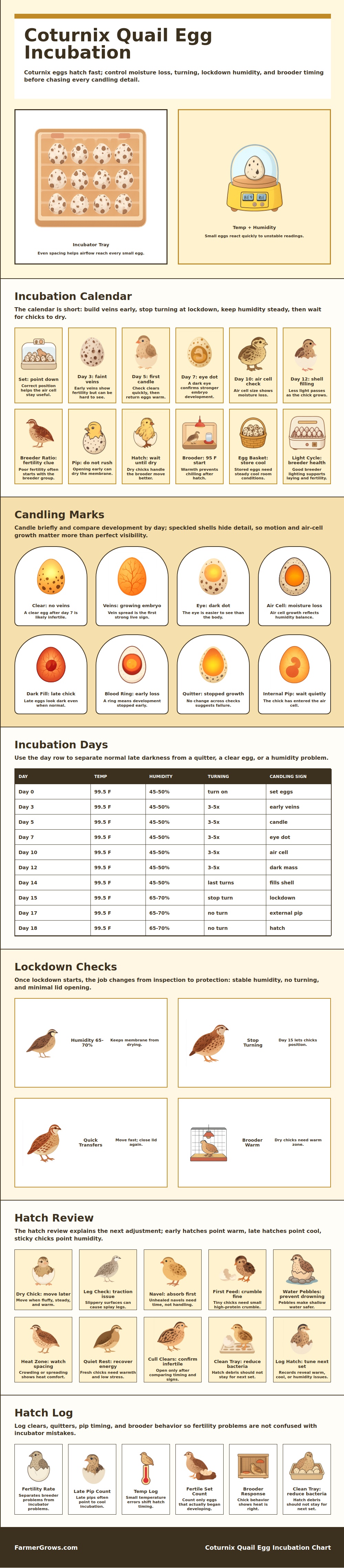
To incubate Coturnix quail egg successfuly, individuals must pay close attention to the temperature and moisture level within teh incubator. Coturnix quail eggs has a short incubation cycle, meaning that individuals must maintain the incubator’s temperature and moisture levels to ensure that the eggs successfully hatch. Additionally, individuals have to be careful not to over-handle the eggs, as this can cause several problem for the developing embryos within the eggs.
Furthermore, if individuals opens the incubator to look at the eggs, the eggs will lose some of their humidity levels, forcing the incubator to work more harder to replace the humidity within the incubator. Additionally, if individuals handle the eggs too frequent, there is a risk of introducing bacteria into the eggs, as well as exposing the embryos to cooling stress. Another process to perform within the incubator is candling the Coturnix quail eggs.
How to Incubate Coturnix Quail Eggs
When candling the eggs, individuals should look for specific indicators of the development of the embryo within the egg such as the presence of a dark eye dot or the presence of an air cell. The air cell indicate the moisture levels of the eggs; if the air cell is too large, it means that the eggs have lost too much moisture. Additionally, an air cell that is too large can lead to the embryo within the egg being too weak to perform the pip process.
In contrast, if the air cell within the egg is too small, the embryo may drown within the egg due to small air cell. As the Coturnix quail eggs approach the end of the incubation period, individuals should lock the eggs down within the incubator. During the lockdown period, individuals should not being turning the Coturnix quail eggs within the incubator.
Additionally, the humidity within the incubator should be increased during this period. Increasing the humidity prevents the inner membrane of the eggs from becoming too firm. If the humidity within the incubator is too low during this period, the membrane may shrink around the developing embryo, which can cause the embryos to become pinned to the shell.
Additionally, moisture within the shell allow the embryo to break free from the shell once fully developed. When the Coturnix quail eggs begin to hatch, individuals will notice either an internal pip or an external pip. An internal pip occur when the embryo within the egg begins to break the shell from the inside of the egg.
An external pip occurs when the embryo begins to break the shell from the outside of the shell. In either case, individuals should not attempt to assist the embryo in perform the pip process. If individuals allow the embryo to complete the pip process naturaly, it will be able to absorb the remaining yolk and dry off.
If individuals attempt to assist the embryo in performing the pip process, the chicks may experience stunted growth. After the Coturnix quail eggs have hatched, individuals must transfer the chicks to a brooder. When transferring the chicks, individuals must manage the heat within the brooder to ensure that the chicks do not huddle together in the brooder.
If the chicks begin to huddle together in the brooder, this indicate that the brooder is too warm. If the chicks do not huddle together, but instead begin to scatter to the edges of the brooder, this indicates that the brooder is too hot. Additionally, chicks require fine crumble feed and access to water for proper development within the brooder.
However, the water must contain small pebbles at the bottom of the waterer to ensure that the chicks do not drown in the water. Finally, after the chicks have matured in the brooder, individuals should conduct an audit of the hatch of the Coturnix quail eggs. During this audit, individuals can determine how many Coturnix quail eggs were clear and how many Coturnix quail eggs developed problems during incubation.
By keeping track of the number of eggs that successfully developed into chicks, individuals will be able to determine if the breeder ratio caused the issues with the Coturnix quail eggs or if the incubator caused the issues. Thus, by tracking the number of eggs that successfully hatched, individuals can determine if the incubator or the breeder ratio impact the success of the Coturnix quail eggs.