Gladiolus Bulb Bloom Time Calculator
Estimate gladiolus bloom dates from planting date, corm size, soil temperature, bloom group, succession spacing, spike harvest stage, staking needs, and first fall frost.
Choose a real planting situation, then adjust the dates, corm grade, soil warmth, and succession plan. The calculator treats gladiolus as corm-grown cut flowers, not generic bulbs.
Gladiolus Bloom Time Results
Your gladiolus corm bloom estimate will appear here.
| Soil temperature | Bloom timing effect | Corm risk | Grower action |
|---|---|---|---|
| Below 50°F | Add 12 to 18 days | High rot and slow rooting risk | Wait, pre-sprout warm, or improve drainage |
| 50 to 54°F | Add 7 to 12 days | Marginal for gladiolus | Plant only in well-drained beds |
| 55 to 64°F | Add 0 to 6 days | Acceptable spring start | Good first outdoor planting window |
| 65 to 78°F | Normal to 5 days faster | Best rooting and shoot growth | Ideal main succession planting range |
| Above 82°F | Fast growth, shorter display | Moisture stress rises | Mulch lightly and water evenly |
| Corm grade | Typical diameter | Timing adjustment | Spike expectation |
|---|---|---|---|
| Jumbo | 1.5 in or larger | 4 to 8 days earlier | Strong stems, large florets, best for show cuts |
| No. 1 | 1.25 to 1.5 in | Baseline | Standard cutting-grade bloom timing |
| No. 2 | 1 to 1.25 in | 5 to 10 days later | Usable spikes but fewer florets in stress |
| Small or cormel-grown | Under 1 in | 12 to 24 days later | Late, short, or vegetative in cool seasons |
| Bloom group | Baseline days | Best use | Succession note |
|---|---|---|---|
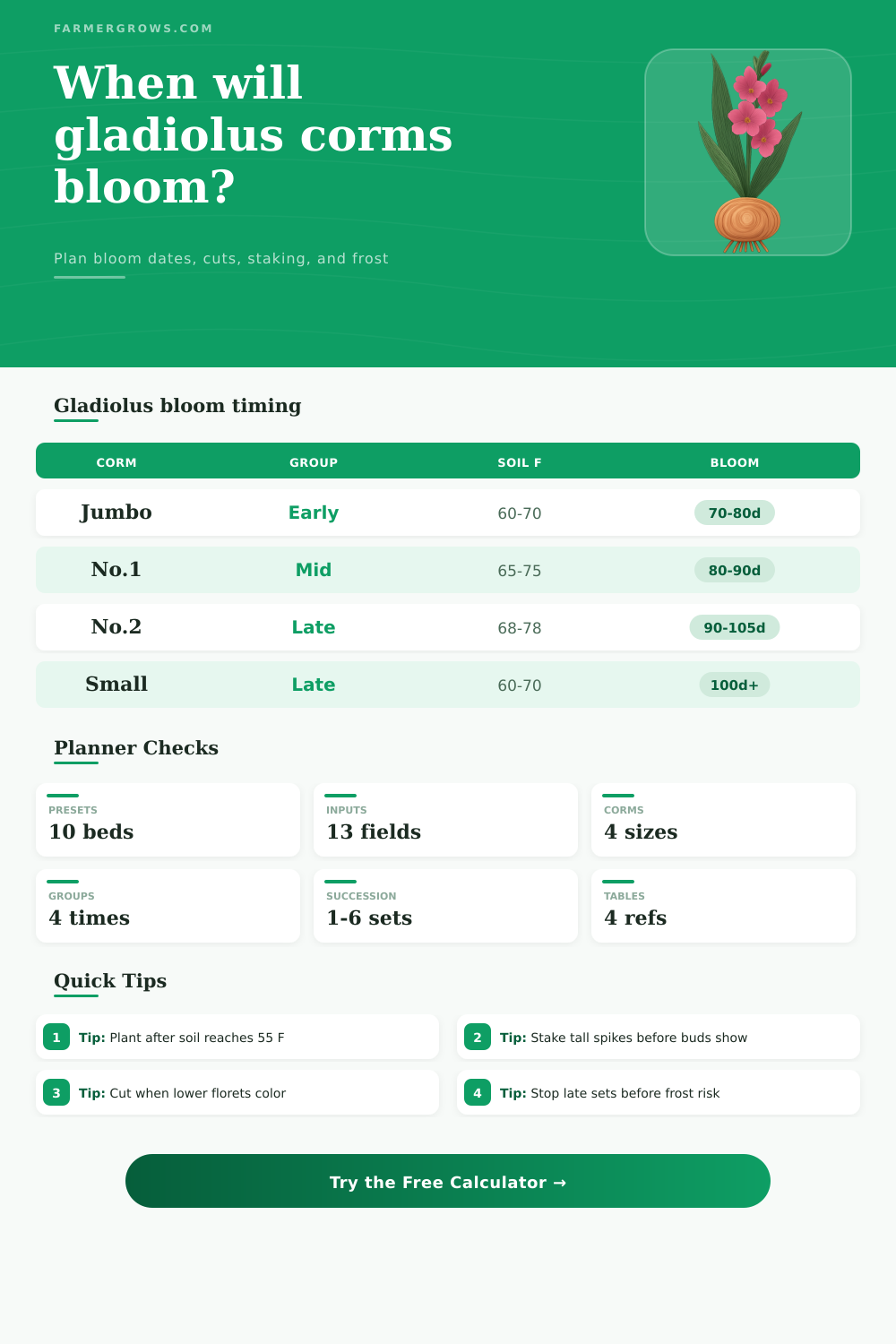
| Very early | 65 to 75 days | First farmers market bunches or event cuts | Pair with midseason corms for a longer run |
| Early | 75 to 85 days | Home garden bouquets and summer borders | Plant every 7 to 10 days for smooth cuts |
| Midseason | 82 to 95 days | Main crop rows and mixed color blocks | Reliable core group for most climates |
| Late or giant-flowered | 95 to 110 days | Large spikes, shows, and late-summer color | Stop planting earlier in short seasons |
| Planning factor | Best timing | Calculator effect | Field cue |
|---|---|---|---|
| Spike harvest | Tight color to first floret open | Cut date is 1 to 4 days before full display | Lower buds show color and stem is firm |
| Staking or netting | Before spikes elongate | Poor support lowers readiness score | Install support near 18 to 24 in leaf height |
| Late succession | Last bloom before frost | Frost gap under 10 days raises risk | Stop planting when predicted bloom meets frost |
| Corm digging | After foliage matures, before hard freeze | Not a bloom date, but noted for fall planning | Leaves yellow after bloom and frost is near |
Succession tip: For cut flowers, smaller weekly plantings usually beat one large planting because gladiolus spikes do not all hold at the perfect cut stage for long.
Staking tip: Put netting, string, or stakes in before flower spikes stretch. Waiting until buds show color often means crooked stems and broken leaves.
Bloom estimates are planning ranges. Cultivar, corm storage quality, water stress, thrips pressure, and sudden heat can shift real gladiolus bloom dates by a week or more.
Want to have a June wedding with glads? Need them in full force at a farmers market all month long in July? Want big spikes before fall’s cool weather set in?
With gladiolus, it doesn’t work that way; they don’t bloom at will. The trick is to understand how they react to genetics, light cues, corm size and soil warmth. Then, you must make sure those four elements lines up so the blooms you want appear when you need them. That’s no easy task in your head, but there are formulas (like this planting calculator)… That factor in all four variables and tell you when to start sowing to hit your desired date (assuming you know your frost danger).
How to Get Glads to Bloom When You Want
The trick here is thinking of glads more like biological timers than set-it-and-forget-it plants. Otherwise, you’ll find yourself waiting until mid-July for a single flush of flowers then weeks and months of green, useless spikes after that.
The single most controllable variable are corm size. The bigger the better. Larger corms has more stored energy, which means they can absorbs leaves and roots faster while waiting for flower signal. Often a jumbo corm will bloom several weeks ahead than a small one planted side-by-side in identical conditions. If your reason for growing these beauties is to enjoy them as cut flowers, spending little money on tiny corms is rarely economical; you’re really paying for storage space, not for flowers.
Here’s how various grades translate into days-to-spike (from the chart on this page). The rate of growth depend a lot on soil temperatures. Don’t plant when soil is still cold and sodden or corms will rot before emerging from ground. Gladiolus roots needs warmth to initiate growth. When soil isn’t at least fifty-five degrees Fahrenheit, it’s like waiting with your door wide open for thieves: The corm will stay dormant (and susceptible to damage) until then. Better to wait to sow till the soil warms up so that things gets going faster and stronger. Many gardeners try to rush things by planting too soon, impatient to be out working in soil… But it pays off down the road if you can just hold on.
With succession planting, you can spread out your crop and enjoy it gradually. How? You plant some corms now, others every ten to fourteen days, and so on. That way, there’s never a big spike of blooms all at once; but several groups flowering one after another. The calculator shows you the window of bloom for each set, helping you see how many sets you’d need to have blooms for weeks on end. If you space the planting about every ten days to two weeks apart, you’ll have a steady supply of stems (as opposed to only having those that peak all at once).
Why stagger planting? Individual glads don’t last long as cut flowers because a couple of florets open first, followed shortly by the rest. If you haven’t staggered your planting, you’re either cutting stems that aren’t quite ready yet. Or stashing them till they go limp.
Tall kinds needs staking, but it’s too late to do so once they sends up their flower spike above the foliage. You need to have stakes in place before that happens. Install a row of netting first. It helps keep stems upright and simplifies cutflower harvesting. It also protects the flowers and underground corms when summer storms come through and the bed threaten to fall apart.
The limiting factor on timing is your own local frost date. If you plant a variety that blooms late, too near fall, you can’t force it and get it finished up in time to avoid a killing frost. To protect against this potential frost damage to maturing corms (or even just the developing spike), the calculator alert you if planting your last set is risky. You get both your flowers for this season, and healthy corm for next.
The science of growing gladiolus for cut flowers is all about managing their reserves of energy (and timing it to the weather and time). This means not planting too early or late, and using succession planting to create a steady harvest instead of one big burst. You should of used it. It’s a lot like dating: “I can’t help how I feel,” as the song says; you can’t make the weather cooperate. But here are some tips on getting your timing right, which will take away the guesswork. Plan instead, and you’ll have plenty of the tall beauties at just the moment you want them, week after week all season long. Actualy, it’s moddern and luxurius.