Orchard Spacing Calculator
Estimate tree counts, row counts, canopy fit, and spacing density for a new orchard block. The calculator handles block shape, setbacks, row spacing, tree spacing, reserve trees, and layout pattern.
Pick a real orchard layout to seed the calculator. Each preset sets the shape, dimensions, row spacing, tree spacing, setback, canopy spread, pattern, and reserve buffer.
Orchard Spacing Output
Results use the selected block shape, row spacing, tree spacing, canopy spread, and reserve buffer.
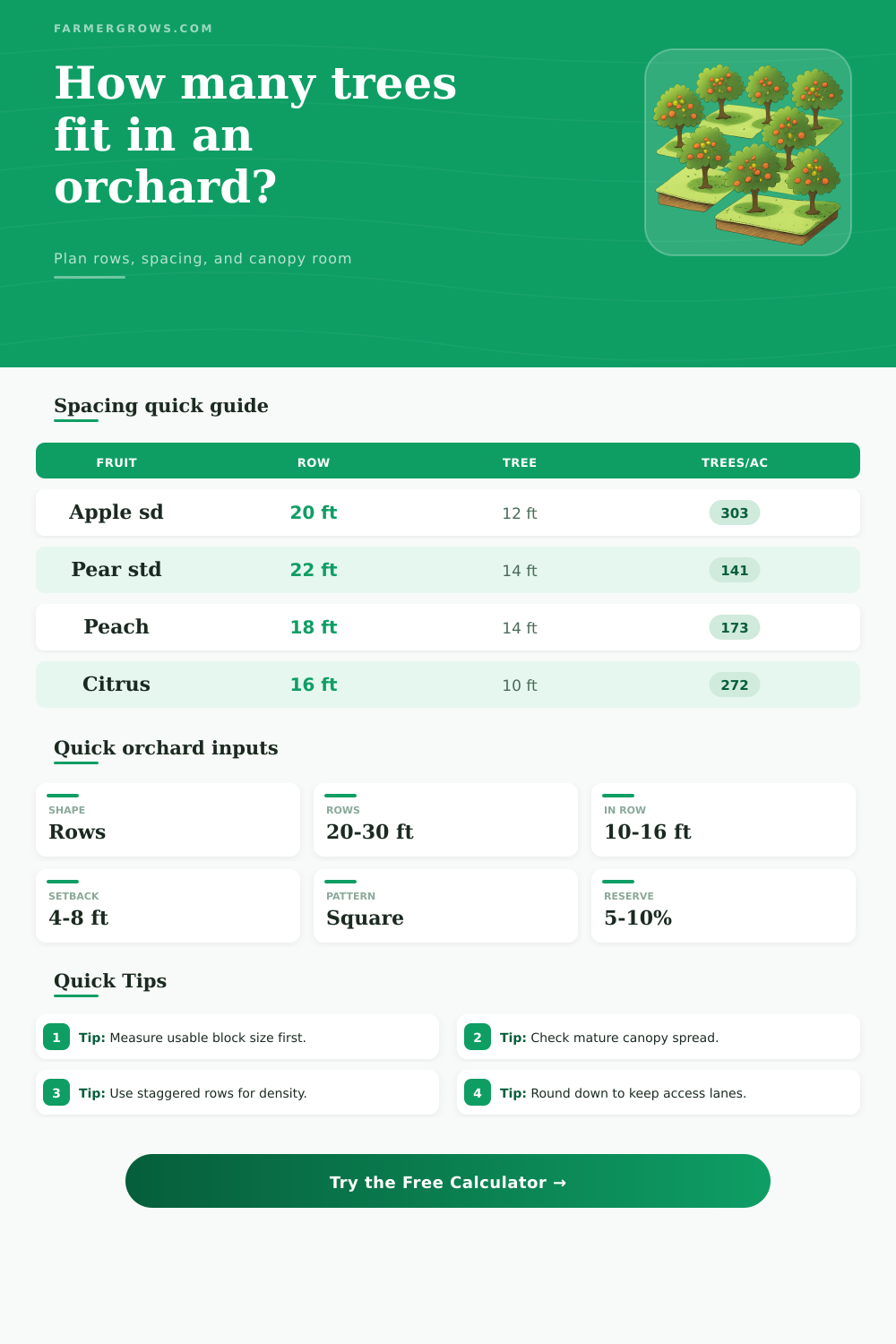
| Fruit | Row gap | Tree gap | Notes |
|---|---|---|---|
| Apple sd | 20 ft | 12 ft | Home row |
| Pear std | 22 ft | 14 ft | Upright |
| Peach | 18 ft | 14 ft | Warm site |
| Citrus | 16 ft | 10 ft | Mild zones |
| Spacing | Sq ft | Trees/ac | Trees/ha |
|---|---|---|---|
| 12 x 12 | 144 | 303 | 747 |
| 15 x 15 | 225 | 194 | 478 |
| 18 x 18 | 324 | 134 | 332 |
| 20 x 12 | 240 | 182 | 449 |
| Tree type | Canopy | Row gap | Note |
|---|---|---|---|
| Apple dwf | 8-10 ft | 12-14 ft | Light prune |
| Apple sd | 12-14 ft | 18-20 ft | Standard |
| Pear | 14-18 ft | 20-24 ft | Tall habit |
| Citrus | 10-14 ft | 14-18 ft | Warm sit |
| Pattern | Factor | Density | Use |
|---|---|---|---|
| Square | 1.00 | Base | Easy row |
| Staggered | 0.87 | +15% | More fit |
| Hedgerow | 0.93 | +8% | Tighter |
| Super-int | 0.80 | +25% | High care |
When planning an orchard, you must consider the space that the tree will require to grow. Trees are living organism and there branches will grow and cover the trees. If there is not enough space for the orchard’s trees, then the branches will cover the trees and prevent sunlight from reaching the trees.
Furthermore, if there is not enough space for the trees for air to move through the trees, then there is a chance that the orchard will develop fungal disease on the trees. If there is too much space for the orchard’s trees, however, then land will be wasted and there will be the necessity of mowing grass area that will not produce fruit from the orchard. Thus, there must be a balance between the number of trees that are planted into the orchard and the amount of space that each of those trees require to grow.
Planning Space for Orchard Trees
Many orchard owner make the mistake of calculating the distance between the trees’ trunks without considering the area that the trees’ branches will cover. That area is known as the canopy spread of the trees, and is the area that the branches will cover of the trees when the trees are mature. For instance, a tree with a mature canopy spread of fourteen feet will require more than fourteen feet of space between the trees for the orchard owner to move between the rows of trees with a mower.
Using a calculator to determine the amount of space that each row of trees will require is of assistance to the orchard owner because the calculator can make the necessary mathematics calculations for the orchard owner. A setback is another consideration for orchard owners. A setback is the space that must be provided between the outermost branches of the trees and the boundary of the orchard owner’s property line or fences.
The reason for this space is that the branches of the trees will grow outward from the tree’s trunk, as will the roots of the trees. Thus, if there was no setback between the outermost trees and boundary lines, the tree’s branches could extend into another orchard owner’s property. The setback allows those who own the orchard to walk around the perimeter of the orchard without encountering any tree branches.
A setback, therefore, is a necessity of orchard planning. One more consideration is the layout of the orchards trees. The standard orchard layout is a grid pattern.
A grid pattern may not necessarily be the most efficient layout for orchards with different shapes of land. For instance, a staggered row pattern may be more efficient. A staggered row pattern allows for more trees to be planted into the orchard because the branches of the trees will not line up in a grid with other trees’ branches.
The rows of trees should still be maintained, however, to ensure that individual trees have enough light to perform the process necessary for the growth of the orchard’s fruits. Another consideration for orchard owners is the number of trees that will be planted into the orchard with a reserve buffer of trees. Tree owners may die due to various reason.
If there are not extra trees within the orchard that can be planted in the place of the dead trees, the orchard will have an empty space within it. Thus, by having a reserve buffer of trees within the orchard, there will always be enough trees in the orchard for it to remain full and complete. Orchard owners must also consider the space that is required for the roots of the trees.
Different type of trees have different root systems and the space that their roots will require to grow. Furthermore, there are different amount of space that will be required for orchards with different types of fruit trees. For instance, apple trees may require different amounts of space for their roots than peach trees.
Thus, you can use reference tables to determine the space requirements for the different types of fruit trees. In addition to the space that is required for the roots of the trees, there are also various pieces of orchard equipment that will be used within the orchard. For instance, there may only be a ladder for pruning the trees.
The width of the rows of trees in the orchard may, therefore, be much more narrow. However, if there are plans for using a tractor or a riding mower, then there will need to be enough space in the orchard for the machine to move through the orchard. The width of the orchard equipment can be measured.
A margin of error can be added to this measurement to ensure that there is enough space within the orchard to allow the orchard owner to use the equipment. Otherwise, the orchard owner will be required to trim the edge of the orchard with hand tools, which is more difficult than using the orchard equipment. Due to these various considerations for orchard layout, tree roots, orchard equipment, tree growth, and reserve trees, orchard owners have to make decisions now that will positively or negatively affect their orchard for many years into the future.
Thus, by considering each of these factors during the planning stage of the orchard, there will be less difficulty in making changes to the orchard. For instance, it is easier to change a number in a calculator than it is to move a mature tree that has been planted into the orchard. By planning the orchard correctly and making certain to consider each of these factor, the orchard will have room for each of its trees, the trees will be healthy and strong, and the orchard will be easier to maintain overall.