Citrus Tree Spacing Calculator
Plan orchard rows, pollinator rows, irrigation zones, and yield for oranges, lemons, limes, mandarins, grapefruit, and mixed citrus blocks.
📋Preset citrus blocks
🌿Planting inputs
All spacing inputs use the same unit toggle. The calculator converts metric to imperial internally, then sizes the block from edge buffer to edge buffer.
📊Results
Orchard results
Select a preset or enter your own block size to see the orchard layout.
📋Full Breakdown
🔀Comparison grid
🗒Reference tables
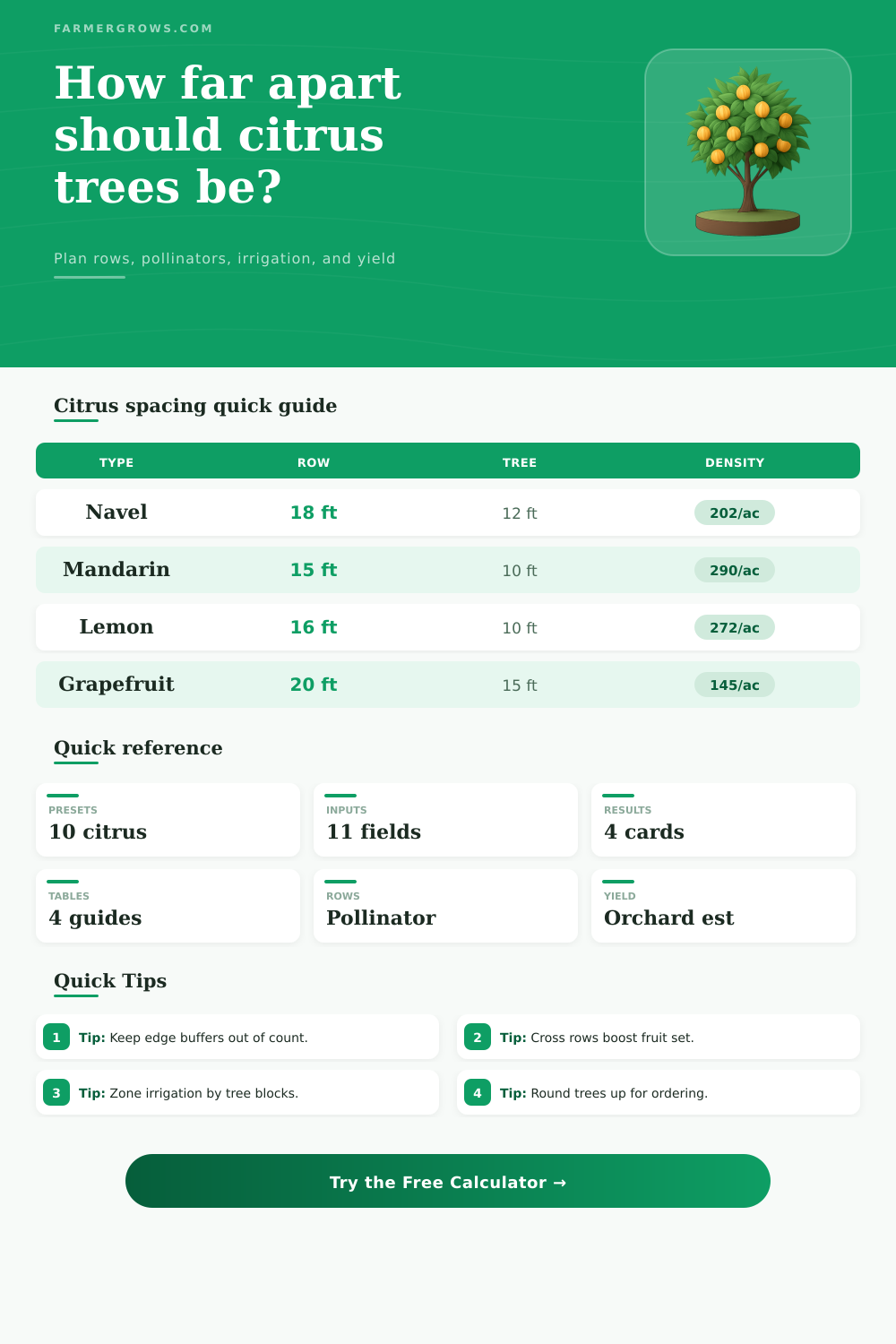
| Type | Row | Tree | Density |
|---|---|---|---|
| Navel | 18 ft | 12 ft | 202/ac |
| Mandarin | 15 ft | 10 ft | 290/ac |
| Lemon | 16 ft | 10 ft | 272/ac |
| Grapefruit | 20 ft | 15 ft | 145/ac |
| Mode | Every | Rows | Use |
|---|---|---|---|
| Self | 0 | 0 | No strip |
| Assist | 5 rows | 1-2 | Light mix |
| Cross | 4 rows | 2-3 | Strong set |
| Cross | 6 rows | 1-2 | Wide block |
| Zone | Trees | Emitters | Notes |
|---|---|---|---|
| Small | 24 | 48 | Quick valve |
| Medium | 48 | 96 | Core block |
| Large | 72 | 144 | Long run |
| Wide | 96 | 192 | Big zone |
| Spacing | Density | Yield | Use |
|---|---|---|---|
| Tight | 280/ac | Low | Early fruit |
| Balanced | 220/ac | Mid | Main block |
| Wide | 170/ac | High | Large trees |
| Open | 140/ac | Very high | Big canopy |
💡Planning tips
Measure from trunk center to trunk center, not canopy edge.
Keep each valve zone compact for simpler pressure balance.
When you plant an orchard, you must make a decision about the spacing between each of the trees that you will plant. The spacing of the trees will determine the health of the orchard that you eventually form with your planted trees. If you plant your trees too closely to one another, the branches of the trees may interfere with one another in that they may block sunlight from reaching some of the inner portions of the trees.
The lack of sunlight that reaches those portions of the trees can lead to the trees producing less fruit with those portions of the trees, as well as possibly leading to the trees becoming more susceptible to pest that may develop on those portions of the trees. However, if the trees is planted too far from one another, then you will waste both your land and your irrigation tubing. You want to find a balance in the orchard that provides enough space for each of the trees to grow while maximizing the amount of fruit that each acre of your orchard can produce.
How to Space Trees and Plan an Orchard
The nursery should not base the spacing of the trees upon the size of the saplings that you purchase. Sapling sizes are smaller than those of mature trees. Furthermore, you must also consider the canopy vigor of the trees that you plan to grow.
Those trees with high amounts of canopy vigor will grow their branches outwards in a manner that requires more space than trees with lower amounts of canopy vigor. Furthermore, if the trees with high amounts of canopy vigor have their branches in contact with the branches of other trees within the orchard, those two trees will compete for the same amount of light and air to performphotosynthesis and perform respiration, respectively. Thus, there may be a decrease in the amount of fruit that grow on the lower branches of these two trees.
In addition to the distance between the trees in your orchard, there are other factor to consider in planning the orchard itself. For instance, you must ensure that the distance between the rows of trees for your orchard is wide enough to account for the size of your tractor and mower, as well as for the movement of the crates of harvested fruit. Additionally, an edge buffer between the trees and the boundary of your orchard will provide the necessary space for your maintenance workers and machinery to efficiently maintain your orchard.
An additional factor to consider is that some of the citrus varieties that you may choose to grow are self-fertile, meaning that each tree will produce fruit without any assistance from other citrus trees. However, many of the other citrus varieties will require another citrus tree to aid in the production of the trees’ fruits. In these instances, you can plant dedicated rows of pollinator trees every few rows of your main crop orchard.
The specific frequency with which you should plant these rows will be dependent upon the amount of assistance that the citrus variety require to perform pollination. Planting these pollinator rows will ensure that each tree in your orchard will be able to produce its fruits, though at the expense of some of the land that can be used to produce the citrus fruits of your main crop orchard. Irrigation of the orchard is another important consideration in planning your orchard.
If you run a single long irrigation pipe to your orchard, the water pressure will decrease along the length of that orchard. Thus, you can divide your orchard into irrigation zones of a certain number of trees. With this method, each tree within a zone will be supplied with the same amount of water.
However, if you place too many emitters of water within an irrigation line, the trees at the beginning of the orchard will be watered beyond the amount required of those trees, but the trees at the end of that orchard will not receive enough water to optimally grow its crops. An orchard calculator will aid in your planning efforts. Such a calculator will calculate the density of the trees that you will establish within your orchard, as well as the amount of fruit that each acre of orchard will produce.
The calculator will provide you with the number of trees that you must order for your orchard. Furthermore, if you plan your orchard to have a higher degree of tree density than others, you will find that the amount of fruit that each individual tree can produce increase. Many orchard growers attempt to plant their orchards at high degrees of density.
Many growers believe that if there are more trees in the orchard, those orchards will produce more fruits. However, there is a limit to how many trees can be planted into the land that you own to cultivate these fruits. If the trees in the orchard are too closely planted to one another, the trees will compete for nutrients from the soil and the water that the trees require to perform photosynthesis and respiration.
Thus, each tree will produce less fruit than if they were individually planted. Furthermore, different varieties of citrus trees require different amount of space to grow their branches. For instance, Grapefruit trees are larger than mandarin trees, so Grapefruit trees will require more space within the orchard to ensure that their branches do not touch the branches of other trees.
Finally, it is also necessary to account for the maturity rate of each of the trees. Not all of the trees will mature at the same time; some will produce fruits at a faster rate than others. Thus, when planning the orchard, you should base your expected yield upon the percentage of trees that will mature and produce their fruits.
The planning of the orchard is the most important part of starting to establish an orchard; you cannot move any of the trees once they are established within the orchard. Furthermore, by planning for factors like canopy vigor, pollination, and irrigation, you can ensure that each tree within your orchard has the space to reach its full potential.