
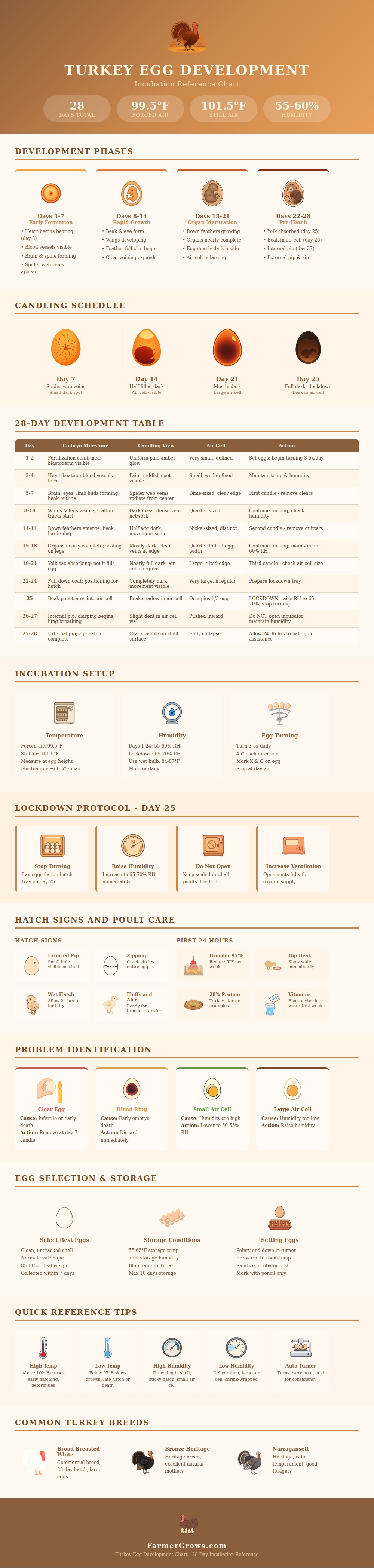
Raising turkey egg requires an understanding of the developmental stage of the turkey embryo within the eggs. A development chart is helpful to those attempting to raise turkey eggs from the number of days the embryo develops. Such a chart will show the invisible processes occurring within the eggs.
The entire process of raising turkey eggs from the time the incubator place the eggs in takes twenty-eight days. During these twenty-eight days, turkey embryos requires specific ranges of temperature, humidity, and the eggs are required to be turned within. Many individuals fail at attempting to raise turkey eggs because they are the same within each of the twenty-eight days, but the requirement change based off the growth of the turkey embryo.
How Turkey Eggs Grow and Hatch
During the early stages of development, the turkey embryo is creating it’s organs, feathers, and physical strength. The heart of the embryo begins to beat, blood vessel develop within the embryo, and the embryo can be seen as clear within the egg when candling. However, the incubator must maintain the temperature, as well as the turning of the eggs to prevent the embryo from adhering to the shell within which it develop.
Any mistakes during this period may lead to weak or poorly develop turkey poults. During the second week of development, the turkey embryo begins to develop its eye, its beak, its limbs, and its feather tracts. These features are visible when candling the eggs, which appear more darker due to the presence of the embryo within the eggs.
At this stage, you can separate viable eggs from non-viable eggs. Non-viable eggs should be removed from incubation because the presence of bacteria within the dead turkey poult can affect the live poults within proximity to those dead eggs. During the third week of development, the embryo complete its growing phase.
Down feathers have developed on the poults, the air cell within the egg has begun to expand, and the embryo has reached it’s full size. The incubator must maintain the humidity within a proper range for the membranes within the egg to not become too tough for the poult to break through its shell. Many people make the mistake of introducing humidity level to the incubator too early in the incubation process for the turkey eggs; however, the humidity should only be adjusted later in the incubation process.
Around day twenty-five of incubation, the incubator is to be adjusted once again. During this portion of incubation, the eggs are to stop being turned, the incubator is to increase the humidity, and the eggs are to remain within. At this time, the poult is beginning to develop the mechanism necessary to hatch from its shell.
The poult requires moisture to develop its membranes necessary to exit the shell. However, if you open the incubator at this stage, the humidity within the incubator will drop, which could lead to the membranes of the turkey poult to tighten within the shell prior to the poult beginning to “zip” its shell around itself. At the time when the turkey poult begins to hatch from its shell, a few step occur.
The poult makes an internal incision into the air cell within the egg, the poult begins to breathe the air within the egg, and the poult zips its shell around itself. Some poults may take a few hours to hatch from their shell, while others may take a full day to finish hatching. During this period, no attempt should of be made to assist the poults in hatching from their shells; most poults have the ability to complete hatching without assistance.
Once the poult emerges from its shell, and is dry and fluffy, the poult can be moved to a brooder. The brooder should begin at ninety-five degrees, and the temperature within the brooder should drop over time as the poult begins to grow. Turkey eggs are much larger than chicken eggs, and the turkey poults requires more care during their first week of life.
During this time, the poult requires feed with high level of protein, as well as electrolytes within its water. After the poult has hatched, it should have access to warmth, water, and feed. Following the development stages of a turkey’s egg, an individual is able to anticipate the needs of the embryo within the egg.
By understanding these development stage, an individual becomes aware of the way in which the temperature, humidity, and turning of the eggs should be managed to ensure that the turkey embryo develops and hatches successfuly.