Tractor Torque Calculator
Estimate engine, PTO, wheel, and drawbar torque from tractor specs, gear reduction, and tire radius.
The calculator converts all metric entries to imperial internally, then shows dual-unit results for torque and pull.
🔧 Breakdown
| Engine hp | RPM | Torque lb-ft | Torque Nm |
|---|---|---|---|
| 25 | 2600 | 50.5 | 68.5 |
| 45 | 2400 | 98.4 | 133.4 |
| 95 | 2100 | 237.5 | 322.1 |
| 160 | 2000 | 420.2 | 569.8 |
| PTO type | RPM | Best use | Torque cue |
|---|---|---|---|
| 540 std | 540 | Small tools | Higher gear |
| 1000 std | 1000 | Heavy tools | Lower speed |
| Ground drive | Varies | Seeders | Speed linked |
| Live PTO | Match spec | Balers | Stable output |
| Wheel torque | Radius | Pull lb | Pull kN |
|---|---|---|---|
| 900 lb-ft | 15 in | 720 | 3.2 |
| 1200 lb-ft | 18 in | 800 | 3.6 |
| 1800 lb-ft | 24 in | 900 | 4.0 |
| 2600 lb-ft | 30 in | 1040 | 4.6 |
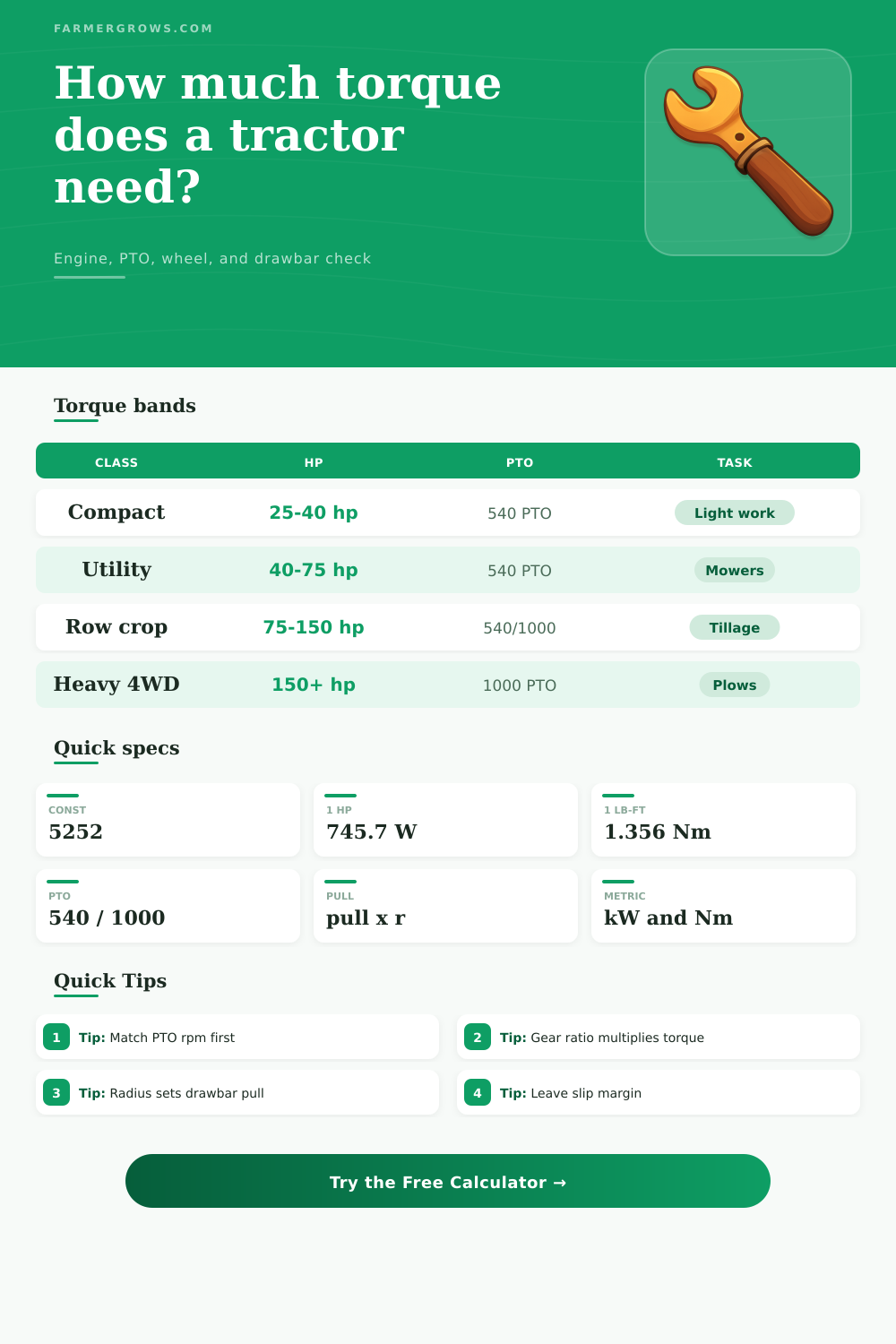
| Tractor class | Engine hp | Common job | Torque note |
|---|---|---|---|
| Compact | 20-40 | Mowing | Quick PTO spin |
| Utility | 40-75 | Loader work | Good midrange pull |
| Row crop | 75-150 | Tillage | Higher gear spread |
| 4WD | 150+ | Heavy draft | High axle torque |
Torque is the rotational force that a tractor engine creates. The torque of a tractor is the force that allow the tractor to pull an implement through the soil. While horsepower is a measurement of the rate at which the tractor performs work, the torque of that tractor is a measurement of the actual force that is provide to the tractor’s drive train.
Therefore, a tractor that has a high horsepower rating but low torque may not have enough rotational force to pull a heavy implement through heavy soil. Thus, it is necessary for a person to understand the concept of torque to determine if a tractor will be able to perform a specific task without stall. The torque of a tractor engine travels from the engine to the implement that the tractor is performing.
What Tractor Torque Is and Why It Matters
In this instance, the torque travels from the engine’s crankshaft to the transmission and axles of the tractor. The transmission contains a set of gear ratio that allows for the multiplication of the torque that the tractor’s engine creates. Each gear ratio within the transmission increase the amount of torque that is provided to the tractor’s axles.
For instance, if the gear ratio within the tractor’s transmission is 3:1, the tractor’s transmission will multiply the engine’s torque by three times. Furthermore, there are additional gear ratios within the axles of the tractor that will multiply the torque once more. The final amount of torque that the axles multiply is the drawbar pull that move the implement.
However, because some of the components of the tractor’s drive train create friction, there will be losses within the drive train. Thus, the amount of torque that the engine creates will be more than the amount of torque that is transmitted to the tractor’s axles. The torque of an engine is related to the horsepower of that engine and the revolutions per minute (RPM) of that engine.
An engine’s horsepower is equal to the amount of torque that the engine create multiplied by the engine’s RPM, divided by a constant. Thus, a driver must ensure that the engine’s RPM is set to the correct RPM to allow the tractor to perform its task efficienty. For instance, a driver may use a power take-off (PTO) to allow another implement to be performed by the tractor.
Each implement that is connected to the PTO have a specific RPM at which it should be performing its tasks. For instance, some implements may require an RPM of 540 or 1000 RPM. Therefore, if a person attempts to connect a 540 RPM implement to a 1000 RPM PTO shaft, the implement will not perform correct to the tasks that are required of it.
Tire size and tire weight also play a role in the way in which the torque of the tractor is utilized to pull the implement. If the radius of the tires is larger, less torque is utilized to move the tractor. However, if the radius of the tires is smaller, more draft force is applied to the ground.
Additionally, the person can add ballast to the tractor to increase its traction. By increasing the weight of the tractor, the tractor will be able to more effective utilize its available torque without the tires slipping in the soil. Slip occurs when the tires of the tractor spin in the soil without allowing the tractor to move forward on the ground.
Slip typically occurs at a rate of 10 to 15 percent when the tractor is moving under heavy loads. Thus, by increasing the weight of the tractor, the traction of the tractor is increased. Increased traction allows for the torque generated by the tractor to be effectively utilized in performing its task.
Tractors are also constructed in different classes to provide the necessary torque to perform different tasks. Compact tractors tend to have lower torque ratings and are used for tasks that require less torque to perform, such as mow. Utility tractors have a medium level of torque and are typically used for tasks that involve using a loader.
Finally, large row crop tractors and four wheel drive tractors have very high levels of torque, which are necessary to till the soil deep or to perform heavy plowing tasks. If a person attempts to utilize a tractor with limited torque to perform a heavy task, the engine will struggle to provide the amount of torque necessary for that implement. Matching the tractor to the implement is necessary to efficiently utilize the tractor.
If the tractor is incorrectly matched to the implement, that tractor will consume more fuel to accomplish the same task, the tractor will experience more wear and tear from the work, and the engine will struggle to maintain even RPMs. Thus, if the torque of the tractor is ensured to be able to meet the demand of the implement, the tractor will perform its task more efficient. Finally, the tractor should be regularly checked for any mechanical issue that may occur during the work.
Issues like worn tractor bearings or dry tractor joints will lead to the tractor losing some of it created torque to the implement.