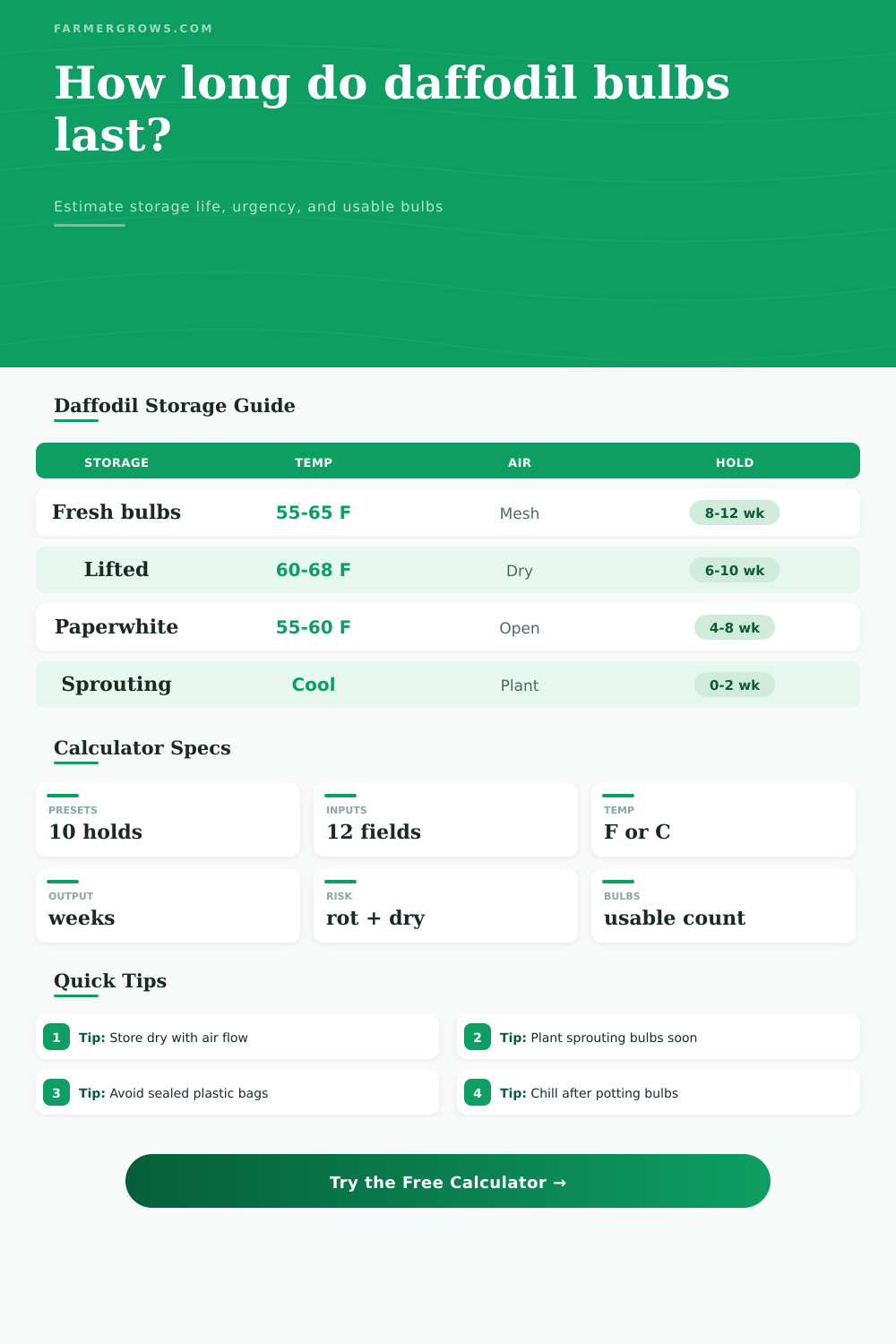
Daffodil Bulb Shelf Life Calculator
Estimate how many weeks daffodil bulbs can stay out of the ground from bulb condition, storage temperature, humidity, air flow, sprouting, and your planting or forcing deadline.
Choose a real holding situation, then adjust the storage room, package, bulb quality, and weeks until planting or potting.
Daffodil Bulb Storage Estimate
Storage estimate will appear here.
Firm bulbs in mesh at 55 to 65 F can usually wait several weeks while beds are prepared.
Let skins dry in shade, remove soil, then store in a shallow ventilated layer until replanting.
Visible shoots or roots mean dry storage is nearly over; plant or pot before growth dehydrates.
Temperatures above 70 F plus damp air quickly raise basal rot and mold pressure.
| Storage temperature | Dry bulb effect | Calculator factor | Best use |
|---|---|---|---|
| 55 to 65 F | Ideal cool-room holding range for firm dormant bulbs | 100% | Fresh fall bulbs before outdoor planting |
| 66 to 68 F | Still usable if humidity is low and air flow is good | 92% | Short waits and retail storage rooms |
| 45 to 54 F | Cool enough to slow decline, but avoid damp condensation | 86% | Garage or basement hold in breathable packaging |
| 35 to 44 F | Cold storage begins to act like chill; dry bulbs can dehydrate | 68% | Only short holds unless bulbs are potted for forcing |
| 69 to 75 F | Warm storage shortens shelf life and favors rot organisms | 58% | Move bulbs to a cooler place soon |
| Above 75 F | High stress, faster moisture loss, and higher basal rot risk | 32% | Plant or pot promptly after inspection |
| Starting condition | Base shelf life | What to inspect | Action threshold |
|---|---|---|---|
| Fresh firm retail bulbs | About 12 weeks | Firm neck, dry tunic, no sour smell | Plant when soil is cool in fall |
| Lifted, cured, firm garden bulbs | About 10 weeks | Dry basal plate, intact skins, no wet wounds | Replant after summer curing and sorting |
| Divided offsets with dry skins | About 8 weeks | Small bulbs dry faster than top-size bulbs | Plant offsets before they shrivel |
| Slightly dry or light weight bulbs | About 5 weeks | Wrinkling, hollow feel, loose outer scales | Plant soon and water after planting |
| Late-season bargain bag | About 4 weeks | Mixed sizes, broken tunics, hidden soft bulbs | Sort hard, discard soft, plant quickly |
| Soft, moldy, or sprouting bulbs | Zero to 2 weeks | Soft basal plate, blue-gray mold, long shoots | Use only firm bulbs immediately |
| Package method | Air movement | Moisture behavior | Shelf life note |
|---|---|---|---|
| Mesh bag or open crate | Excellent | Lets skins dry evenly | Best choice for dormant daffodil storage |
| Paper bag, loosely folded | Good | Buffers light moisture swings | Useful for small labeled lots |
| Cardboard shallow layer | Moderate | Can absorb dampness from humid rooms | Keep bulbs one layer deep if possible |
| Dry peat or vermiculite | Moderate | Protects lifted bulbs from rapid drying | Use dry medium, not moist potting mix |
| Perforated plastic bag | Poor | Condensation pockets can form | Short term only with frequent checks |
| Sealed plastic or closed bin | Very poor | Traps moisture and ethylene | Highest rot risk; open and sort promptly |
| Planting or forcing goal | Timing target | Storage interpretation | Calculator warning |
|---|---|---|---|
| Outdoor fall planting | Plant after soil cools before hard freeze | Dry storage is temporary, not winter storage | Warns when planned wait exceeds safe hold |
| Emergency late planting | Plant if soil can still be worked | Firm bulbs usually perform better planted than stored too long | Urgent if shelf life is under two weeks |
| Indoor forcing, hardy daffodils | Pot first, then chill 12 to 13 weeks | Dry shelf storage does not replace moist chilling | Flags roots or sprouts as pot-now signs |
| Paperwhite narcissus | Force indoors without long cold treatment | Store cool, dry, and start batches every few weeks | Shortens hold in warm rooms |
| Dividing garden clumps | Lift after foliage yellows and cure in shade | Replant once sorted, especially small offsets | Counts weeks from lifting or purchase |
Dry and ventilated beats sealed and tidy. Daffodil bulbs are living storage organs. Keep them in mesh, paper, or shallow trays where air can move, and remove any soft bulbs before one bad bulb spreads rot.
Do not confuse dry holding with forcing chill. Hardy daffodils for indoor forcing should be potted and then chilled at cold, moist rooting temperatures for about 12 to 13 weeks before warmth and light.
It’s october, and then the panic sets in. Yes, the bulbs were purchased back in August, when stock was fresh at garden centers, and all was well. The bulbs rested in their boxes on the kitchen counter (or maybe in the garage) while the bed were still filled with fading summertime perennials. Finally you need to get them in the ground before the frost comes.
But is that heap of seemingly inert clumps even worth forcing, or has it rotted? Before you force or plant, this daffodil bulb shelf life calculator shows how long they can be stored safly without losing quality. It also calculates the chance of them rotting and tells you when to get them planted.
How to Store Daffodil Bulbs Correctly
No more guessing: Do you have a garden or just a bunch of desiccated onions? NO, daffodils aren’t immortal: Even these remarkably tough guys have their limits. And no, bulbs were never meant to sit in storage for months, but rather to weather the winter as living thing meant to last until then. It’s basic biology.
All the energy for next year’s flower is stored in those fleshy scales of the bulb itself. When in storage, it is still breathing even if slowly, expending that energy. That process can be accelerated by heat, and also humidity (promoting rot) or dryness (promoting shriveling).
The calculator above does the math for you, translating environmental variables into an easy-to-grasp timeline of viability. Save yourself the guesswork with coefficients and conversions; just plug in your storage conditions. The one variable is temperature.
When fresh from the retailer, bulbs are packed cool and rushed off as fast as possible. The moment they reach your cozy home, however, all bets is off; the clock accelerates. To compensate, the tool adjusts the base shelf life based on whether you are storing at a sweltering seventy-five or a crisp fifty-five.
The impact is significant. To us humans, maybe it doesn’t seem like much (a couple of degrees)… But to a bulb, it’s the difference between a sprint and a slow burn. If you keep them in a heated garage, for instance, the kind most people call their “storage space”, chances are the math will show that your opportunity has already passed. And that’s where people mess up. Because the bulbs still look okay on the outside, they think they have all the time in the world.
All the action take place inside, long before any brown patches appear on the outer skin. The air-flow/humidity deal: Yes, you want to keep those bulbs dry, but not wet; yes, you want them firm. Daffodil bulbs are happiest in a mesh bag (they hold in the bulbs but allow moisture to escape). A sealed plastic bag? A death sentence. That traps condensation as well as ethylene gas, a perfect storm for what’s called basal rot.
This tradeoff is spelled-out clearly in the tool’s humidity/temperature/ethylene charts; the so-called reference tables. Even with slightly higher temperatures, a well-ventilated paper bag will beat a sealed bin. It’s cheap insurance: air movement. No one bulb can infect all the others if it gets soft and moldy.
The last line of defense is to inspect. Don’t put bulbs into storage and forget about them. Examine them. Any that has gone soft, show signs of blue mold, or emit a sour odor must be discarded at once. Enter your number of damaged bulbs on the calculator, which will adjust the total usable count. For big orders, this is key. Even a small percentage of rot can multiply fast when all are confined in a single place. And by the time the entire bag reeks, it’s usually already too late to salvage the rest.
There is also a difference between forcing bulbs indoors and holding bulbs while waiting to plant them outdoors. Hardy daffodils will want a prolonged period of cold once potted up before forcing them into bloom. A dry storage doesn’t provide that chill. With forcing of either hardy kinds, or paperwhites specifically, the tool can help you realize when the dry-on-the-shelf life is nearing the point of actual growth, which isn’t far off.
Bulbs with sprouts are already in a hurry, using up the reserves in their bulbs to grow green shoots. Those shoots will dry out if not carefully tended…game over.
The bottom line: Get solid bulbs in the ground before freezing weather comes. That’s what the urgency rating is for. As you will see, it also includes a quality score. Does it say “get the trowel out today” or “you’ve got weeks to spare?” If it says the former, there’s still time; if it says the latter, time to get the trowel out.
And then there are the gentle-storage conditions of course, a high score meaning you treated the bulbs well. A low score means they went through something stressful on their way to you, which might lead to smaller flowers in the spring.
No need to be a botanist to save your bulbs: Just remember to respect their biology. Keep ’em cool, keep ’em dry, and plant ’em before they burn through their own fuel. Spring rewards the autumn vigilance.