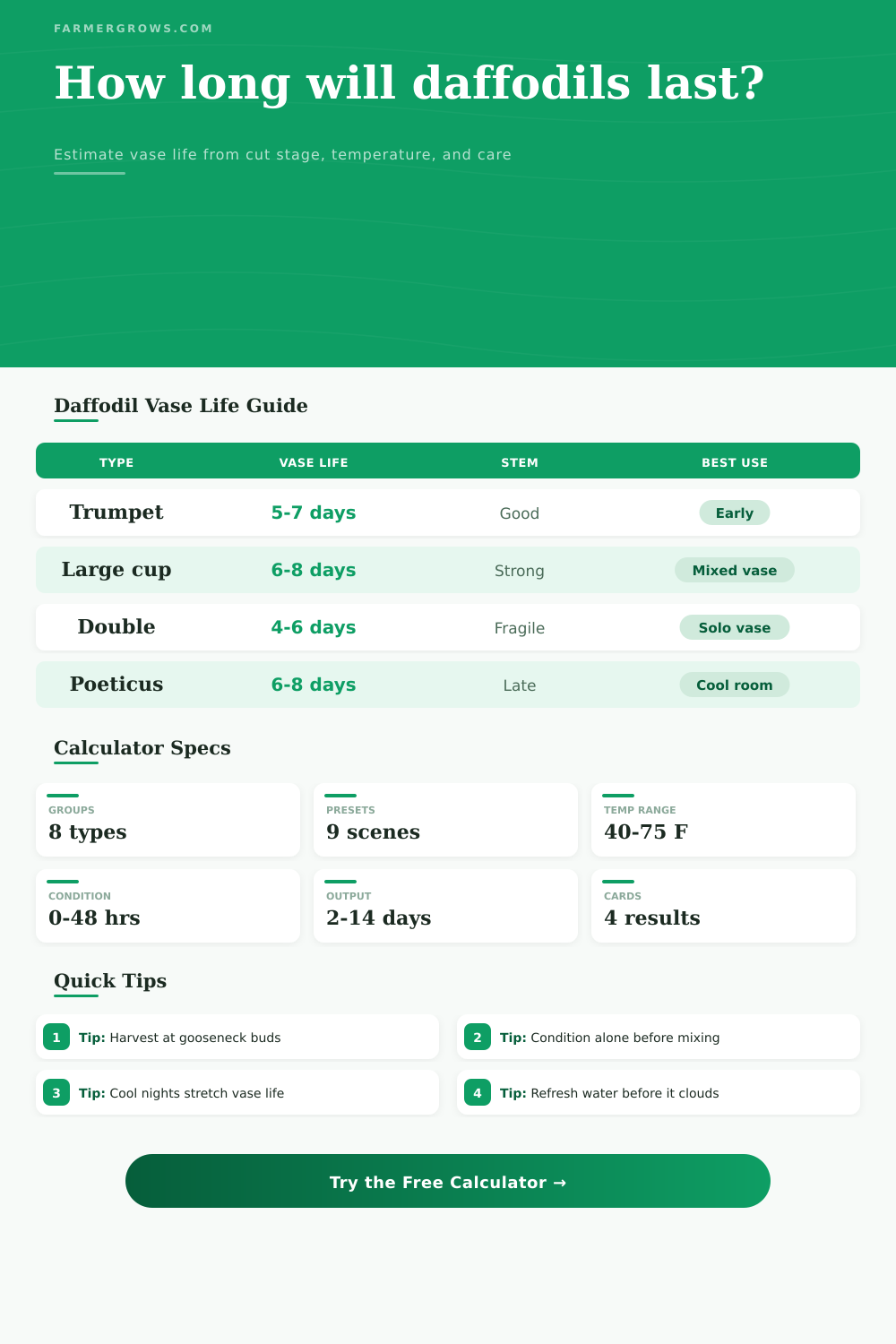
Daffodil Flower Vase Life Calculator
Estimate how many display days your cut daffodils have left from cultivar group, bud stage, harvest age, separate conditioning, water care, temperature, and mixed-bouquet risk.
Start with a real daffodil harvest or display situation, then tune the handling details to match the stems on your bench, market bucket, or kitchen vase.
Daffodil Vase Life Estimate
Your daffodil estimate will appear here.
Longest remaining display, lowest mixing risk, and clearer water in multi-day home or market vases.
Works well for daffodils alone, especially when water is refreshed before it turns cloudy.
Heat and sun speed opening, petal aging, pollen shed, and leaf yellowing.
Fresh daffodil mucilage can injure sensitive companion flowers before the stems are conditioned.
| Daffodil group | Typical vase life | Best cut stage | Handling note |
|---|---|---|---|
| Trumpet daffodil | 5 to 7 days | Colored bud to gooseneck | Strong early stems; avoid hot display shelves. |
| Large-cupped daffodil | 6 to 8 days | Gooseneck colored bud | Good bunching group for market buckets and home vases. |
| Small-cupped daffodil | 6 to 8 days | Colored bud to half-open | Usually durable when harvested before full opening. |
| Double daffodil | 4 to 6 days | Half-open bloom | Extra petals hold water and bruise, so keep them upright and cool. |
| Jonquilla and fragrant clusters | 5 to 7 days | First florets showing color | Several florets open over time; remove spent blooms cleanly. |
| Tazetta or paperwhite | 6 to 8 days | First flowers cracking open | Often grown indoors; avoid very warm rooms after opening. |
| Poeticus daffodil | 6 to 8 days | Colored bud to gooseneck | Late season type that benefits strongly from cool nights. |
| Miniature daffodil | 5 to 7 days | Colored bud | Shorter stems need stable shallow vessels and clean water. |
| Cut stage | Opening reliability | Life effect | Best use |
|---|---|---|---|
| Colored tight bud | Moderate to high | Can last well but may open slowly indoors | Shipping, gifting, and delayed display |
| Gooseneck colored bud | High | Best balance of open reliability and vase days | Farmstand bunches and home cutting |
| Half-open bloom | Very high | Good immediate show with moderate remaining life | Same-day arrangements and double daffodils |
| Fully open bloom | Already open | Shorter remaining life after harvest | Short events or table jars |
| Open with soft petals | Declining | Usually only a brief display period left | Enjoy at once, do not store |
| Condition | Recommended range | Calculator effect | Why it matters |
|---|---|---|---|
| Cold holding | 34 to 40°F / 1 to 4°C | Slows opening while preserving freshness | Low temperature reduces respiration and water loss. |
| Cool display | 55 to 62°F / 13 to 17°C | Adds display days compared with warm rooms | Cool rooms delay petal aging and wilting. |
| Normal room | 63 to 68°F / 17 to 20°C | Baseline for home vase life | Good compromise between opening and longevity. |
| Warm display | 70°F+ / 21°C+ | Shortens remaining display time | Heat, sun, and vents accelerate senescence. |
| Mixed bouquet step | Minimum target | Risk level | Practical note |
|---|---|---|---|
| Daffodils alone | No waiting needed | Low | Clean water is usually enough for a solo daffodil vase. |
| Condition before mixing | 12 to 24 hours | Low to moderate | Hold daffodils separately, then do not recut into the mixed vase. |
| Mix with tulips or iris | 24 hours preferred | Moderate | Sensitive companions show injury fastest when sap is fresh. |
| Mix immediately after cutting | Not recommended | High | Fresh mucilage can block stems or damage companion flowers. |
Condition daffodils separately before mixed bouquets. Place freshly cut stems in their own clean water for at least 12 to 24 hours, then move them gently without making a fresh cut into the shared vase.
Use cool nights to slow the clock. Moving daffodils to a cool, frost-free room overnight can preserve petals, especially after the flowers are fully open.
Something happens to daffodils that you’ll notice one particular day, though not all at once. First, their necks begins to go slightly limp, as if they suddeny have a touch of arthritis. Then, the petals no longer trumpet in bright yellow, but merely hang there, looking washed-out and worn out. That’s just part of what’s called senescence (natural aging) here. And narcissus farewells come on sooner then nearly any other spring-flowering thing. If only I should of knew just how many days ahead the slump would set in! It is the difference between a bucket of tired-looking stem to throw away and a sparkling centerpiece.
That’s where my daffodil calculator comes in. It figure the math for me. It takes into account the kind of cultivar, how it was grown, and how warm it got. This creates a reasonable guess, not a hunch or wishful thinking; that is likely to be right.
How to Make Your Daffodils Last Longer
What’s the first variable? The bud stage. Why? Because most of us know we’re supposed to cut our daffodils when the buds are still green and tight, thinking that will buys them more time. Truth: Tight buds don’t always open well indoors, and what happens? You wind up with brown tips and wasted stems. The gooseneck stage, where the colored bud droops gently off the stem into its namesake shape, is sweet. The flower has committed to going open, but hasn’t spent any energy on developing petals yet. Have you cut ones that are fully open already? Your window gets way smaller. To adjust for that, the tool includes that, too, basing the baseline life expectancy based off how far along the bloom was.
One surprising variable that home gardeners tend to neglect is temperature. A flower placed in a cozy spot next to the window on a warm kitchen counter may hang on for four days; the same one placed in a chilly hall can extends to eight. It’s not simply that it’s comfortable in there for the flower, but rather that metabolism is also accelerated by warmth, which causes the plant to exhaust its own stores of sugar and water at a quicker pace. Make sure to enter your room temperature to get an accurate calculation, as final number will include it.
The two silent killers of vase life are water quality and vase hygiene. As daffodils heals their cut stems, they ooze out a sticky sap called mucilage. It is loaded with bacteria that clog the flower’s vascular system and rapidly cloud the water. Cloudy water means the stem cannot drink, and an overfull vase won’t matter because the flower will wilt from dehydration anyway. By changing the water regularly (daily) and starting off with a clean vase, you remove the bacterial barrier. Your vase cleanliness and water change frequency are included in the calculator, which penalizes neglectful care habit that directly reduce the display time.
The notorious rumor is half-true: daffodils can kill other flowers if they are mixed in immediately without conditioning. Well, sort of. When cut and placed directly into water, those same blockers in the sap will prevents water uptake in sensitive companions (such as tulips or roses). To avoid this problem, all you have to do is condition them. By leaving daffodils in their own water for 24 hours, the sap clears and they can then be mixed with most other flowers without any issues. If you’re mixing a bouquet with fresh cuts and some sensitive varieties, the included risk assessment tool even warn you about it.
Knowing this stuff makes flower care less guessing and more strategic: Knowing your flowers will keep twice as long in clean water in a cool room means you don’t order an extra bunch; knowing they will be floppy in two days spares you all the heartbreak of having arranged them. The daffodil pages offer baseline data on different groups (from super-tough trumpets to delicate doubles) to quickly look up what to expect (a sort of reference table). The point is: Match your care regimen to the plant’s biology.
If you’re a daffodil lover, yes, they are tough (but not on their hydration requirements). Make those last longer by thinking of it less as “a container holding my stems” and more as “a living system I’m supporting.” Let the calculator take all the fancy calculations about the stage and temperature to give you a realistic estimate of how long they’ll last. Then it tells you exactly how long it will last, which lets you know when to expect some slight drooping… And plan for it accordingly.
It is not a small thing, except that it is one, and it matters. Most of the sleight-of-hand is knowing what you’re measuring; once you get that, the yellows lasts as long as intended.