
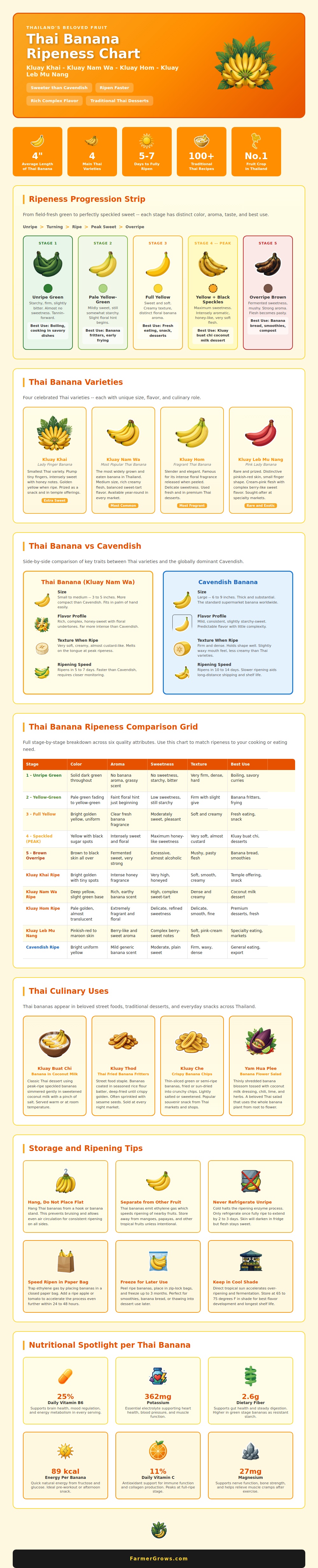
In your mind’s eye, you’re buying Thai bananas that will be dessert, but before you get around to cooking them up, they’ve turned to mush. And you know what? It is rarely anyone’s fault; even if you have talent, it comes down to patience. It’s timing. Whereas the bananas we see at our local Western supermarket are mild-flavored Cavendishes, those found in Thailand (such as the Hom or Lady Finger) has a brief window of perfection. Their window of being something other than an overripe sludge is shorter: They’re sweeter, they’re riper, and you’d better watch out because they’ll be ready at just the right instant.
In Thailand, this quick change of state are divided into five steps, which form basis of the visual guide. Those green, hard-as-a-rock bananas you get when they’re delivered is not snack-worthy. But they’re perfect for boiling or frying with other ingredients in savory curries, thanks to that hardness. If you put a ripe banana in the sauce, it would of fall apart.
How to Pick Perfect Thai Bananas
Then something happens inside: the chemical composition changes, starch turns into sugar, and the flesh becomes pliable, soft enough to dip into batter without coming undone. Fritters at the night markets is all about texture, so this stage (pale yellow-green on the outside) is best moment to make them.
But most give up after it’s completely yellow. They think that’s as good as it gets. No! They look their best with those specks of black on golden surface. That is the sign of the sweetest moment. It has a ripe aroma like honey. And yet it’s also the time when things can turn sour fast. Go to bed with ideal fruit and awake to fermented mush.
The key is to watch closely because things change quickly. Each variety reaches this point at its own pace, as shown in the chart. However, this rule applies to both Kluay Nam Wa and Kluay Khai. Failure to pay attention and you’ll miss boat.
The clock is what controls the storage strategy. Storing bananas hanging up keeps the air circulating around all sides, which allow the fruit to ripen evenly instead of patchily going soft at any one point (the way it would if the bananas were stacked). Storing them apart from other fruits that produce ethylene (avocados, for instance, or mangoes) add more time to the clock. This adds a few extra hours here and there.
To accelerate, try storing a banana in a paper bag with an apple. To slow things down, separate the banana into individual fingers. Little tricks like these buys you leverage on the clock.
Despite being a pretty dinky fruit, they’re a serious nutritional powerhouse. A single Thai banana deliver significant potassium and vitamin B6. That’s a whole lot of bang for your buck in terms of maintaining efficient muscle functioning and energy use, more than you’d think possible from such a little bite of something. They also change in their fiber composition over time: unripe (green) bananas contains resistant starch, which feeds our gut bacteria, while ripe ones has simple sugars, which can be used for instant energy. So it’s not just in the kitchen where there is a nutritional turnaround.
Green bananas put some gas in your tank; when they are ripe, they fire you up right now. The key to mastering bananas is how to read their skins like a weather report: it’s all about how usable they are. Stop thinking of food as just “good” or “bad.” Instead, understand that each stage has its place in the kitchen if we use the right tool for the job.
Don’t wait until those spots emerge, though. Peel ’em now, pour some coconut milk over them while still warm and savor the joy of being mindful. Every minute you watch for it will be repaid by that brief instant of just-right sweet goodnes.