Soybean Growing Degree Days Calculator
Estimate soybean heat units, stage timing, and maturity group fit with base 50°F GDD logic.
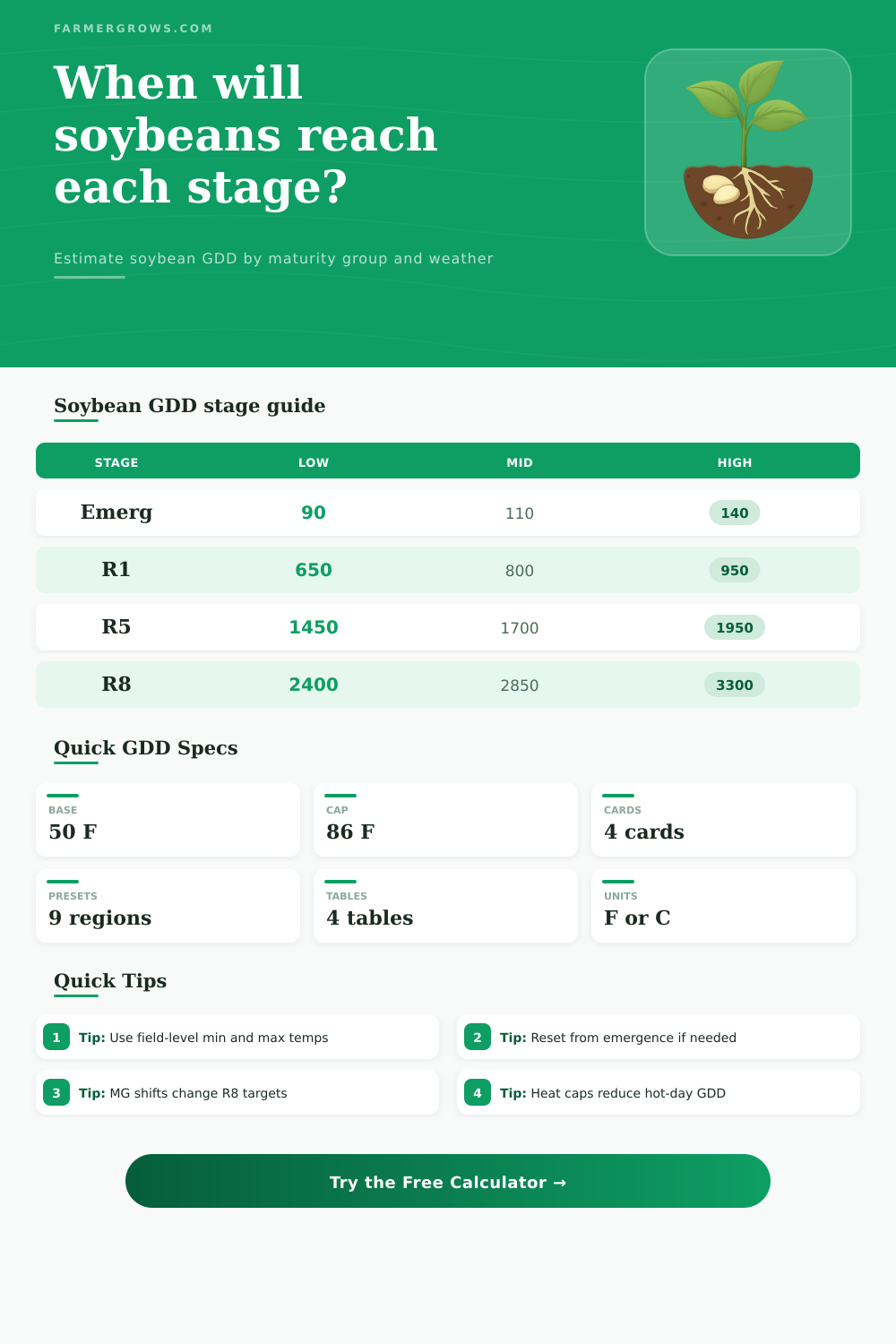
| Stage | What it means | Typical GDD from emergence | Field use |
|---|---|---|---|
| VE | Cotyledons above soil surface | 90 to 140 from planting | Stand count and crusting check |
| V2 | Second trifoliate open | 250 to 400 | Early vigor and nodulation timing |
| R1 | One open flower on main stem | 650 to 950 | Begin reproductive scouting |
| R3 | Pod 3/16 inch at upper nodes | 950 to 1300 | Fungicide and stress decisions |
| R5 | Seed 1/8 inch in upper pod | 1450 to 1950 | Seed fill protection window |
| R6 | Full green seed fills pod cavity | 1800 to 2400 | Late irrigation and disease checks |
| R7 | One mature pod color on main stem | 2150 to 2850 | Harvest planning begins |
| R8 | Most pods at mature color | 2400 to 3300 | Physiological maturity estimate |
| Maturity group | Common fit | Approximate R8 target | Planning note |
|---|---|---|---|
| MG 00 to 0 | Northern Plains, far north | 2400 to 2600 GDD | Short vegetative period, frost risk matters |
| MG 1 | Upper Midwest and Canada edge | 2550 to 2750 GDD | Often chosen for narrow fall windows |
| MG 2 | Iowa, Minnesota, Nebraska fringe | 2700 to 2950 GDD | Common full-season northern Corn Belt fit |
| MG 3 | Central Corn Belt | 2850 to 3100 GDD | Balances canopy time and fall drydown |
| MG 4 | Lower Midwest and Mid-South | 3000 to 3250 GDD | Longer reproductive window in warm areas |
| MG 5 | Delta and southern production | 3150 to 3450 GDD | Photoperiod response becomes more visible |
| MG 6 | Gulf and southern long season | 3350 to 3650 GDD | Use with local variety maturity notes |
| Method | Formula concept | Best use | Caution |
|---|---|---|---|
| Capped soybean | Average capped high and floored low, then subtract base | Most field planning because very hot days are limited | Still an estimate, not a crop model |
| Simple mean | Average daily high and low, then subtract base | Quick comparison with older notes or weather summaries | Can overstate heat on very hot days |
| Observed import | Add weather-station GDD already accumulated | Blending station records with a forecast window | Match base and cap settings first |
| Stress adjusted | Multiplies effective accumulated GDD by a field factor | Scenario comparison for drought, stand loss, or irrigation | It is a planning adjustment, not physiology proof |
Cool start
High 68°F and low 48°F often produce only about 9 capped GDD per day, so emergence and V stages stretch out.
Moderate canopy
High 82°F and low 62°F produce about 22 capped GDD per day, a common planning pace during active growth.
Hot spell
High 96°F and low 74°F produce about 30 capped GDD per day because the upper cap limits the high temperature.
| Scenario | Typical MG | Daily GDD pace | What to compare |
|---|---|---|---|
| Early northern planting | 00 to 1 | 8 to 18 | Emergence lag and first frost risk |
| Full-season Corn Belt | 2 to 4 | 18 to 28 | R1, R3, and R5 scouting windows |
| Double-crop after wheat | 3 to 5 | 24 to 32 | Days left to R7 before frost |
| Southern long season | 5 to 6 | 25 to 34 | Photoperiod delay and late disease pressure |
This calculator estimates soybean development timing for planning. Confirm crop stage in the field before making pesticide, irrigation, harvest, or insurance decisions.
Soybeans does not grow based off the calendar date. Additionally, soybeans do not continuously grow at the same rate throughout the soybean season. Two field of soybeans planted on the same date may be in different stages of development.
This is because one field might be planted in an area that experience cooler temperatures than the other field. Because temperature affects the growth of soybeans, farmers should not use the calendar date to manage the soybean field. Instead, farmers should use the Growing Degree Day calculation to monitor the development of there soybean fields.
Use Growing Degree Days to Track Soybean Growth
Growing Degree Days is a method of calculating how many days it take for soybeans to grow from a seed to a mature plant. Growing Degree Days use the biological clock of soybean plants. The biological clock of soybean plants only advance if the temperatures are above 50 degree Fahrenheit.
If the temperatures are below 50 degrees, the biological clock of soybean plants stop. Thus, soybean plants require the use of Growing Degree Days to calculate the number of days it take for soybeans to grow from a sprout to a mature soybean plant. Soybean plants have limit to the amount of heat they can use to grow.
If temperatures rise to too high of a degree, soybean plants will not grow at a faster rate. To account for this, a farmer should use an temperature cap in the Growing Degree Day calculation. Using a temperature cap will ensure that Growing Degree Days calculations does not become too high.
Additionally, using a temperature cap ensures that the Growing Degree Day calculations remains accurate to the growth of soybean plants biology. The maturity group of soybean plants is another variable that should be account for in the Growing Degree Day calculations. The maturity group of soybean plants is essentially the genetic makeup of soybean plants.
Different soybean variety have different maturity groups. For example, soybean plants from the northern region of the country will have a different maturity group then soybean plants from the southern regions of the country. Using the maturity group in the calculation account for the genetic makeup of soybean plants.
Thus, it is important to include this measurement in Growing Degree Day calculations because the length of days also impact soybean plants as much as the temperature. Another variable to consider in Growing Degree Day calculations is when to start counting the Growing Degree Days. Growing Degree Days can be start at the time of planting the soybean seed.
However, Growing Degree Days should actualy start at the time the soybean seed emerge from the ground. Growing Degree Days can be started at the time of emergence of soybean cotyledons to allow for accurate measurement of the development of soybean plants. Starting Growing Degree Days at the time of emergence will allow for the removal of the time period during which the soybean seed is sit in the ground.
Thus, starting Growing Degree Days at the time of emergence will allow for more accurate projection of the bloom and pod fill of soybean plants. The condition of the soybean field can change the way soybean plants use Growing Degree Days. For instance, soybean fields that experience drought will have different rates of development than fields with plenty of water to provide to the soybean plants.
Adjusting Growing Degree Days according to field conditions will account for the difference in growth between drought conditions and well watered fields. Thus, adjusting Growing Degree Days for field conditions will allow growers to have accurate projection of soybean development. Using Growing Degree Days calculations, soybean farmers can identify which reproductive stage the soybean plants are in.
Soybean plants go through the R1 bloom stage and the R8 full maturity stage. Additionally, soybean farmers can use Growing Degree Days to determine when to treat the soybean fields with fungicide. Growing Degree Days can also help farmers determine when to begin harvesting the soybean fields.
Finally, Growing Degree Days calculations are only a guide for farmers. The best way to determine the maturity of soybean plants is to walk into the field and scout the soybean pods for maturity. Thus, farmers should use Growing Degree Days calculations in conjunction with scouting soybean fields.
By using both Growing Degree Days calculations and scouting soybean fields for maturity, farmers will be able to manage the soybean fields according to the biological clock of the soybean plant.