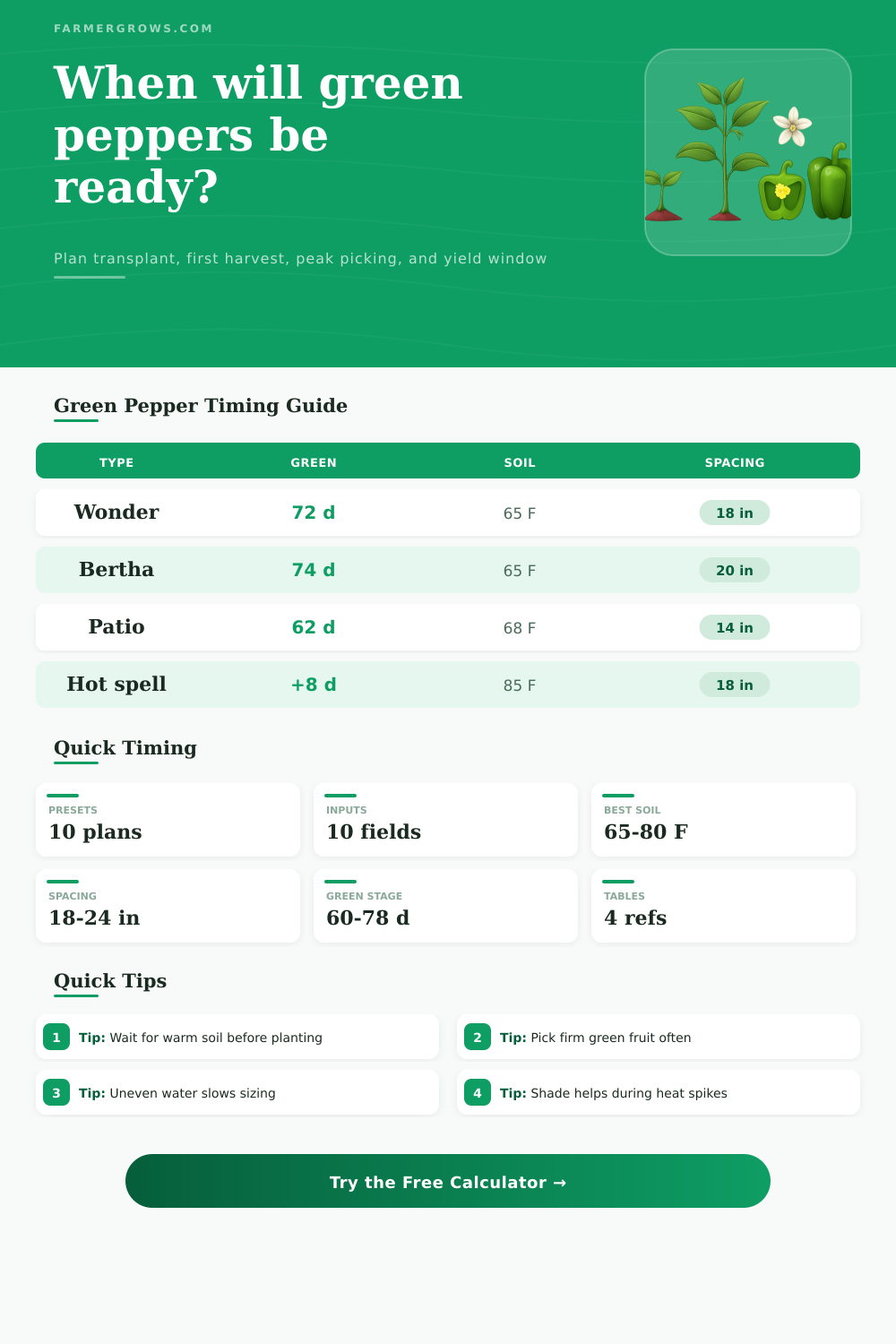
Green Pepper Growth Time Calculator
Estimate transplant readiness, first mature-green harvest, peak picking dates, and the useful yield window for sweet green peppers grown in beds, containers, patios, and greenhouses.
This planner treats green peppers as a harvest stage, not a ripe-color crop. It starts at sowing or transplanting, then adjusts days to the first firm, full-size green fruit for soil warmth, heat units, USDA zone, spacing, transplant age, frost pressure, and watering consistency.
Green Pepper Growth Results
Dates are based on green-stage maturity, not red, yellow, orange, or fully ripe color harvest.
| Green pepper variety | Typical green stage | Heat-unit target | Plant habit | Best use |
|---|---|---|---|---|
| California Wonder | 70 to 75 days from transplant | 930 to 1,020 base-55 GDD | Medium, blocky fruit | Reliable garden green harvest |
| Big Bertha | 72 to 78 days from transplant | 980 to 1,100 base-55 GDD | Tall, large elongated fruit | Large slicing peppers and staking |
| Ace / early green bell | 58 to 65 days from transplant | 760 to 880 base-55 GDD | Compact early plant | Short-season beds and cool starts |
| Lady Bell | 68 to 73 days from transplant | 900 to 1,000 base-55 GDD | Upright green bell | Uniform green peppers |
| Patio Bell | 60 to 66 days from transplant | 760 to 870 base-55 GDD | Small container plant | Patios, balcony pots, compact harvests |
| Temperature condition | Green pepper response | Timing effect | Field action |
|---|---|---|---|
| Soil below 55°F | Roots stall and transplants sit | Add 14 to 20 days | Wait, cover, or use black mulch |
| Soil 60 to 64°F | Survival is fine, growth is slow | Add 5 to 9 days | Protect from cold nights |
| Soil 65 to 80°F | Best root growth and fruit sizing | No delay | Maintain steady moisture |
| Air above 90°F often | Flowers drop and fruit set pauses | Add 5 to 12 days | Use afternoon shade and even water |
| Plant spacing | Growth effect | Green harvest impact | Use case |
|---|---|---|---|
| 10 to 12 inches | Fast canopy closure, more competition | May delay first large green fruit | Intensive beds with strong fertility |
| 15 to 18 inches | Balanced canopy and airflow | Best default for green bell timing | Home gardens and raised beds |
| 20 to 24 inches | More branching and fruit size | Often improves peak harvest duration | Large-fruited varieties |
| 14 to 16 inch containers | Root volume limits heat and water buffering | Earlier fruit, shorter window | Patio and dwarf green peppers |
| Maturity stage | What to look for | Days from transplant | Harvest note |
|---|---|---|---|
| Flowering | White blossoms on strong branches | 25 to 40 days | A cold or hot spell here changes harvest timing |
| Fruit set | Small green peppers hold behind blossoms | 35 to 50 days | Water stress can abort young fruit |
| Full-size green | Firm, glossy, thick-walled green fruit | 58 to 78 days | Pick now for green pepper yield |
| Color turn | Green fruit begins red, yellow, or orange change | 15 to 25 days after green | Leave only if ripe color is the goal |
For earlier green peppers: Transplant after nights are reliably mild and soil is warm. A frost-free calendar date still needs root-zone warmth to keep plants moving.
For a longer window: Pick full-size green fruit before color break, keep moisture steady, and avoid crowding large-fruited plants that need airflow and light.
PEPPERS: If you’re like most gardeners, you’ll have tried to get them up too soon, too-early spring transplants into chilly ground, and seen those bright-green seedlings aboveground while their underground roots fails. No, forget about the calendar; peppers want heat, not an early date. Here’s the calculator that tells you what to expect for the rest of the season using local frost dates and soil temperatures. It take the guesswork out of things. Now, you just has peace of mind and a game plan you can play out.
At the beginning of the season, there’s one key element: Soil temperature. Because peppers are a tropical plant, they does not like being planted in cool ground left over from winter that hasn’t warmed up yet. Cool soil slows down even the pepper roots growth, eventually halting it entirely. The tool accounts for this by adjusting when it thinks you’ll harvest, depending on whether the ground is already warm or has been slow to warm. Why does it matter? A late start throws off the whole season. Planting in cool soil means no crop, while starting too late indoors (waiting out the last of the heat) mean missing prime summer conditions. Get it just right, and you’re golden; get it wrong, and…well, you know the rest.
How to Know When to Plant Peppers
It’s true that timing varies greatly depending on which pepper you’re sowing: A smallish plant like a Patio Bell is not the same as one destined to grow to massive size like a Big Bertha. Each variety has its own baseline days-to-maturity; the calculator accounts for that. Generally, smaller plants bears sooner but also stop bearing earlier. Bigger ones take longer to reach maturity, requiring more growing days, but they keep right on trucking into fall with another round or two. Make sure you match length of your growing days to the plant’s growth habits.
Many growers don’t realize how much their watering schedule comes into play when timing things. Plants can’t develop fruit evenly if they’re getting inconsistent water; likewise, flower drop happen if there are any skips in the moisture. Because drought stress adds days to the countdown, the tool takes your watering schedule into account. Consistency means the plant’s metabolic processes continues to flow smoothly. It’s not enough to keep the plant alive, you want it to produce. If you’re experiencing a dry spell or unpredictable rain, know that the harvest window will take longer then under ideal conditions.
Another factor is heat units. These are the measure of the total amount of heat that has been delivered to you since transplant time. Even if you’ve had a cool spring and then a hot summer, it can all add up and catch up; maybe you’ll get a decent crop anyway. Or maybe you won’t have enough heat to finish maturing fruit if your season is consistantly mild. You will find tables listing how long various temperatures take to do things on the page.
Fifty-five or lower is when root action stop in pepper growing areas. Wait till the ground warms up before the plant starts growing actively rather than barely existing. How do you account for space? Competition and airflow are affected by how far apart things grow. Peppers in a tight row will compete for nutrients and light, slowing down their fruit set (and making them more susceptable to disease). Your expected peak yield adjust based off the spacing you put into the calculator. Giving a pepper plenty of elbowroom means it’ll have time to mature into a larger fruit, but also lengthen its harvest window. It’s a quantity versus quality balance; your garden design determines what works best.
Knowing these factors will give you confidence in reading the resulting dates: Look for more than just when to find the earliest green fruit; also look for prime picking time and the close-out date when the yield window closes toward frost. From there, you know what to freeze, make into preserves or otherwise work up into meals. No more hoping about it. You’ll know exactly how your own conditions affect things.
The best-laid plans outweigh guessing any day. Calculating for soil temperature, water habits and the specific nature of each variety means matching up your work to their needs, and avoiding the dangers of planting impulsively in cool soils. You should of been a patient gardener to reap what she sows.