
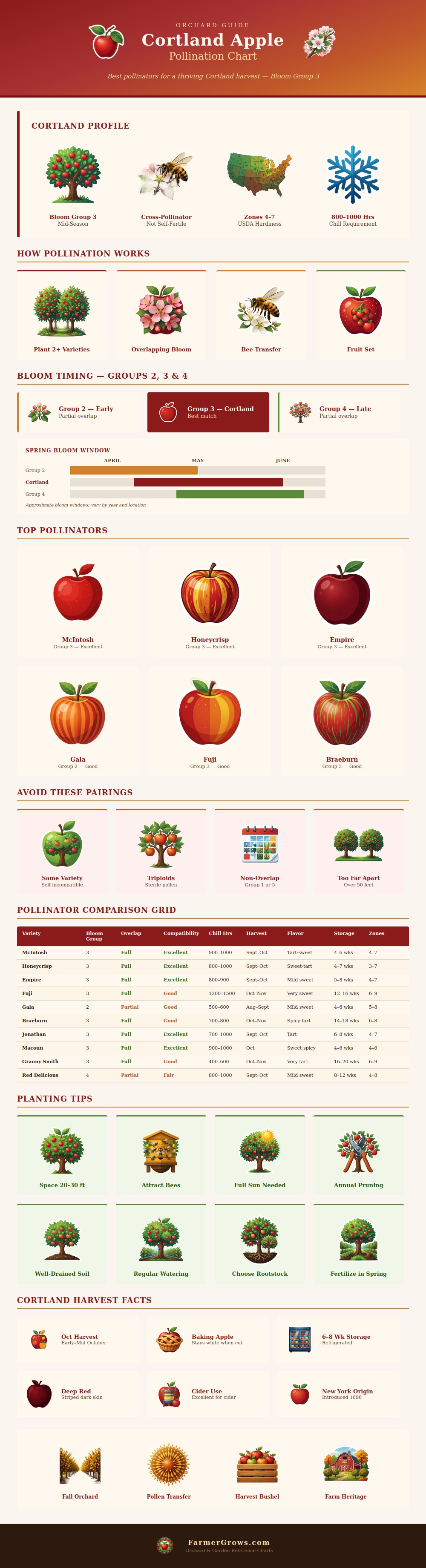
Cortland: A handsome tree, but what good is that if it doesn’t bear? Unless you know how this apple likes to be treated. Plant it, and the tree may gets sun and soil right, yet produce no crop. Why? Because apples are typically not self-fruitful; they require another nearby tree for pollinate them. One that’s in bloom just when the other one is. It’s not optional biology, but biology: Apples need a partner.
So who does Cortland work with (the answer: not itself)? The chart above tells you. One common mistake in planting trees are choosing exact same kind. Many gardeners think if one tree is an apple, another similar-looking tree will bear apples, to. Not so. Cortland is self-sterile, and cannot pollinate itself. A different variety has to be present to get things going. Otherwise, all those blooms falls to the ground after they open and there is no crop; there are just bare branches instead of fruit.
How to Grow Cortland Apples Successfully
The other half of the equation? It is all about timing. You can choose a compatible partner, but what good does that do if neither one bloom at the right time for the other? Cortland is a mid-spring variety (Bloom Group 3), as infographic shows. Some top performers such as Honeycrisp and McIntosh is also in this group, making them great partners. That means when those trees bloom simultaneously, bees coming and going between them transport pollen well. That leads to good fruit set.
Pairing Cortland instead with an earlier bloomer in Group 2, or a later one in Group 4, doesn’t work because the windows don’t exactly match up. The pollination window narrows, meaning that there may be no crop at all, or a thin one. Better to get on nature’s page rather than try to fight it by matching your planting plan to its timing.
There are some things to watch out for. For one thing, don’t select any triploids (they’re sterile and won’t contribute pollen). Also, trees farther different than 50 feet away from each other is less likely to get visited by bees who bridge the divide. Cluster your pollinators close enough for them to cover ground, since bees like to work efficiently. It’s clear in the graphic where the best overlaps are complete and where only partial- or fair-matches occur. Stick with the “Excellent” recommendations and you’ll know you’ve maximized chances without guessing.
But even more reason to honor Cortland is that it’s good to eat. Developed in 1898 in New York State specifically for scab resistance and good color after storage, it also has a white interior that doesn’t turn brown when sliced. This makes it superior for salads and pie-making, where discoloration isn’t appetizing. The one caveat: Although it may be among the longest-lasting apples, it doesn’t last as long than some other late-keepers. However, if stored chilled, it keeps its tart-sweet flavor just right for about six weeks. This gives you time to spread out your cooking into early winter instead of jamming everything into October.
Planning is everything; without thinking through how and where an apple tree will grow before you dig the hole, success won’t come easy. First: Is this a suitable place to grow an apple tree? (Hardiness zones vary.) Cortland need about 800-1,000 hours of cold temperatures to awaken properly from its sleeping state. Then: Good drainage is a must, and you should of water regularly when things are dry (but not soggy soils). Annual pruning is also key (to keep the tree’s canopy open so light penetrates), which will help reduce disease and improve fruit quality.
Spacing is important. A good pollinator is a must. Do the homework now, choose the right one from the recommended list, and space it accordingly for year-round success.