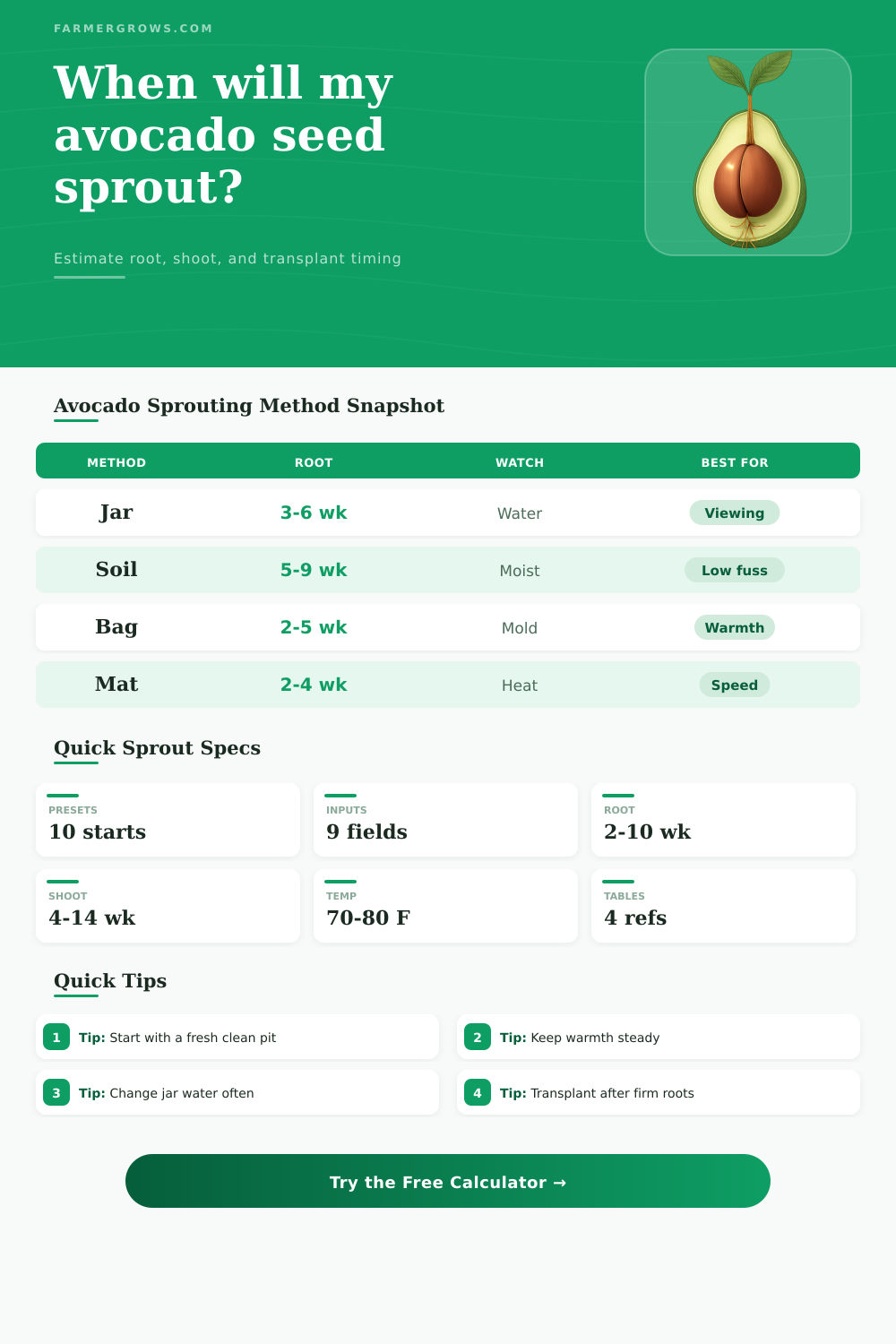
Avocado Seed Sprouting Time Calculator
Estimate when an avocado pit may crack, root, send a shoot, and become ready to pot up based on method, freshness, warmth, moisture, light, and care rhythm.
Avocado pits vary a lot by variety and storage age. Use the estimate as a care planner, then judge the pit by visible cracking, firm white roots, and steady shoot growth.
Sprouting Time Estimate
Timing combines method baseline, seed condition, warmth, moisture, care frequency, pit size, and current growth stage.
| Sprouting method | Root timing | Strength | Main risk | Best use |
|---|---|---|---|---|
| Toothpick water jar | 21 to 45 days | Root is easy to see | Stale water or full submersion | Learning and visual tracking |
| Clean cup water start | 24 to 50 days | Simple setup, easy rinsing | Tip confusion or algae | Kitchen windowsill starts |
| Damp towel bag | 16 to 35 days | Warm humidity around seed | Mold if too wet | Fast rooting checks |
| Half-buried soil pot | 35 to 65 days | Less transplant shock | Harder to inspect root | Low handling and steady care |
| Peat plug or coir cup | 30 to 58 days | Even moisture near pit | Dry plug edges | Small indoor greenhouse trays |
| Seed-zone temperature | Sprouting effect | Typical adjustment | Care note |
|---|---|---|---|
| Below 60°F / 16°C | Very slow or stalled | Add 18 to 28 days | Move away from cold glass and drafts |
| 60 to 67°F / 16 to 19°C | Slow but possible | Add 8 to 16 days | Use patience and check for rot |
| 68 to 79°F / 20 to 26°C | Best indoor range | No penalty | Keep moisture steady, not soggy |
| 80 to 85°F / 27 to 29°C | Fast if moisture is clean | Subtract 2 to 6 days | Inspect bag starts more often |
| Above 86°F / 30°C | Stress and mold risk | Add 4 to 12 days | Avoid hot direct sun and sealed heat |
| Timeline stage | What you may see | Normal timing | Care move |
|---|---|---|---|
| Start and hydration | Skin removed or cleaned pit swells slightly | Day 0 to 10 | Keep base moist and top exposed |
| First crack | Seed seam opens from bottom or side | Day 14 to 45 | Do not pry the halves apart |
| Taproot appears | Firm pale root grows downward | Day 21 to 70 | Protect the root from drying or bending |
| Shoot rises | Stem pushes from the top split | Day 35 to 95 | Give bright indirect light |
| Young leaves open | Stem has active green leaves | Day 55 to 120 | Begin pot acclimation if started in water |
| Transplant cue | Ready level | What it means | Next step |
|---|---|---|---|
| No crack | Not ready | The pit has not committed to growth yet | Wait, warm, and keep moisture steady |
| Cracked pit only | Early | Growth has started but root is not established | Keep in the current method |
| Short root under 2 in | Nearly ready | Root is alive but still fragile | Handle gently and avoid drying |
| Root 2 to 4 in with shoot | Ready | Root can anchor into loose potting mix | Plant bottom half, leave top exposed |
| Leaves open | Ready now | The seedling needs nutrients and support | Pot up and keep bright indirect light |
For water starts: Keep only the bottom third of the pit in water, change cloudy water promptly, and keep the pointed end upward.
For bag or soil starts: Aim for damp, warm, and airy conditions. Soggy towels and sealed heat can rot a pit faster than they root it.
It’s a long-term experiment to grow an avocado from seed (and they don’t all germinate at the same speed, nor even year to year). Some take two months; some a few week. It depends on freshness of the seed, warmth (you want it not too hot and not too cold), and moisture.
That means you get to input that data into the calculator, which does the math for you. But knowing how each variable will influence the equation make it easier to understand what your results mean for you. Most of us don’t realize how much this shapes the timeline: The sprouting method make a difference.
How to Use the Avocado Calculator
With jar of water, you’ll see the root take shape. However, it requires regular attention so it doesn’t rot, along with supply of fresh water. In soil, your seed gets tucked away; the process is steadier, but you lose visibility in exchange for less hands-on care each day. A plastic bag with a moistened towel will hasten things (humid conditions plus trapped heat = faster action), but can get moldy if too much moisture accumulate. Every one has its own cadence. And the calculator converts that cadence into days, not guesses.
Temperature is the one thing at the center of all those guesses. How does an avocado seed behave? Like other seeds, it respond to heat. It reacts the same way it would to light, but since we’re indoors, we’ll call it heat. The ideal range is anywhere from about sixty-eight to seventy-nine degrees. Growth are slower when it is cooler, and anything under that does not promise much. Anything warmer than about eighty-five risks stressing the seed, despite what the calendar says.
The tool wants to know temperature as read right near the seed, which is usually different than a thermostat reading or one taken on the windowsill. A few degrees can make a difference when deciding whether to wait a little longer or relocate the container.
You can think about it in two simple ways: freshness and moisture. The calculator accounts for both, with moisture being a slight (but dependable) advantage. It’s just that fresher-looking seeds has some extra oomph inside them. That’s a tiny bit of stored energy to give your crop that initial boost.
Too little water will stall a seed; too much water can make the seed vulnerable to other problems like soft spots and off-odors fast. The calculator provides a way of balancing those risks without simply wishing the factors all falls into place.
The rest of story involves light and inspecting habit. Steady growth on the shoots requires bright indirect light (though the root will grow in lower light, too; just a long wait with no clear indication till weeks later). Habitually checking for issues catches them sooner, but more often means more handling. This translates to the calculator. We roll all those habits into the end result and you can see if you’re actualy speeding things up or slowing them down in subtle ways.
It’s not a guarantee of specific timing (that would of been impossible), but an output intended to inform your actions. When it tells you the root window is coming in the next week or so, you’ll remember to leave the towel wet or the water on. It lets you know when the shoot is probably still several weeks off, so you don’t need to check every day.
And if the probability isn’t as high as you want, the breakdown will indicate which input(s) is dragging the estimate downward, older seed, less frequent checks, or cooler temperature. Rerun the numbers with just that one variable altered and see what impact the change makes to the prediction. It’s not a prediction; it’s a planning tool, which is by far its most useful property.
Once a seed has committed and begun to grow, an avocado seed are forgiving. But in the first few weeks, it needs consistency, and the calculator just helps you keep up with that so you can pay attention to the little decisions that realy do impact timing.