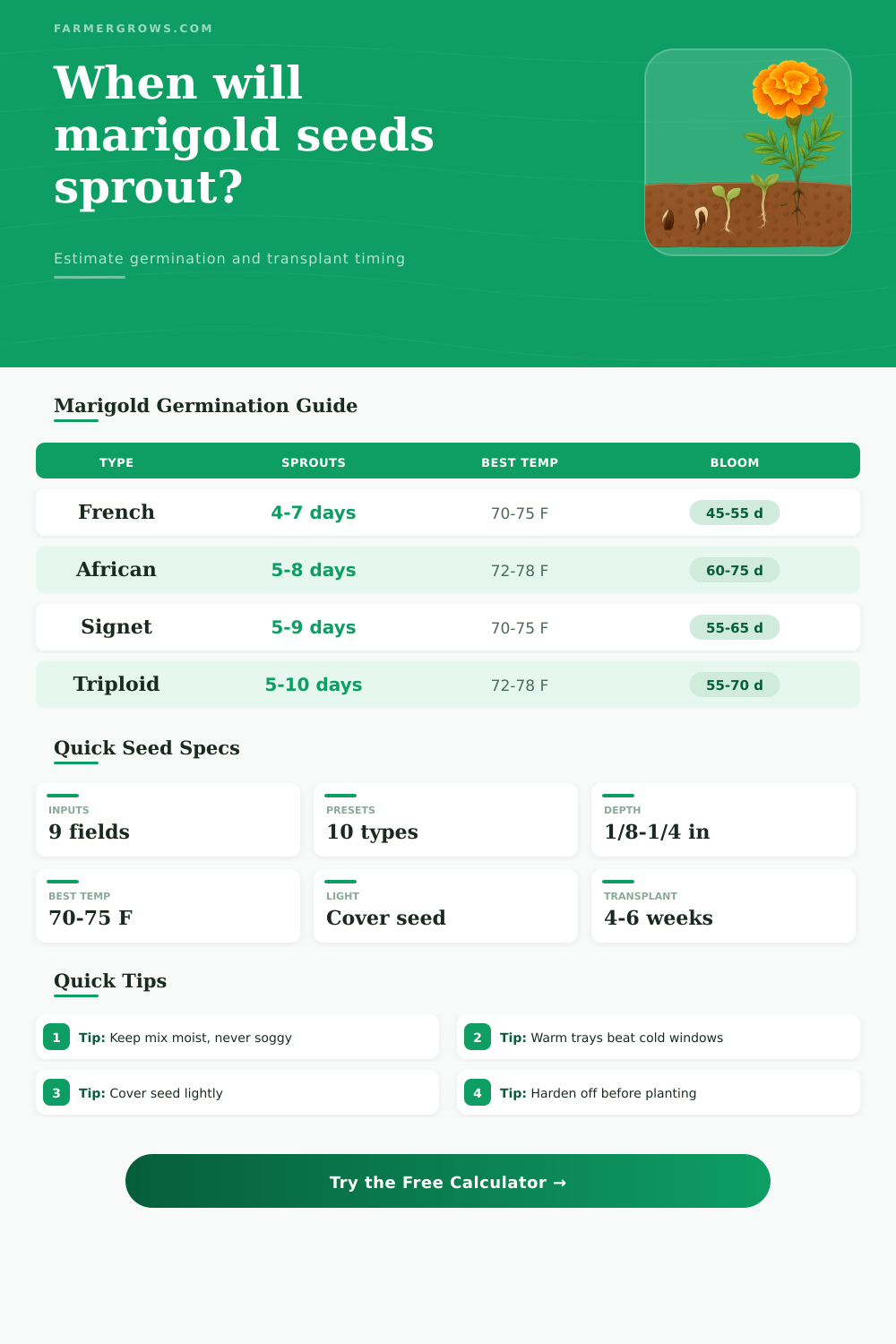
Marigold Seed Germination Time Calculator
Estimate when French, African, signet, triploid, gem, and pot marigold seeds should sprout based on soil temperature, seed age, depth, moisture, medium, and days since sowing.
Marigold seed is usually quick when the mix is warm and evenly moist. Use the calculator to spot cold trays, old seed, overly deep sowing, or wet media before you give up on a flat.
Marigold Germination Estimate
The estimate combines the variety baseline with temperature, depth, light, moisture, seed age, and medium corrections.
| Variety group | Typical germination | Best soil temp | Bloom after sowing | Grower note |
|---|---|---|---|---|
| French marigold | 4 to 7 days | 70 to 75°F | 45 to 55 days | Fast, compact, good for packs and edging |
| African marigold | 5 to 8 days | 72 to 78°F | 60 to 75 days | Needs more time before large flower display |
| Signet and Gem | 5 to 9 days | 70 to 75°F | 55 to 65 days | Fine leaves, small flowers, avoid overwatering |
| Triploid hybrid | 5 to 10 days | 72 to 78°F | 55 to 70 days | Often grown as transplants for uniform beds |
| Pot marigold | 6 to 10 days | 60 to 70°F | 45 to 60 days | Calendula type; tolerates cooler starts |
| Mexican mint marigold | 7 to 14 days | 70 to 78°F | 80 to 100 days | Slower herb-type marigold, keep warm |
| Soil temperature | Expected speed | Stand risk | Best action |
|---|---|---|---|
| Below 55°F / 13°C | Very slow or stalled | High | Move tray warmer or wait for outdoor soil to rise |
| 55 to 64°F / 13 to 18°C | Slow, often 9+ days | Moderate to high | Use a heat mat or cover bed with clear protection |
| 65 to 69°F / 18 to 21°C | Good but not fastest | Low to moderate | Keep moisture even and avoid cold nights |
| 70 to 75°F / 21 to 24°C | Fast and even | Low | Ideal target for most marigold seed trays |
| 76 to 82°F / 24 to 28°C | Fast, watch moisture | Low to moderate | Vent humidity domes once seedlings emerge |
| Above 85°F / 29°C | Uneven if dry or hot | Moderate | Lower heat mat setting and improve airflow |
| Seed depth | Speed adjustment | Emergence risk | Use this when |
|---|---|---|---|
| Surface only | 0 to +1 day | Drying and light exposure | Only with steady mist and humidity cover |
| 1/8 inch / 3 mm | Fast | Low if covered | Fine seed mix, indoor tray, small-cell packs |
| 1/4 inch / 6 mm | Normal | Low | General marigold trays and outdoor beds |
| 1/2 inch / 13 mm | +2 to +4 days | Moderate | Sandy outdoor bed that dries quickly |
| Over 3/4 inch / 19 mm | +5 days or more | High | Avoid unless soil crusting and moisture are managed |
| Crop plan | Germination check | Transplant or thin | Bloom target |
|---|---|---|---|
| Indoor French packs | Day 4 to 7 | Day 28 to 42 | 45 to 55 days from sowing |
| Indoor African plugs | Day 5 to 8 | Day 35 to 56 | 60 to 75 days from sowing |
| Signet edible border | Day 5 to 9 | Day 28 to 42 | 55 to 65 days from sowing |
| Direct-sown bed | Day 6 to 12 | Thin at true leaves | 50 to 75 days depending on type |
| Older seed backup | Day 7 to 14 | Keep extra seedlings | Add 7 to 14 days if stand is thin |
Use the soil temperature: A windowsill can feel warm while the tray mix sits near 60°F. Marigolds usually respond faster to bottom warmth than to brighter light.
Judge the whole window: Do not discard a flat on day 5 if the calculator shows cold soil, older seed, or deep cover. Correct conditions and watch the late edge.
The timing of when your seeds start to sprout is key to feeling like a success as a first-time gardener; meaning things like marigolds, which are great plant for beginners, get you started fast. It’s tempting to think “oh, my seed must be no good” if you sow a flat in early spring and don’t have any sprouts by day ten, but most of the time marigolds (and many other seeds) just need a little tweak here and there, a tiny bit more or less of something (to go ahead and germinate). With a calculator that factors in seed age, temperature, depth, medium, and moisture for one estimated timetable, you can tell if you’re just running slow or if something has to changes.
The single greatest variable for timing is soil temperature. Marigold seeds prefers consistent warmth in the root zone, which stays a few degrees cooler than temperatures found on windowsills or in unheated rooms. That can extend the wait time, and stretch out the stand, too. Once you enter the actual seed-zone temperature into the calculator, it do the math for you so you don’t have to guess whether the seed is the problem or if the cool tray are the cause.
How to Know When Your Seeds Will Grow
The same is true with seed age: The fresher, the better (though generally speaking, fresh seed will arrive at the party in time). If you’re using older seed, the tool factors that into the expected window, so no abandoning a flat too early, or leaving it longer hoping for germination from seed that’s already expired.
“Moisture and depth play more against each other than you’d think.” Though marigold seeds are tiny, any deeper than a quarter-inch will add days, with an increased chance for rotting to boot; meanwhile, even in ideal temperature conditions, you may delay germination by allowing the surface to dry out before watering again. The calculator’s ability to combine these variables into one number (rather than creating two separate checklists) help provide a better sense of why a specific sowing is falling behind.
For example, what about outdoor beds? That adds another complication: soil crusting, wild temperature swings, and uneven moisture all makes the growing window longer then it would be in a controlled indoor tray. With the tool, you can switch the medium setting to include those actual conditions rather than indoors-only assumptions.
After that comes the question of when to set out seedlings, after they’ve sprouted. The output factors in how older seeds or a cool start affect transplant timing. This gives you something to plug into your hardening-off plan, so you won’t have to estimate extra days yourself. So the entire schedule doesn’t get off-kilter.
All the number-crunching comes down to this: It converts fuzzy “uh-oh” to “Oh, yes! Here’s what I’ll tweak.” Your calculation’s result is typical; it is good, so maintain steady heat at the bottom and keep moisture level even. Result is far out of expected range? You should of either adjust depth, or replace seed. Either one, less guessing and more growing.