Soil Porosity Calculator
Estimate total porosity from bulk density and particle density, then split the pore space into water-filled and air-filled pores for practical soil structure decisions.
Use a preset to load realistic starting values for texture, density, organic matter, compaction class, water-filled pore space, and core size.
Porosity Results
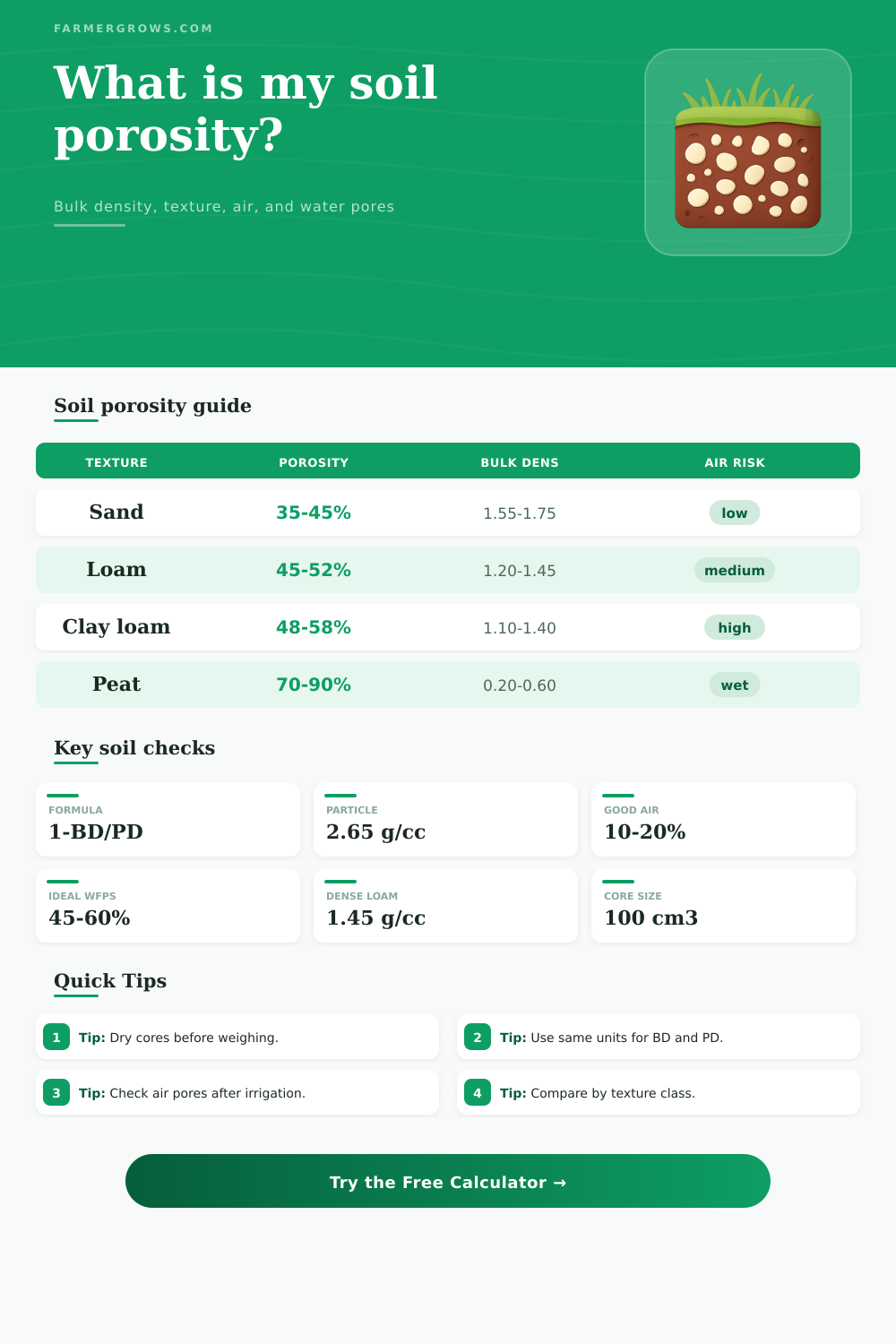
The main value uses total porosity = 1 - bulk density / particle density. Air and water pores are estimated from water-filled pore space.
Typical porosity ranges vary by texture, organic matter, aggregation, and traffic history. Use this grid as a comparison point, not a lab standard.
| Texture | Typical porosity | Good bulk density | Dense warning | Field interpretation |
|---|---|---|---|---|
| Sand | 35-45% | 1.45-1.65 g/cm³ | Above 1.75 g/cm³ | Roots need deeper moisture because pores drain quickly. |
| Loamy sand | 38-46% | 1.40-1.60 g/cm³ | Above 1.70 g/cm³ | Organic matter helps keep medium pores open. |
| Sandy loam | 40-50% | 1.25-1.50 g/cm³ | Above 1.60 g/cm³ | Often responsive to cover crop roots and reduced traffic. |
| Loam | 45-52% | 1.15-1.40 g/cm³ | Above 1.50 g/cm³ | Balanced air and water if sampled outside wheel tracks. |
| Silt loam | 45-55% | 1.10-1.35 g/cm³ | Above 1.45 g/cm³ | Surface sealing can reduce infiltration even with fair porosity. |
| Clay loam | 48-58% | 1.05-1.35 g/cm³ | Above 1.45 g/cm³ | Small pores hold water; macropores are valuable for oxygen. |
| Clay | 50-62% | 0.95-1.30 g/cm³ | Above 1.40 g/cm³ | High total porosity may still have poor drainage when wet. |
| Organic muck | 70-90% | 0.20-0.60 g/cm³ | Above 0.80 g/cm³ | Particle density is much lower than mineral soil. |
| WFPS range | Air pore condition | Likely field condition | Root oxygen note |
|---|---|---|---|
| Below 35% | High air, low water | Dry or recently drained soil | Roots may be water limited even if oxygen is good. |
| 35-45% | Good air reserve | Drying but workable | Good for cultivation if structure is stable. |
| 45-60% | Balanced | Near field capacity for many soils | Common target for active roots and microbes. |
| 60-70% | Air shrinking | Moist or fine textured soil | Monitor aeration-sensitive crops. |
| 70-85% | Low air | Wet, compacted, or slow draining | Root oxygen stress becomes more likely. |
| Above 85% | Very low air | Saturated or perched water | Avoid traffic and wait for drainage before tillage. |
| Class | Field sign | Porosity effect | Air pore concern | Sampling advice |
|---|---|---|---|---|
| Loose | Fresh tillage or fluffy bed | High temporary pores | May settle after rain | Resample after the bed firms. |
| Friable | Aggregates crumble by hand | Stable mixed pores | Usually low | Use as the best comparison core. |
| Moderately firm | Probe pressure rises | Macropores reduced | Moderate after rain | Compare row and between-row cores. |
| Firm track | Wheel rut or hoof pressure | Air pores collapse first | High in wet weather | Sample inside and outside the track. |
| Severe pan | Roots flatten or turn | Dense layer blocks roots | High below pan | Sample by depth to isolate the layer. |
| Core volume | Pores at 40% | Pores at 50% | Water at 60% WFPS | Common use |
|---|---|---|---|---|
| 50 cm³ | 20 cm³ | 25 cm³ | 15 cm³ | Small lab rings or shallow checks. |
| 100 cm³ | 40 cm³ | 50 cm³ | 30 cm³ | Common mineral soil bulk density ring. |
| 250 cm³ | 100 cm³ | 125 cm³ | 75 cm³ | Coarse soil or stony garden comparisons. |
| 5 in³ | 2.0 in³ | 2.5 in³ | 1.5 in³ | Small imperial core sleeve. |
| 10 in³ | 4.0 in³ | 5.0 in³ | 3.0 in³ | Larger field ring for mixed aggregates. |
Porosity estimates are most useful when cores are collected at consistent depth, soil moisture, and traffic position. Laboratory methods may be needed for legal, engineering, or research-grade reporting.
Soil porosity are the measurement of an empty space between soil particles. Porosity is a critical factor in determining how soil behave in the field. Soil porosity will determine whether the plant roots can breathe and whether the water that lands on the soil will stay in the soil or run off it surface.
Using the calculator, you can convert the invisible concept of soil porosity into a measurable number. The calculator determine soil porosity using the bulk density and the particle density of the soil. Bulk density measures how much oven-dry soil will fit into a specific volume.
How to Measure Soil Porosity
The higher the bulk density of the soil, the more closer the particles will be pressed together. The closer the soil particles are to each other, the few number of pores the soil can contain. Particle density measures the solid material contain within the soil.
Most mineral soils has a particle density that is close to 2.65 grams per cubic centimeter because the minerals in the soil include quartz and feldspar. If the soil contains organic matter, the particle density of that soil will be lower because organic matter is less dense than the mineral matter in soil. To determine the total porosity of the soil, one subtracts the ratio of the bulk density to the particle density from 1.
The calculator performs this calculation. The calculator divides the total porosity into the portion of pore space that is filled with water and the portion of pore space that is filled with air. The distribution of water and air within the soil pores is far more important than the total porosity of the soil.
Air in the soil pores are essential for root respiration of plants. A soil with 48% total porosity may have a high amount of water in that soil which will affect the ability of the soil’s roots to breathe. A sandy soil has 38% total porosity but if the pores in the sandy soil are mostly filled with air, that soil will allow for adequate root respiration.
The percentage of pore volume that is taken up by water can be enter into the calculator. The calculator can then provide the fraction of the pore space that is taken up by air. Soil texture provide a general idea of the porosity characteristics of soil.
However, soil texture is not the only factor in determining soil porosity. Sandy soil contains relatively large pores that allow for rapid drainage of water from the soil. Thus, sandy soil have relatively low total porosity.
Clay soils contain a relatively high total porosity compared to sandy soil but the pores within clay soil are smaller in size which allows for slow movement of water within clay soil. Air can dissapear from clay soil after it rain because of the slow rate at which air can exit the clay soil pores. Loam soil has soil texture characteristics that is in between sandy soil and clay soil.
Many soil growers find that loam soil is the easiest to manage. The user can select the texture of the soil on the calculator. The results of the soil porosity will be provided along with the typical range of soil porosity within that texture class.
However, the individual must enter the bulk density of the soil to account for difference between fields with the same texture. Fields may have varying degree of compaction of the soil particles. Compaction of the soil occurs when heavy equipment moves over wet soil.
When soil that contains equipment passes over wet soil, the large pores in that soil can collapse. These large pores, called macropores, are important to soils in that macropores allow for the rapid drainage of water from the soil, and the macropores allow roots to exchange gases with the soil. If the macropores in soil collapse due to compaction, the air-filled fraction of that soil will decrease, even if the total porosity of the soil remains an acceptable number.
The calculator include a compaction class selector, which applies a penalty to the structure score that reflects the compaction history of that soil. The calculator allows for the input of the volume of soil cores that were collected from the soil, as well as the dry mass of those soil cores. Many soil samples are collected within rings of a known volume, and the cores of soil are dried and weigh to determine their dry mass.
If the core calculation option is chosen on the calculator, the calculator will automatically convert the dry mass of the soil and the volume of soil cores into bulk density. Furthermore, the calculator use the core volume to calculate the volume of pores, the volume of water, and the volume of air within the soil samples. These values can be displayed in either metric units or imperial units.
The organic matter percentage of soil influence the particle density of soil and its ability to form aggregates. Soils that contain more organic matter will have a lower bulk density due to the lighter mass of organic matter, as well as due to organic matter’s ability to bind soil particles into crumbs. The organic matter percentage can be entered into the calculator, and the organic matter percentage will shift the structure score.
While the structure score can neither be measured in a soil laboratory, the structure score is a means of combining three soil parameters into a single figure that can be compare to other soils. Because fields are often not uniform in their soil composition, the bulk density of different areas of the same field can differ. For instance, the area of a field that is used to park sprayers will have higher bulk densities than the rest of the field.
Furthermore, areas of a field that have been amended with compost will have lower bulk densities than areas that have not been amended. Beyond these effects, the depth at which soil samples are collected and the moisture content of the soil will impact the bulk density measurements. The depth at which samples are collected and the moisture content of those samples should be held constant in any comparison of bulk densities of soil samples from different areas of a field.
The tables located on the page provide information regarding soil based off the calculated bulk densities of soils samples. Bulk densities that are above the warning threshold for soils of a given texture indicate that the roots of plants may become restricted in their ability to move through that soil. Water-filled pore spaces that are above 70 percent indicate that the soil contains too many pores that allow water to enter the soil, and that aeration of the soil may limit the activity of microbial organism in that soil.
These calculations provide a means of understanding soil without examining the soil samples themselves; they are not hard and fast rules, but they do provide guardrails for soil management decision of farmers and agronomists. Furthermore, by using these calculations regularly, farmers will begin to think about soil in terms of the pores within the soil rather than only observing the soil’s surface.