
There’s a certain type of panic that comes from scattering seeds onto the soil, then waiting for them to sprout. You water the seeds every day. Your neighbor garden is full of green things; yours is still empty.
It’s not usually a matter of good or bad luck, or soil quality… It’s almost invariably about depth. If seeds is planted too shallow, tiny ones are exposed to hungry birds and drying winds. If they’re planted too deeply, they’re buried in darkness and use up their stored energy before ever seeing the light of day. Mastering this is one of the single best garden moves you’ll make, it turns hope into something more like biology.
How Deep To Plant Seeds
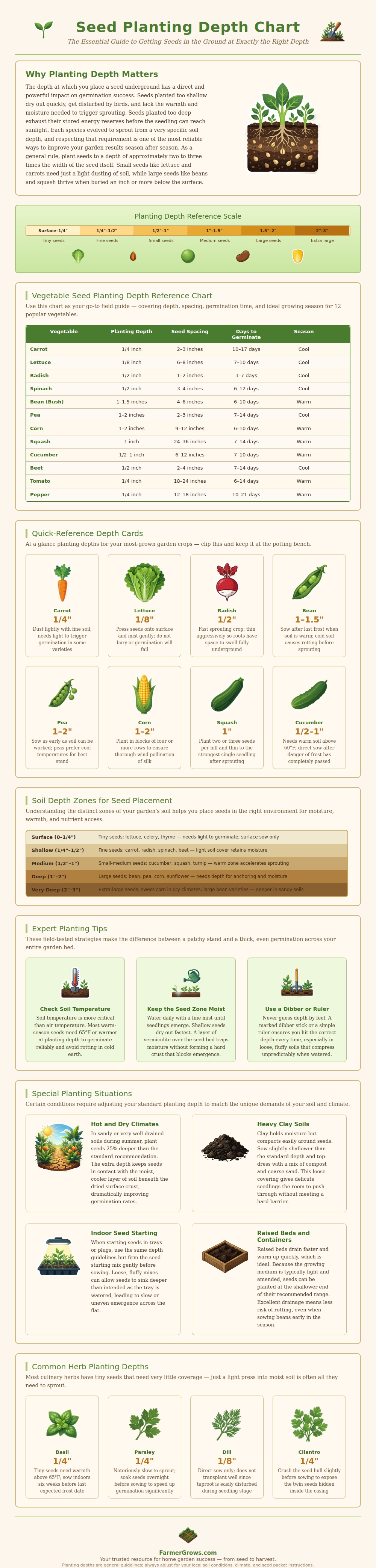
That’s what the chart (above) does: it sizes up each seed by size, not necessarily by kind, and tells you how deeply below ground it belongs. Why? Because generally speaking, bigger seeds contains more energy. A big bean kernel contain enough fuel to force its way upward an inch or more to break free to the air. Delicate little lettuce seeds contain next to no reserves, and if you bury them even slightly deeper then that, they’ll be smothered before they have time to begin growing.
Understanding these differences makes sense visually. It groups everything from tiny herb seeds to heavy corn kernels into zones of common-sense depth, so no guessing is required. This prevents frustration for beginning gardeners who often just add shovelful after shovelful, covering their seed with dirt willy-nilly.
The science: It’s a race against depletion, so no Ph.D. Required to grasp the physics. Each seed’s battery of stored-up energy in the form of food reserves in its cotyledons has only so much juice. What is used on pushing upward (the shoot) and downward (the root) depletes it. The slower the drain (if the ground is cool), the slower depletion (hence why squash fares better planted deeper into warmer soil layers; it’s a warm-season crop). But a seed cannot push up out of the ground if it runs out of battery power along the way.
That’s why carrots don’t do well in heavy clay if you press them too tightly down or mound too thickly above. The soil itself become a physical barrier to their strength. Radishes, on the other hand. Fast and furious, can outrun any attention-getting time by sprinting to daylight even if you’ve only made a half-inch cover over them.
Which brings us back to the real world: You must adjust according to what your actual ground conditions are. For instance, if your soil is very sandy (meaning it will dry right out in high summer) you may want to plant those big seeds a bit deeper than recommended so they can find reliable moisture at any depth. The problem with sand? Those tiny granules allow water through fast, so even an inch down the surface remains as dry as toast…until you water again.
With heavy clay, on the other hand, go shallow; dampness causes it to pack up tight. That impenetrable mat will be like a concrete ceiling above tender shoots, and amending with compost can help break it up. Again, keep planting depth down initially, and give the baby some chance of fighting its way through.
Seed-starting mixes are light and fluffy, with all their own oddities when used indoors. Great, until you water: Then they settle, making seeds sink below where you’d planned. Instead of being right next to the surface of the cells in a cell pack or whatever, they get stranded, mid-cell. A gentle firming of the mix beforehand will prevent this sinking action, ensuring that the quarter-inch mark on your ruler truly equals a quarter inch once the thing gets its first watering.
Uniformity beats intensity any day; a consistent bed mean a uniform emergence, which leads to much less chaotic thinning (and maintenance) down the road. When it comes time to plant, keep it simple. Dig holes all the same depth (a dibber or even a chopstick will help). Don’t guess at feeling your way to the right level… That’s a recipe for an uneven stand. Gently water with the mister setting; don’t dislodge those teeny seeds any farther than intended. Sprinkle lightly over them, maybe with some vermiculite, to retain moisture but not create a hard crust. And then wait.
If you are tempted to dig around to see what progress they’re making, resist: You’ll break off their delicate root tips that form just under the surface, and disturb the biology doing its thing. Trust your depth measurement, and let nature take its course. Emergence of the seedling, when it actually happens; is unlike any other garden chore; it’s a different kind of satisfaction, as if you were no longer involved but simply having to respect the plant’s own built-in design. Show respect.
The thing has done its part (or yours) by creating an ideal growing environment, and now it is following its evolutionary instructions. Water well, wait, let it lift itself. You should of prepared for this. Actually, the process feels more naturaly than expected. It’s a luxurios feeling to see them grow based off your hard work.