Kale Plant Spacing Calculator
Estimate kale rows, final plant count, seed needs, bed density, bunch potential, and harvest weight for baby leaf, bunching, full-size, lacinato, curly, and overwintered kale.
Use this calculator before direct seeding or transplanting kale. It accounts for bed margins, row spacing, plant spacing, stand loss, harvest style, and the difference between dense baby-leaf plantings and larger bunching plants.
Kale Spacing Plan
Results count rows and plants from usable bed dimensions, margins, row spacing, in-row spacing, stand percentage, and kale harvest style.
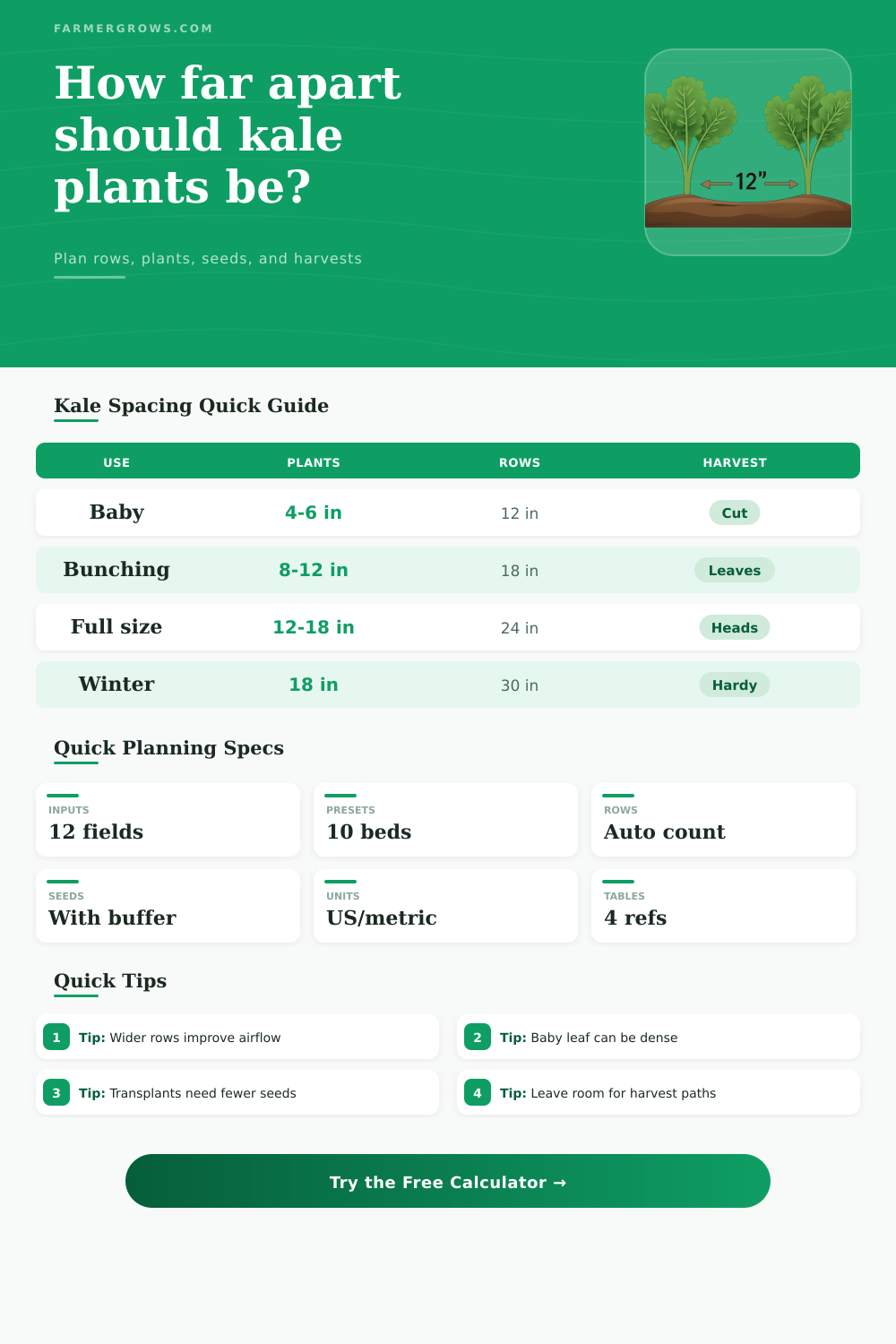
| Harvest goal | Plant spacing | Row spacing | Best layout | Use when |
|---|---|---|---|---|
| Baby leaf salad kale | 4 to 6 in | 8 to 12 in | Dense rows | Cut young leaves at 4 to 6 in tall. |
| Cut-and-come bunching | 8 to 12 in | 14 to 20 in | Raised beds | Harvest outer leaves every week or two. |
| Full-size family plants | 12 to 18 in | 18 to 30 in | Rows or blocks | Grow larger leaves with strong airflow. |
| Overwintered kale | 16 to 24 in | 24 to 36 in | Wide rows | Plants stay in place through cold weather. |
| Kale type | Typical spacing | Growth habit | Harvest note | Spacing caution |
|---|---|---|---|---|
| Curly green kale | 10 to 18 in | Upright rosette | Good for bunches and repeated leaf harvests. | Too tight can trap moisture in curled leaves. |
| Lacinato or Tuscan | 12 to 18 in | Tall central stem | Long leaves are easy to bunch. | Give more row room in windy sites. |
| Red Russian | 8 to 14 in | Open, tender leaves | Works well for baby leaf or bunching. | Bolts sooner in heat, so dense spring beds work. |
| Dwarf container kale | 8 to 12 in | Compact plant | Good for patios and small beds. | Containers need steady water at tight spacing. |
| Planting method | Seeds per station | Stand buffer | Thinning target | Best fit |
|---|---|---|---|---|
| Direct seed stations | 2 to 3 | 10% to 20% | Thin to 1 plant | Outdoor spring and fall beds. |
| Transplants | 1 plant | 5% to 10% | Replace weak plants | Early crops and uniform market rows. |
| Dense baby leaf rows | 3 to 6 | 15% to 25% | No single-plant thinning | Cut-and-regrow salad production. |
| Overwinter starts | 1 to 2 | 15% to 25% | Keep strongest plants | Cold-season survival and spring shoots. |
| Project | Bed size | Spacing plan | Approx plants | Harvest focus |
|---|---|---|---|---|
| Small salad bed | 4 x 8 ft | 6 in plants, 12 in rows | 72 to 90 | Baby leaf cuts |
| Family bunching bed | 4 x 12 ft | 10 in plants, 18 in rows | 36 to 45 | Weekly leaves |
| Market garden bed | 30 x 4 ft | 8 in plants, 15 in rows | 120 to 140 | Bunching kale |
| Winter row | 50 x 3 ft | 18 in plants, 30 in rows | 30 to 34 | Cold-season plants |
For baby leaf: Dense rows are useful only when leaves are cut young. If plants will stay for months, widen both plant spacing and row spacing.
For humid gardens: Kale leaves can hold moisture. Wider rows and side margins help airflow, reduce leaf disease pressure, and make harvesting easier.
For winter crops: Start with more room than a spring salad bed. Large crowns, mulch, row cover, and thaw cycles all need working space.
For market bunches: Plant count is not the only target. Uniform spacing makes bunch size, harvest speed, and weekly cutting schedules easier to manage.
Chances are, you began with the best of intentions: drawing a tidy grid onto your piece of paper representing your garden bed, then envisioning all the straight rows of perfect kale or what-have-you receding into the future. What starts out looking like an orderly plan in reality gets tossed by Mother Nature, who doesn’t give a hoot about geometry. Kale (for example) doesn’t want to be polite and stay within the lines; it wants to stretch out and spread around. And if you try crowding them up because you’d rather skip shuffling around space, they’ll pay you back in spades with legginess and disease on the leaves.
How much room you allow between leaf often makes the difference between a patch of leggy survivors and a salad bowlful of tender greens. You can save yourself the guesswork about how many plants will fit in your four-by-eight-foot raised bed; after plugging in your desired harvest size and bed size, the calculator up top do all the math for you.
Why Spacing Your Kale Matters
What you enter matters more then you might think: it forces you to be clear about what you are realy growing. Do you want giant, structural Lacinato kale plants with heads that look like dark green swords standing tall? Or do you want baby leaves picked each week, in cut-and-come-again fashion?
These is two very different goals. They also require two very different approaches to spacing. Mixing them up will yield a disappointing harvest faster than anything else. For baby leaf crops, packed plants; four to six inches apart, are a good thing; the lush carpet of young greens love being dense. With full-size plants, plenty of breathing room is essential; sometimes 18-30 inches between plantings per row are required so that air can flow through the canopy.
Most beginning gardeners don’t think much about airflow when growing kale, but they should, since by the time they realize it’s an issue, it’s too late. Broad-leaved kale holds moisture well (particularly those with curly ruffled edges). If there isn’t enough space between plants for air to flow through, that trapped humidity invite rot and mildew. This isn’t simply a matter of letting each plant have room to stretch its limbs: It’s a matter of keeping foliage dry and healthy.
Adding inches to your row width is good insurance against having half your crop give in to fungal problems, particularly if you’re gardening in a wet climate where mornings tend toward dewy rather than crisp. In addition, it considers how many seeds will actualy make it to germinate and survive as seedlings. Real life (read: real soil) isn’t always perfect. Sometimes birds feast on seed. Slugs gobble sprouting seeds. Other areas of the bed is simply not-so-lucky.
It’s good planning to build in a cushion for such losses, to account for a realistic number of plants at planting time, instead of hoping. This is especially true with direct sowing, when you’ll need to thin later, a task nobody looks forward to. Placing two or three seeds per station allow Mother Nature to select which one thrives (while the others are weeded out), and the strongest seedling wins. Transplants don’t have that same drama. However, being precise with your spacing estimates helps you avoid the worst scenarios, like crowded beds or missing empty spots here and there.
But then there’s kale, which is a whole other variable for overwintering. Kale need more space than it did when growing in summer. This is because it will live through winter assaults like snow loads, frost heaves, and thaw-and-freeze cycles. These are harder on crowded plant. And if they’re spaced out so each plant has its own crown of space to enlarge into as spring approaches? So much better. You have an easier path to harvest in soggy months (without stepping on somebody else’s plant).
The difference is explained in the reference tables on the page. Yield factors changes from those super-thin baby leaf cuttings to sturdy winter survivors. The bottom line: Spacing out the beds means spacing out your plans for growing kale. How ambitious can you be? How practical? Aim for plenty of plants to serve in your bowls, but not so many that they fight one another for light and nutrients.
Better spaced-out kale equals fewer problems with pests and disease, plus clean leaves and quicker growth. The calculator even lets you see how to find that balance before you break ground, and turn those theoretical measures into an actual plan for planting your bed. Get the figures first, adjust based off where you live, and then roll up your sleeves.
Right spacing isn’t just good gardening practice, it’s good eating, because a kale can do what its designer meant it to do…if given space.