Cow Manure Composting Time Calculator
Estimate how long cow manure needs to actively compost and cure based on bedding, pile size, moisture, turning, heat records, and final garden use.
Cow manure composting is not just a calendar count. Wet dairy scrapings, dry bedded pack, straw, sawdust, pile size, heat history, and the intended crop all change the safe waiting window.
Your Cow Manure Compost Estimate
Use the result as a planning guide, then confirm with pile temperature, smell, texture, and local food-safety rules before applying to edible crops.
| Composting setup | Active phase | Curing phase | Turning rhythm | Best use |
|---|---|---|---|---|
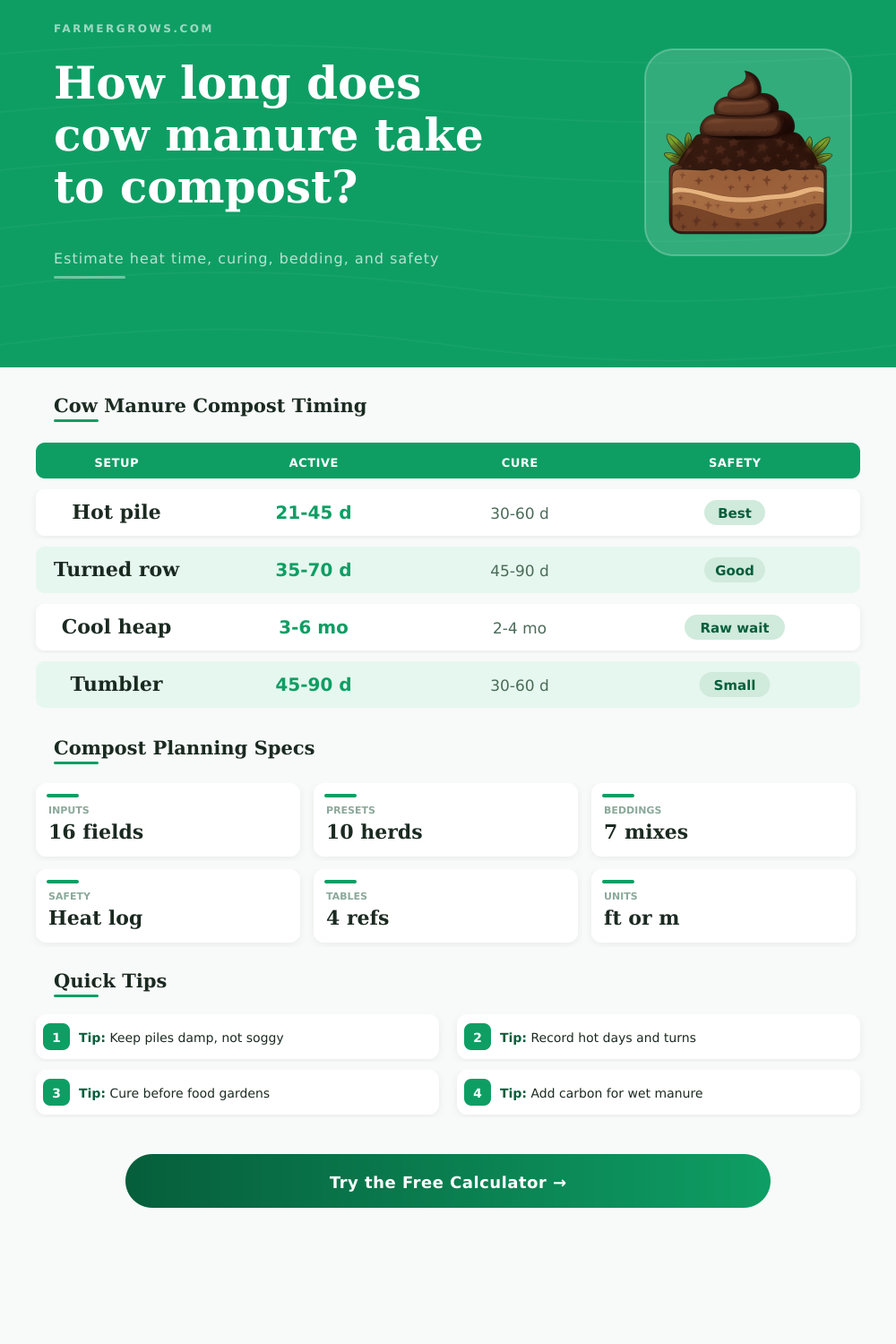
| Hot turned pile | 21 to 45 days | 30 to 60 days | Every 3 to 7 days | Finished compost for gardens after curing |
| Turned windrow | 35 to 70 days | 45 to 90 days | Every 7 to 14 days | Field or large garden batches |
| Bedded pack heap | 45 to 90 days | 60 to 120 days | Every 10 to 21 days | Farm bedding and soil-building compost |
| Covered static pile | 60 to 120 days | 60 to 120 days | Monthly or aerated | Slow, protected composting |
| Cool open heap | 3 to 6 months | 2 to 4 months | Monthly if possible | Ornamentals or raw-manure timing |
| Small tumbler | 45 to 90 days | 30 to 60 days | Every 2 to 5 days | Small well-balanced batches |
| Material | Typical role | Starting ratio | Speed effect | Watch-out |
|---|---|---|---|---|
| Chopped straw | Carbon plus air space | 0.5 to 0.9 per 1 | Fast when moist | Long stems need chopping |
| Dry shredded leaves | Balanced brown | 0.8 to 1.3 per 1 | Moderate-fast | Matted leaves slow air flow |
| Corn stalks | Coarse structure | 0.7 to 1.1 per 1 | Moderate | Large pieces cure slower |
| Wood shavings | Absorbent carbon | 0.5 to 0.9 per 1 | Moderate-slow | Can tie up nitrogen |
| Aged sawdust | Strong carbon | 0.3 to 0.6 per 1 | Slow if overused | Needs extra moisture |
| Shredded cardboard | Emergency brown | 0.6 to 1.0 per 1 | Moderate | Must be shredded and wetted |
| Heat record | Turn record | Suggested handling | Food crop caution | Result label |
|---|---|---|---|---|
| 131 to 160°F for 15 days | 5 or more turns | Cure until earthy and cool | Best documented compost path | Documented |
| 131°F for 3 days | Static or aerated | Cure thoroughly | Use extra caution in small piles | Partly documented |
| Warm but below 131°F | Any | Treat as partly composted manure | Use raw-manure harvest intervals | Extended wait |
| No heat record | Unknown | Compost longer and cure | Do not topdress edible parts | Unknown |
| Starting mix size | Heat potential | Typical shrinkage | Management note | Best shape |
|---|---|---|---|---|
| Under 0.5 yd³ | Low | 25 to 35% | Needs insulation or extra cure time | Small bin |
| 0.5 to 1 yd³ | Moderate | 30 to 45% | Can heat if balanced and covered | Compact cube |
| 1 to 4 yd³ | High | 40 to 55% | Good home or small farm pile | 3 to 5 ft tall |
| 4 to 12 yd³ | High | 45 to 60% | Needs loader or tractor turning | Windrow |
| Over 12 yd³ | Very high | 45 to 65% | Watch oxygen, runoff, and hot spots | Long windrow |
For edible crops: Only use well-cured cow manure compost around food plants. If the pile did not heat reliably, treat it like raw manure and allow a longer pre-harvest interval.
For faster compost: Aim for sponge-like moisture, visible bedding structure, and a pile large enough to hold heat without becoming wet, sealed, or compacted.
When it’s done, I know: Cow manure smells very specific, nothing like the pungent ammonia of freshly mucked bedding, or the sour funk of anaerobic sludge. Look for a rich, earthy aroma like a rain-soaked forest floor; that’s your signal that what’s left is ready to give back some life. Getting to that point take time, the one ingredient you can’t shortcut.
Once you plug in your starting ingredients and your turning schedule, the heap calculator does math for you. This way, you don’t have to guess if pile is truly cooking or if it is just sitting there looking brown. Why it matters: Cow manure are variable, and most times either there’s too much water in it (dairy scrapings) to drown microbes, or there’s too much carbon (dry bedded pack) for fast decomposition unless you get the balance just right, which is why these input fields don’t assume one average but ask about both your bedding ratio and approximate amount of moisture. Conditions vary; tell the tool what you’re dealing with.
How to Make Good Cow Manure Compost
A heap of slick dairy stuff will probably require far more leaves or other straw to form air pockets. These pockets allows oxygen into the center of the heap. Without them, microbes run out of air and start breaking down matter without oxygen, which produces odor instead of heat and slows the whole process down to a crawl.
Temperature is most important factor in making sure any composted food crop is safe. It destroys not only weed seeds, but also pathogens that may have been present when you started composting the item. To be considered “cooked,” most guidelines recommend reaching about 131 degrees F for multiple days in a row. The calculator records number of days spent at or above these critical temperatures.
But here’s what you need to know: It takes mass to get there. A small pile won’t hold enough heat to really sterilize whatever you’ve put into it. And the insides will rarely reach that level of heat even if some part of the outside warms up a bit on sunnier days. That’s where depth helps, the closer together things are in space, the better insulated, and therefore the warmer. So volume is more important than you’d think!
First, you’re introducing oxygen back into the areas where microorganisms is actively digesting. These organisms are depleting the area of oxygen. Secondly, you’re pulling cooler outer material into the hot center, ensuring even treatment for all the materials in the pile. This active phase is dependent on how often you turn your pile (the tool takes your turning interval into account).
If you turn too infrequently, you run the risk of creating cold spots within the pile which stall decomposition altogether. Conversely, if you turn too much, you might lower the temperature before the microbes complete their job. The right timing varies with weather conditions and size of your pile. Your pile size also change from month to month depending on the weather.
The one thing most gardeners do wrong is rush curing, the stage when material is not quite finished stabilizing. Once the active heat subsides, slower-acting fungi and other organisms break down complex organic compounds into stable humus. This is when slower-acting fungi and other critters works on breaking down more-complex organic compounds into more-stable humus. Don’t use uncured compost. It will rob your soil of nitrogen as microbes scramble to finish digesting leftover sugars. It may also contain salts that cook emerging plant roots. The curing times shown in the results estimate how long it takes chemical process to finish.
The nature of the bedding also dramatically alters how things work in the heap. For example, sawdust is an excellent absorber of moisture (good), but forms a very tight weave that blocks air flow if not well turned (bad). In contrast, straw retains its fluffiness even when moist (good) and has good structure that allows oxygen to move deeply into the pile (good). These material variations are neatly summarized in the reference tables on the page: they tell you what ratio of carbon volume (e.g., straw) is needed compared with your manure volume to achieve the best balance. If you get this wrong you’ll likely end up with either a wet stinky mess, or a dry stagnant pile that won’t heat up.
To sum up: When it comes to dealing with poop from cows, there’s no hard-and-fast calendar, just watching the biology. Turn it, and if it still steamy-hot even in cool weather, you’re doing OK; when it has a pleasant aroma of sweetness, and resembles rich, crumbly earth, then you’ve probably got it finished. According to best practices, my date calculator tells me what day to shoot for, but I know I won’t spread until the eyes tell me so (and the nose knows). Watch the heat and trust the process. Then, check for that earthy forest floor scent before you place it near your tomatoes.