Chicken Manure Composting Time Calculator
Estimate when chicken manure, coop litter, or deep bedding will be garden-ready, how much dry carbon to add, how often to turn it, and whether the batch needs extra curing before use around food crops.
Chicken manure is strong, wet, salty, and nitrogen-rich. This calculator treats it differently from yard compost by estimating ammonia risk, carbon demand, hot-compost confidence, curing time, and a harvest safety buffer.
Chicken Manure Compost Plan
Your estimated active phase, cure window, carbon balance, and use-safety notes will appear here.
| Compost confidence | Typical active phase | Minimum cure | Best use |
|---|---|---|---|
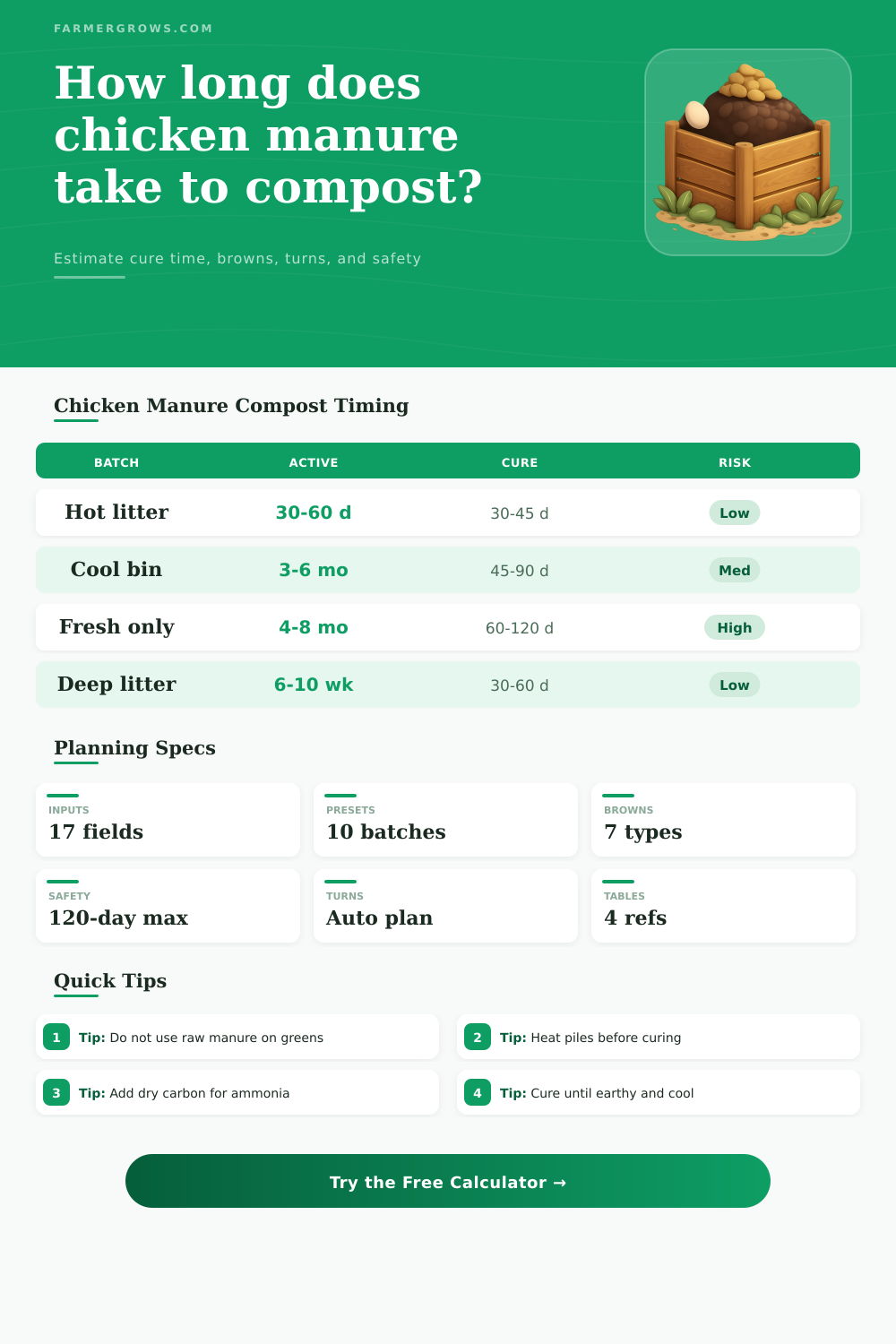
| Hot, turned, measured | 30-60 days | 30-45 days | Vegetable beds after earthy cure |
| Warm but inconsistent | 60-120 days | 45-75 days | Fruiting crops, orchards, ornamentals |
| Cool bin or unmeasured | 90-180 days | 60-120 days | Soil building before planting season |
| Raw or fresh only | 120-240 days | 90-120 days | Aged manure use only after long wait |
| Carbon source | Typical C:N | Best role | Chicken manure caution |
|---|---|---|---|
| Dry shredded leaves | 50-70:1 | Fast balancing and airflow | Moisten if leaves shed water |
| Chopped straw | 70-90:1 | Structure and odor control | Keep pieces short for faster heating |
| Pine shavings | 250-500:1 | Absorbs wet droppings | Can slow finish if overused |
| Shredded cardboard | 300-500:1 | Emergency ammonia control | Soak and mix well to prevent clumps |
| Sawdust | 350-500:1 | Very wet manure correction | Use thinly; it can compact |
| Use case | If fully hot composted | If unverified or raw | Extra caution |
|---|---|---|---|
| Ornamentals and trees | After cool, earthy cure | 60-90 days aging | Avoid direct root burn from fresh manure |
| Tomatoes, peppers, corn | 30-45 days cure | 90 days before harvest | Keep compost off edible fruit |
| Carrots, potatoes, onions | 45-60 days cure | 120 days before harvest | Soil-contact crops need more buffer |
| Lettuce, herbs, greens | Use only mature compost | 120 days or skip | Do not side-dress with raw litter |
| Batch size | Heat potential | Turning target | Common adjustment |
|---|---|---|---|
| Under 15 cu ft | Low | Weekly mixing | Combine with leaves or another cleanout |
| 15-35 cu ft | Moderate | Every 4-7 days | Insulate sides and monitor moisture |
| 35-80 cu ft | High | Every 3-5 days while hot | Open dense clumps at each turn |
| Over 80 cu ft | Very high | Windrow or staged turns | Prevent overheating above 160°F |
Ammonia smell: Add dry leaves, straw, or cardboard and turn the pile. Strong ammonia means nitrogen is escaping and roots may burn if used too early.
Food safety: For crops eaten raw or touching soil, use fully mature compost or keep a long harvest interval when heat was not verified.
Moisture check: Poultry litter should feel like a wrung sponge. Wet clumps need structure; dry dusty piles need water at each turning layer.
Finished sign: Mature chicken manure compost is dark, crumbly, earthy, cool after turning, and no longer smells sharp, sour, or like ammonia.
How does fresh chicken manure work? It’s a powerful soil amendment, but not if applied directly to growing plants, because it will burn their root systems. To get a useful compost out of the stuff, you have to manage it; make it heat up, and wait for time to do its work breaking down the material. By knowing what factors affect decomposition, you take back some control, so you can time your garden plans realisticly (rather than on guesswork). To get those calculations, use calculator above.
Fresh manure has a very low carbon-to-nitrogen ratio, usually ranging from 6 to 10 parts carbon to every part nitrogen. To obtain the desired carbon-to-nitrogen ratio of about 28 to 1, you’ll need some material that’s very high in carbon, such as straw or dry leaves. If there’s not enough carbon, too much nitrogen will go up into air as ammonia gas, a sharp-smelling compound that wastes nutrients. Structural materials also provides spaces for air to make the process aerobic. These aerobic microbes produces the heat that cooks down all those bodies.
How to Make Good Compost from Chicken Manure
Is the temperature right? The pile must heat up to 131-160 F to kill weed seeds and pathogens in the compost. Biological action will cook the pile, or sanitize it at that point. Otherwise, with a cold composting method such as cold aging (because insulation was insufficient or pile size too small) it will happen more slow. Cold composting is fine for ornamental beds, but it is very slow. It cannot be used around food crops like herbs or vegetables eaten raw until many months later. So if you have foodcrops in mind, checking the temperature early are important.
How long will the active phase last? The answer: as long as you continue to turn the pile, which brings in oxygen and spreads out the moisture. Turn too infrequently and you’ll develop anaerobic pockets; they won’t compost but rot. Turn too frequently and you’ll cool the pile too soon, stalling out the breakdown process. To get it just right, check the temperature every few days then adjust according to what does or doesn’t hold heat.
It is also a delicate balance for managing moisture. Because poultry litter is naturaly clumpy and wet. Balance dry carbon materials with wet litter and you have texture that resembles a wrung-out sponge, exactly right. Dripping equals time to add some brown material. Dusty means spray with mist at next turn. Weather and initial moisture levels can vary from batch to batch, making this a more reliable physical way to check the mix different than rigid scheduling.
The last part of the curing process is a matter of good garden health: Let it happen patiently. Wait for it to cool down, as ammonia will only fully go away at cool temperatures. Let the fungal network set up and give it time for any remaining ammonia to dissapears completely. Expect 30-90 days before it’s really mellowed out. This depends on your intended crop and how hot it got while active. Fruiting things like tomatoes is forgiving, but root crops and leafy greens that touch the ground need a longer cushion. Rush this part, and risk leaf burn and stunted growth; not worth all the effort you should of put into getting it hot!
So how do we use the chicken poop effectively? As it says: Not all recipes, but some signs to read. At first, the strong chemical-smelling poop turns to an earthy aroma. It changes from lumpy clumps into one color and consistency, though it is not totally smooth. When you observe these indications combined with the time clues from this tool, you know when it’s ready to spread out.
And there it is! What was once that smelly heap transforms into a solid base for building up fertile ground. It demonstrates that dirty farm refuse have worth, if only you let it simmer long enough and pay attention.