PVC Pipe Volume Calculator
Estimate how many gallons or liters a PVC irrigation, drain, manifold, or greenhouse line holds using actual inside diameter, pipe count, fill percent, fluid type, and slope.
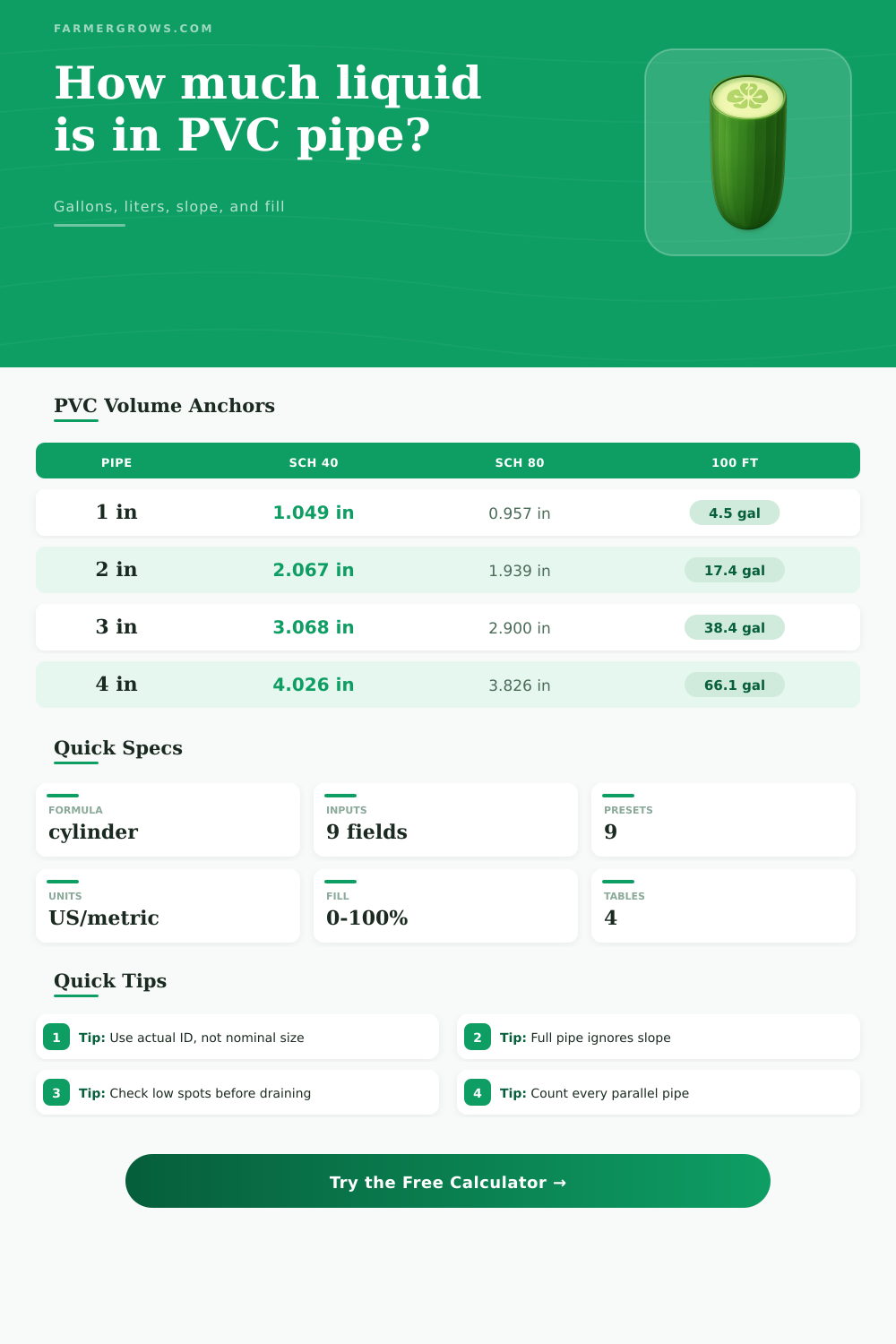
Nominal PVC size is not the inside diameter. This calculator uses common Schedule 40 and Schedule 80 IDs, then applies the cylinder formula: volume = pi x radius squared x pipe length x pipe count x fill percent.
Pipe Volume Results
| Nominal size | Schedule 40 ID | Schedule 80 ID | Why it matters |
|---|---|---|---|
| 1/2 in | 0.622 in | 0.546 in | Small fertigation and bench lines are sensitive to ID changes. |
| 3/4 in | 0.824 in | 0.742 in | Useful for short nursery, misting, and greenhouse branches. |
| 1 in | 1.049 in | 0.957 in | Common header pipe for drip irrigation and garden zones. |
| 1 1/2 in | 1.610 in | 1.500 in | Good midpoint for laterals and small pump discharge lines. |
| 2 in | 2.067 in | 1.939 in | Often used as a farm or greenhouse irrigation main. |
| 4 in | 4.026 in | 3.826 in | Large drain and pond lines hold much more water per foot. |
| Nominal PVC | Schedule 40 | Schedule 80 | Liters at Sch 40 |
|---|---|---|---|
| 3/4 in | 2.77 gal | 2.25 gal | 10.5 L |
| 1 in | 4.49 gal | 3.73 gal | 17.0 L |
| 1 1/2 in | 10.56 gal | 9.18 gal | 40.0 L |
| 2 in | 17.38 gal | 15.29 gal | 65.8 L |
| 3 in | 38.36 gal | 34.25 gal | 145.2 L |
| 4 in | 66.08 gal | 59.68 gal | 250.2 L |
| Mode | Retained factor | Best use | Field note |
|---|---|---|---|
| Full operating pipe | 100% | Pressurized irrigation | Slope changes fall, not the full-pipe capacity. |
| Free-draining pipe | 2% | Flush or winter drain | Assumes open end and no major traps. |
| Standard sloped drain | 5% | Gravity drain check | Useful for normal drainage allowances. |
| Level or closed-end hold | 100% | Storage or isolated line | Assumes liquid remains in the pipe. |
| Low spots / trapped pockets | 15% | Uneven field run | Use when sagging pipe can trap water. |
| Fluid | Density factor | Weight per gallon | Calculator use |
|---|---|---|---|
| Clean water | 1.00 | 8.34 lb/gal | Most irrigation and flush water estimates. |
| Nutrient solution | 1.01 | 8.43 lb/gal | Hydroponic or greenhouse fertilizer lines. |
| Dilute fertilizer mix | 1.05 | 8.76 lb/gal | Conservative fertigation mixing estimate. |
| Salty water / brine | 1.12 | 9.34 lb/gal | Higher-density liquid storage or flushing. |
| Lagoon or wash water | 1.03 | 8.59 lb/gal | Rough farm effluent handling check. |
| Propylene glycol mix | 1.04 | 8.68 lb/gal | Cold-weather non-potable loop estimates. |
A 2 inch Schedule 80 pipe holds less liquid than a 2 inch Schedule 40 pipe because the wall is thicker and the inside diameter is smaller.
Slope does not change the full cylinder volume, but it does help estimate fall, drain behavior, and how much liquid may remain in the run.
The calculator converts the pipe inside diameter into a cylinder area, multiplies by total run length, then converts cubic inches to gallons and liters for practical farm use.
When a person install a new irrigation line or a person plan a drainage run, the person has to determine how much liquid the pipe will hold. The amount of liquid the pipe will hold is a critical measurement for the irrigation system to know because the amount of liquid that a pipe will hold will determine how much water must be ordered for that system. Furthermore, the volume of the irrigation system will determine how long it will take to flush the system.
Additionally, if that amount of liquid is too small for the system to function proper, the irrigation system may never completely empty of it’s standing water. The difference between a pipe that is empty of its liquid versus a pipe that is still holding its liquid is a very small amount, but the amount of liquid that the pipe holds does matter to the function of that system. The inside diameter of the pipe is the measurement that will determine the capacity of that pipe.
How to Calculate the Water Volume in Irrigation Pipes
The nominal size of the pipe is not the same as the actual size of the pipe. For instance, a two-inch pipe with one schedule may hold more liquid than a two-inch pipe with a thicker wall schedule. To determine the capacity of the pipe, you must first measure the inside diameter of the pipe.
You can calculate the volume of the liquid in the pipe by using the formula for the volume of a cylinder, multiplying the result by the length of the irrigation pipe, and then again by the number of lateral irrigation lines that are installed in parallel to the main irrigation line. The fill level of the irrigation pipe will change the volume of liquid that is in the system. For instance, the main irrigation pipe will be full of water, but the lateral lines and drain lines may have different fill percentages.
An irrigator can use a calculator to change the percentage of the fill level to compare how much water would be in each pipe with each percentage level. This difference in fill percentage is one of the reasons that the flushing rate for two irrigation systems may be different than one another. The type of fluid that is in the irrigation system will affect the weight of the liquid and the way in which the system handles that liquid.
For instance, if the irrigation system use nutrient solutions and fertilizers rather than clean water, there are differences in the weight of those liquids. The type of fluid does not impact the sizing of the irrigation pipe, but it does impact the strain placed upon the supports for the irrigation pipe. Additionally, the type of fluid will impact the way in which the liquid move through the system when the valves are opened.
Using the calculator to change the fluid type will allow the irrigator to see how the fluid will impact the weight of the system. The slope of the irrigation system and the drainage settings will determine how much fluid will remain in the system after the laterals are opened. The irrigation system may contain low spots in the system that hold fluid even if the rest of the system is clear.
Using the retained-volume estimate will allow an irrigator to determine if the system has enough slope to empty the system of its fluid, or if more drain points are needed in the system. This calculation will help to determine how and why some irrigation systems contain standing water after flushing, while other irrigation systems contain no standing water. The number of irrigation system runs that are installed in parallel with the main irrigation pipe will multiply the amount of liquid that is in the system.
The main irrigation pipe may be relatively small in diameter, but there may be numerous laterals installed in parallel with the main pipe that will dramatically increase the total volume of the irrigation system. Each irrigation pipe that is installed in parallel with the main pipe must be accounted for in order to ensure that the total volume is correctly calculated. If you calculate the volume of the main pipe, but the volumes of the laterals are not accounted for, the total volume will be under-calculated.
Many irrigation system components may differ from the theoretical calculations of there total volume of liquid. For instance, the number of laterals may not be the same as estimated, or there may be low spots in the system that hold liquids that are not accounted for in the calculations. An allowance field in the calculator will allow the irrigation system designer to account for these small differences in the irrigation system.
When calculating the total volume of the irrigation system, there are numerous reasons why the total volume of the system will matter. For instance, the total volume will help irrigation system operators to determine how much water will be needed to flush the system. Additionally, if the system contains drains, it will help irrigation system operators to determine if the drains will be able to empty the system prior to the temperatures dropping to the point of creating dangerous ice within the irrigation system.
Finally, when the irrigation system contains laterals that require the placement of supports, the total volume of the system will allow those operators to determine the total weight that the irrigation system supports will be carrying when the system is full of water. These calculations dont require any complicated mathematics; the relationship of the cylinder equation to the actual dimensions of the system will produce the desired result.