Slurry Storage Calculator
Estimate housed livestock slurry, wash water, rainfall capture, separator savings, freeboard volume, tank geometry, and NPK nutrient load before sizing a store.
Use this calculator for estimating and scenario planning. Storage, spreading, pollution prevention, permitting, and planning rules vary by region and farm layout, so confirm current local requirements with the relevant authority or adviser before construction or operational changes.
| Livestock class | Typical slurry output | Daily equivalent | Best use in calculator |
|---|---|---|---|
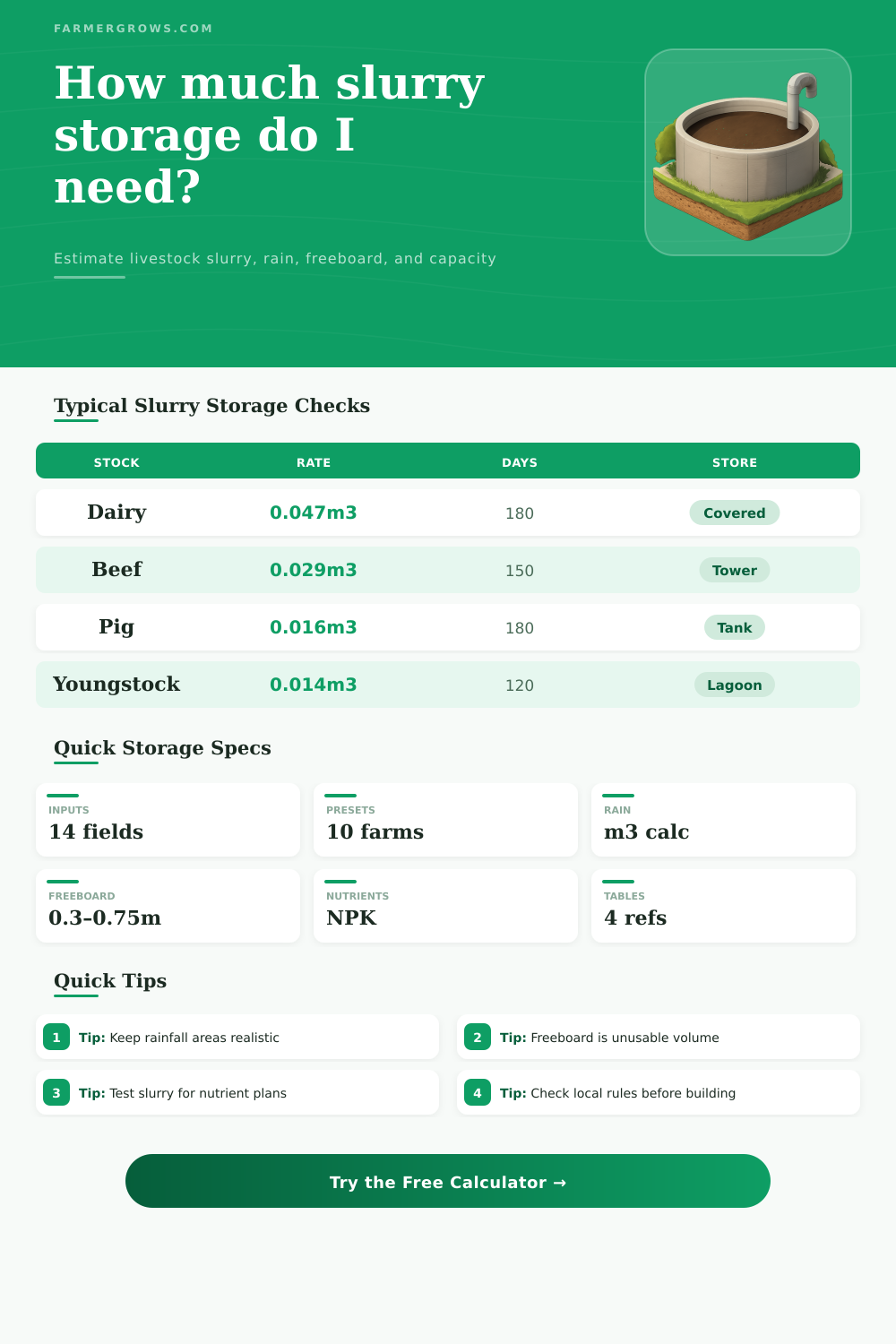
| Dairy cow in milk | 0.33 m³/week | 0.047 m³/day | Milking herd winter storage with wash water added separately |
| Suckler or dry cow | 0.26 m³/week | 0.037 m³/day | Straw-scraped or slatted winter cattle housing |
| Beef cattle over 2 years | 0.20 m³/week | 0.029 m³/day | Finishing cattle in slatted sheds |
| Cattle 1 to 2 years | 0.10 m³/week | 0.014 m³/day | Youngstock, rearing, and replacement heifers |
| Calf under 6 months | 0.04 m³/week | 0.006 m³/day | Calf pens where liquid manure enters slurry storage |
| Grower or finisher pig | 0.11 m³/week | 0.016 m³/day | Pig slurry tank storage before spreading or export |
| Sow with litters | 0.35 m³/week | 0.050 m³/day | Breeding unit slurry with washdown included separately |
| Planning item | Typical allowance | Formula used here | Why it matters |
|---|---|---|---|
| Storage days | 120 to 240 days | Animal slurry rate x head x days | Must cover housed periods, closed spreading periods, and poor field conditions |
| Rainfall on open areas | Farm rainfall for period | Area m² x rainfall mm / 1000 x capture factor | Open stores, dirty yards, and uncovered reception areas can add large volume |
| Steel or concrete freeboard | 0.30 m minimum reference | Plan area x 0.30 m removed from usable volume | Freeboard is safety headspace and must not be treated as storage |
| Earth bank lagoon freeboard | 0.75 m minimum reference | Average plan area x 0.75 m removed | Wind, wave action, rainfall, and embankment settlement need a larger margin |
| Reception pit margin | At least short-term inflow | Use contingency or a separate pit calculation | Prevents overflow during pumping delays, storms, or equipment failure |
| Slurry or liquid type | Total N | P2O5 | K2O | Use note |
|---|---|---|---|---|
| Cattle slurry, 6% DM | 2.6 kg/m³ | 1.2 kg/m³ | 2.5 kg/m³ | Typical stored cattle slurry; crop-available N depends on timing and method |
| Cattle slurry, 2% DM | 1.6 kg/m³ | 0.6 kg/m³ | 1.7 kg/m³ | Diluted or liquid separated cattle slurry |
| Cattle slurry, 10% DM | 3.6 kg/m³ | 1.8 kg/m³ | 3.4 kg/m³ | Thicker slurry with less added water |
| Pig slurry, 4% DM | 3.6 kg/m³ | 1.5 kg/m³ | 2.2 kg/m³ | Typical liquid pig slurry |
| Dirty water, 0.5% DM | 0.5 kg/m³ | 0.1 kg/m³ | 1.0 kg/m³ | Lower nutrient strength but still adds storage volume |
| Store geometry | Gross volume formula | Freeboard volume | Usable capacity note |
|---|---|---|---|
| Rectangular pit | Length x width x depth | Length x width x freeboard | Use internal dimensions; subtract sumps or columns if significant |
| Circular tower | Pi x diameter² / 4 x depth | Pi x diameter² / 4 x freeboard | Measure internal diameter; include wall height only below overflow level |
| Earth bank lagoon | Average surface area x depth | Average surface area x freeboard | Use surveyed average plan area where side slopes are substantial |
| Rated tank or bladder | Manufacturer rated usable volume | Usually built into rating | Enter rating as existing capacity when geometry is not reliable |
Rainfall check: One millimetre of rain on one square metre is one litre. Uncovered yards, tank tops, ramps, and reception areas can quietly become the biggest storage load.
Nutrient check: The NPK estimate uses standard table values. A slurry sample is the better figure for crop nutrient plans, spreading rates, and field records.
Environmental and planning caveat: this calculator is an estimating tool, not legal, engineering, or regulatory advice. Store siting, lining, inspection, separation distances, closed periods, and construction standards should be checked against current local rules and professional guidance.
Storing slurry is easy, except when it is not. It appears straightforward at first: Just build a large enough lagoon (or tank) to hold your manure volume plus whatever extra water comes in via rainfall and leave some empty room as a buffer. Wrong! To calculate how big to make the lagoon, you must factor in the volume of manure. You also need to include how much additional water arrive from rainfall, how many nutrients is in the manure, and how much free space you want to allow for. You can’t afford to miss on any of those variables. Either you’ll be short on lagoon space or else you’re paying for unused capacity.
Know What You’re Storing: First, recognize that manure isn’t produced at a continuous rate. It depends on whether animals are milking or dry; their housing system; the diet they eat; how much wash water arrives from the parlour or yard; and so on. Rainfall and wash water hitting unsheltered areas also add to it. Once you have entered your rainfall numbers and size of your roof, the math is done by a calculator, no more conversion calculations required. Just remember, each square metre of dirty yard contribute additional volume during rainstorms; and freeboard isn’t extra room. Freeboard is empty space reserved for safety’s sake, as regulators and engineers insists.
How to Calculate Slurry Storage Size
The plan changes depending on what type of store is being built. If it’s going to be a concrete tank under the yard, then the geometry of that concrete tank will be known ahead of time and freeboard required will not be huge (though enlarging the tank in future would of been costly). If it’s an earth bank lagoon, it would cost less by volume, but with a bigger freeboard since waves/wind can shove liquid further up the bank. A steel tower saves space but limits your capacity to exclude rainfall. Though you could add some sort of proper cover here too. It all comes down to budget for 20 years of maintenance, available ground, and local rainfall pattern.
Nutrient value is underestimated by most of us at the planning stage. Slurry isn’t waste; it’s full of nitrogen, phosphate and potash that will substitute for bought fertiliser when spread properly. You can get an instant estimate using standard tables in a calculator, or best of all take a sample from your own stock to find out what’s inside. The same sample tells you its dry matter content, how much you’re going to be moving around (and what proportion might be lost to the air after spreading).
The second frequent mistake is assuming rain is an insignificant contribution. In some months it could contribute at least as much than the animals (maybe more) to the amount of liquid that needs to be stored, unless, for example, you divert clean rooftop runoff, or use a floating cover, which greatly reduces the required capacity. That’s something you can play with on the calculator by changing the capture factor, and see how much it changes the necessary capacity.
A common mistake here is thinking that storage requirements apply only to an average year, but they don’t: The worst-case scenario applies. Equipment breaks down; fields gets saturated; closed spreading days coincide. Including a small contingency percent in your math isn’t padding, it’s making sure the store operates every season, rather than requiring costly hauling or emergency spreading.
How much can you use? Does the usable capacity cover the whole house and a bit more for good measure? Do you have a negative balance? You simply have three choices: buy a bigger store; clean up your act (i.e., shrink the dirty part); add a separator; or switch to a different kind of housing system.
Do you have a positive balance? Can you afford the luxurios luxury of having too big a store? Do you plan to expand beyond this size in coming years? Or are there good reasons to wait till the best window for spreading opens before using any more nutrients?
It’s the number that matters if it enables you to make a defendable decision for your regulator, your bank and your adviser. Having an honest estimation of liquid output, appropriate freeboard and realistic rainfall data makes this an asset. An under-sized structure or one constructed with optimistic assumptions means you have an ongoing problem, but not a going-away problem. Naturaly, it will be more differect than expected.