Slurry Tank Capacity Calculator
Estimate usable farm slurry storage after freeboard, open-tank rainfall, agitation reserve, daily livestock output, wash water, and storage-day targets.
Use this calculator for planning conversations, seasonal checks, and early design estimates. Slurry output varies with diet, bedding, wash water, scraped yards, dilution, and local storage rules.
Storage Capacity Results
Capacity is based on usable liquid depth after freeboard, less rainfall allowance and agitation reserve, then compared with slurry generated over the target storage period.
| Storage shape | Volume formula | Surface area for rain | Use this measurement |
|---|---|---|---|
| Circular tank | Gallons = pi x (D / 2)² x liquid depth x 7.4805 | pi x (D / 2)² | Internal diameter and liquid depth after freeboard |
| Rectangular tank | Gallons = length x width x liquid depth x 7.4805 | length x width | Inside length and width at normal liquid level |
| Metric equivalent | m³ = length x width x depth, or pi x radius² x depth | Rain m³ = area m² x rainfall m | Convert m³ to gallons with 264.172 |
| Open rainfall | Gallons = area x rainfall inches / 12 x 7.4805 | Count only exposed surface percent | Use storage-period rainfall, not annual rainfall |
| Livestock group | Planning output | Metric output | What can change it |
|---|---|---|---|
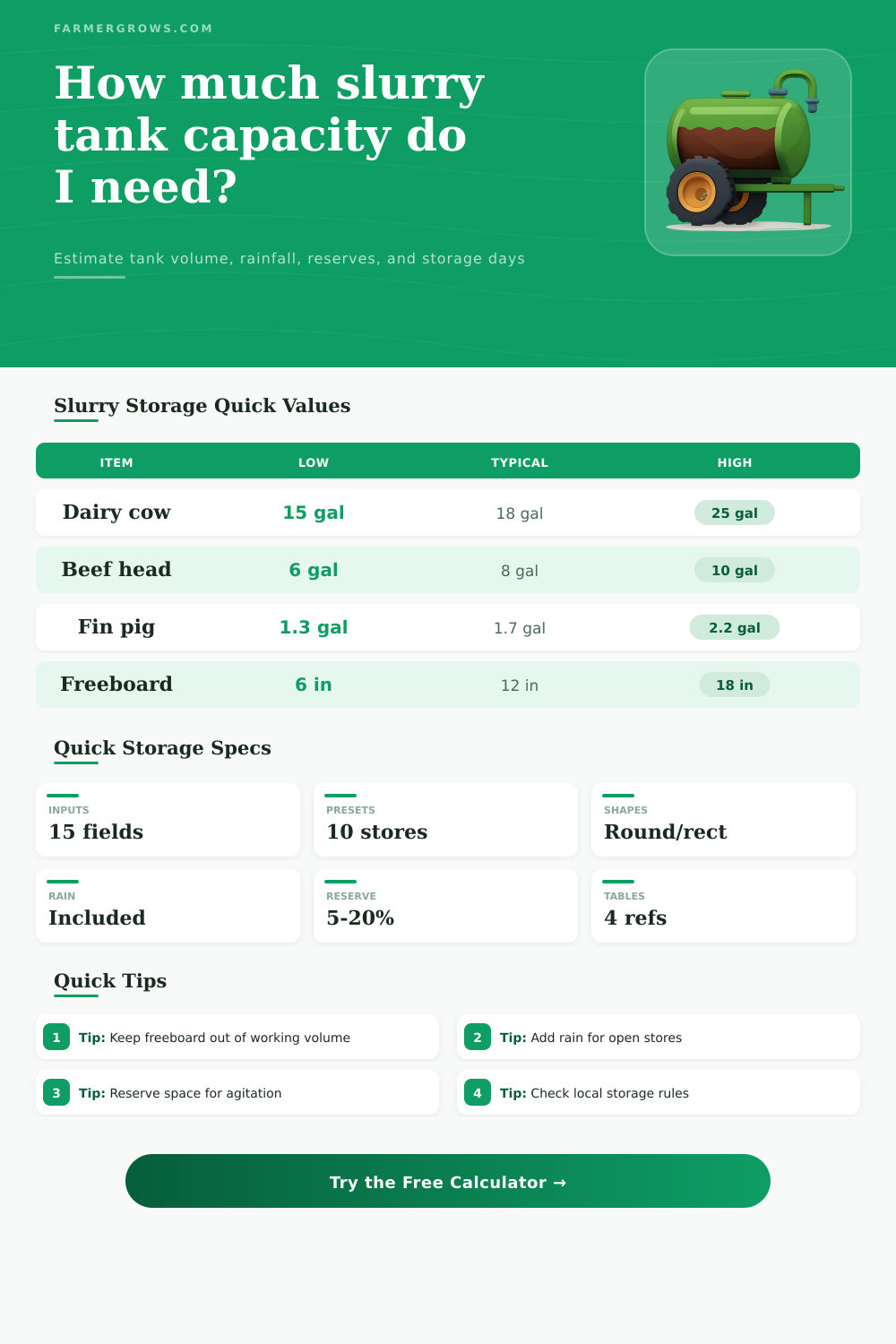
| Dairy cow, slurry system | 15 to 25 gal/head/day | 57 to 95 L/head/day | Milk yield, water use, bedding, parlour wash-down |
| Dairy youngstock | 4 to 8 gal/head/day | 15 to 30 L/head/day | Age, liveweight, loose housing, scrape frequency |
| Beef finishing cattle | 6 to 10 gal/head/day | 23 to 38 L/head/day | Ration moisture, bedding, yard drainage |
| Sow with litter | 4 to 6 gal/head/day | 15 to 23 L/head/day | Wash-down, creep areas, drinker leakage |
| Finishing pig | 1.3 to 2.2 gal/head/day | 5 to 8 L/head/day | Weight range, wet feed, floor washing |
| Winter housed ewe | 0.4 to 0.8 gal/head/day | 1.5 to 3 L/head/day | Bedding capture, floor type, lambing period |
| Allowance | Typical planning range | Formula in this calculator | Why it matters |
|---|---|---|---|
| Freeboard | 6 to 18 in, often 12 in or more | Usable depth = wall depth - freeboard | Keeps storm surge, foam, and wave action out of working volume |
| Rainfall on open stores | Storage-period rainfall for uncovered area | Area x rainfall / 12 x 7.4805 x exposed percent | Open tanks can lose large capacity to clean water |
| Agitation reserve | 5% to 15% of capacity after rain | Working capacity = after-rain capacity - reserve | Leaves room for crust movement, mixing, and foam |
| Safety margin | 5% to 20% on required volume | Required = daily output x days x (1 + margin) | Protects against wet seasons, ration changes, and delays |
| Storage target | Common use | Capacity check | Planning note |
|---|---|---|---|
| 30 to 45 days | Reception or transfer storage | Useful when regular hauling is possible | Not a substitute for closed-season storage |
| 90 days | Short winter or flexible spreading windows | Requires reliable access to land at the end | Wet weather can quickly change the plan |
| 120 to 150 days | Common seasonal target for housed stock | Balances herd output with realistic field access | Rain allowance is important on open tanks |
| 180 days or more | Long closed periods or sensitive catchments | Often needs expansion, covering, or exports | Confirm with nutrient and planning advisers |
Measure usable depth: Do not count the freeboard zone, settled solids, pipe invert losses, or unusable corners as storage. They are real space, but not reliable working capacity.
Separate dirty and clean water: Covering a store or diverting clean roof water can add more usable capacity than a small tank extension on high-rainfall sites.
Calculating the total volume of liquids that your herd will produce during the specific period of time that you plan to determine will require the determination of the amount of liquid produced during the longest period of time that the slurry will be stored. If you dont calculate the amount of liquid that your herd will produce during this period accurate, you may either build a slurry tank that is too small to hold the slurry that will be produced during that period, or you may build a slurry tank that is too large. Should the slurry tank that is built be too small, the slurry tank will fill to capacity before you can begin to spreading the slurry on your land.
Should the slurry tank be too large, however, the cost of building such a tank will be more higher than necessary to store the slurry that your herd will produce. The amount of liquid that an animal produces each day is a variable amount. The amount of liquid that an animal produces each day can change based off the types of animal.
How to Calculate Slurry Tank Size
For instance, milking cows can produce between 15 and 25 gallon of liquid per day, which includes both the water from the parlour in which the cows are milked, and the water that is used in the area of the farm where the milking cows are stored. Beef animals and young stock (young cattle) produce less liquid than milking cows, though the amount of liquid that beef and youngstock animals produce do contribute to the total liquid production of the farm during a season. In addition to the liquid that is produced by the animals, additional sources of liquid (such as wash water, roof runoff, and yard drainage) also contribute to the total liquid production of the farm.
Such additional sources of liquid are included in the calculation of the total amount of liquid that the farm can produce during a season, so that such additional sources of liquid are not forgot in the planning of the construction of a slurry tank. Freeboard is another variable that will impact the size of the slurry tank that is constructed. Freeboard is the amount of space that is left within the slurry tank that is not to be use for storing the slurry itself.
For instance, if freeboard of twelve inches is to be provided for the slurry tank, this will reduce the total capacity of the slurry tank. If a farmer utilizes an open slurry store for the slurry, the freeboard will have to account for the amount of rainfall that may enter the slurry store. The calculator will factor in the amount of freeboard and the amount of rainfall that may enter the store into the total design capacity of the slurry tank, as both of these factors cannot be utilized in the storage of the slurry.
Thus, the calculator ensures that these factors (space for clean water and freeboard) are not include in the total amount of liquid that is calculated that will be produced by the farm. Another factor to consider in the construction of a slurry tank is the physical shape of the slurry tank itself. Slurry tanks that are constructed in the shape of a circle provide the most strength to the tank, and circles are often utilized if agitation of the slurry is to occur within the tank.
Rectangular slurry tanks are often constructed against the buildings or alleys on the farm, but the area of the inside of the rectangular tank must be measured, not the area of the outside of the rectangular tank. Finally, lagoons are often the least costly means of storing the slurry that the farm produces, though lagoons require surveys of the slopes of the land on which they are constructed, as the bank of the lagoon will reduce the depth of the lagoon. The calculator can select each of these shapes, as the physical shape of the slurry tank will impact the area of the slurry tank that is exposed to rainfall.
Another consideration in the construction of a slurry tank is the inclusion of an agitation reserve and a safety margin within the tank. An agitation reserve is an area within the tank that allows for the movement of the slurry within the tank, and prevents the foam that can be created when the slurry is stored within the tank from pushing over the outlet of the slurry tank. A safety margin is constructed into the slurry tank as a percentage of the total tank capacity, and is created as a means of providing for potential wetter winters within the region in which the farm is constructed, as well as any changes to the rations provided to the herd.
An increase in the liquid production of the animals can occur as a result of these changes. Thus, an agitation reserve and a safety margin allow for compensation for these variables and ensure the tank is constructed to hold all of the liquid that will be produced during the determined period. The number of variables that impact the liquid that will be produced by the farm can lead to the amount of liquid that is produced from the farm to differ from the amount of liquid that the slurry tank calculator calculates.
For instance, the type of bedding that is used on the farm, the frequency with which the farm cleans its barns of animals, the amount of liquid that may be lost from the drinking area of the farm, and the amount of liquid that may run off of the farm into surrounding areas all impact the total amount of liquid that is produced by the farm. While the calculator cannot account for each of these variables, it can help separate the liquid production of the farm into its measurable components. Thus, the calculator can allow farmers to provide a clear understanding of the liquid production of their farm to an agricultural adviser.
One means of determining the total capacity of the slurry tank is to actualy introduce slurry into the tank and determine the effective capacity of the tank. If the effective capacity of the tank is less than the required volume of the liquid to be produced by the farm, there is a shortfall in the capacity of the slurry tank, which will require the decision of whether the farmer chooses to cover the area, divert clean water to the slurry tank, or even to increase the size of the slurry tank itself. Should the effective capacity be determined to be greater than the required volume of liquid, there is a surplus in the slurry tank.
In this situation, the farmer will have to make a determination of whether the surplus of capital invested into the construction of a slurry tank can be applied to other needs of the farm. Thus, slurry tank planning is the process that determines the size of a slurry tank to the requirements for the longest period that the slurry will remain stored. The slurry tank calculator enables a farmer to determine such a need prior to the construction of the slurry tank itself.