Slurry Calculator
Estimate livestock slurry volume, storage reserve, tanker loads, crop-nitrogen spreading rate, and NPK totals from herd size, washwater, rainfall, and manure analysis.
Use this calculator for farm planning and record checks. Local nutrient rules, setback distances, closed spreading periods, and permit conditions vary; confirm the final plan with your nutrient adviser, extension service, or regulator.
Slurry Storage and Spreading Results
Results use manure volume per 1,000 lb liveweight, added liquids, rainfall capture, reserve capacity, and the NPK analysis entered above.
| Livestock slurry | Typical production | Total N | P2O5 | K2O | Planning note |
|---|---|---|---|---|---|
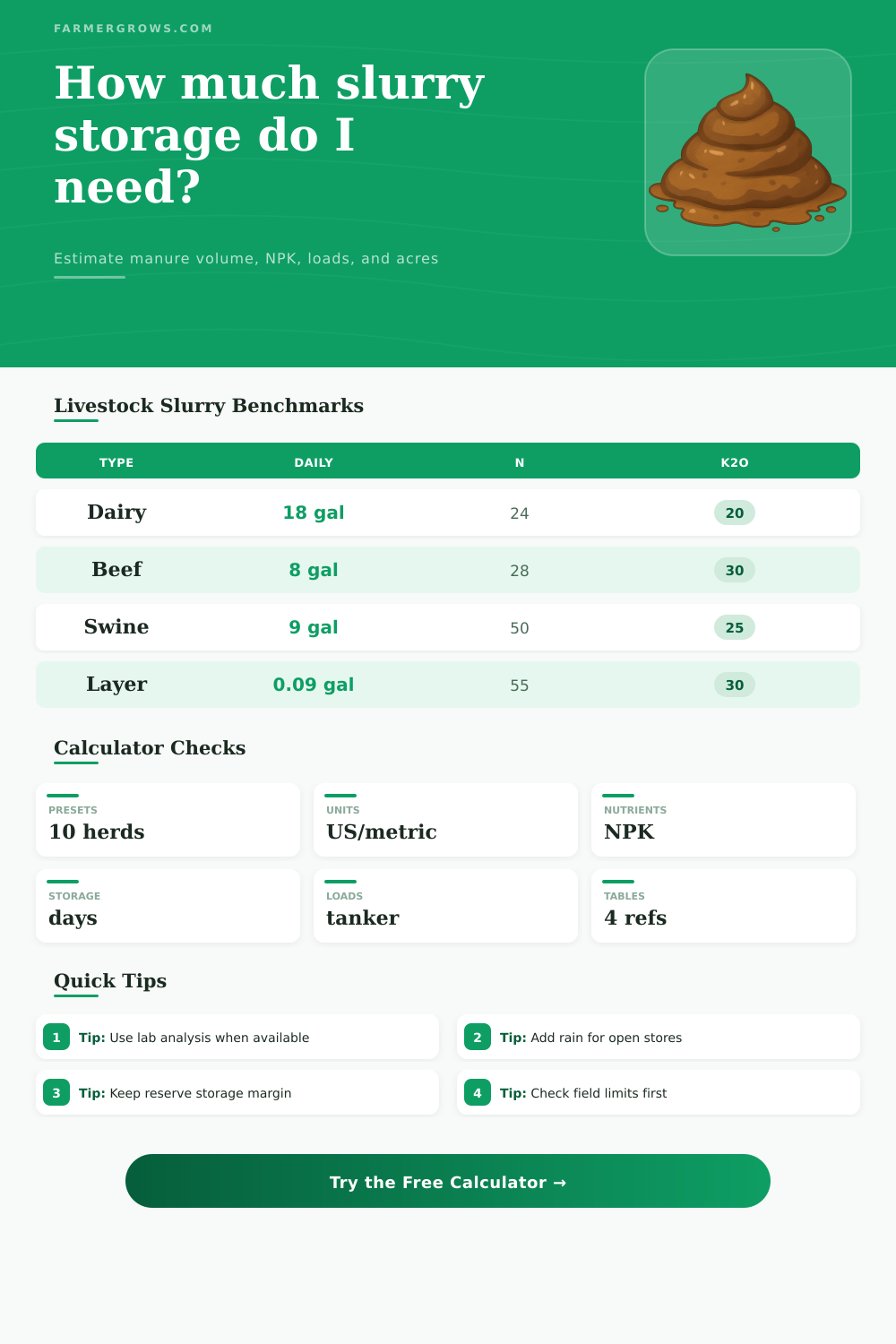
| Lactating dairy cow scraped slurry | 16 to 20 gal/1,000 lb/day | 22 to 28 lb/1,000 gal | 15 to 20 lb/1,000 gal | 18 to 24 lb/1,000 gal | Washwater changes volume quickly |
| Dilute dairy lagoon slurry | 14 to 18 gal/1,000 lb/day before rain | 8 to 18 lb/1,000 gal | 4 to 10 lb/1,000 gal | 8 to 18 lb/1,000 gal | Use agitation and sampling before hauling |
| Beef finishing slurry | 7 to 9 gal/1,000 lb/day | 24 to 32 lb/1,000 gal | 18 to 26 lb/1,000 gal | 25 to 35 lb/1,000 gal | Yard runoff may dominate open systems |
| Swine finishing pit slurry | 8 to 11 gal/1,000 lb/day | 45 to 60 lb/1,000 gal | 30 to 45 lb/1,000 gal | 20 to 30 lb/1,000 gal | Pits can stratify; sample after agitation |
| Sow unit slurry | 8 to 10 gal/1,000 lb/day | 35 to 50 lb/1,000 gal | 25 to 35 lb/1,000 gal | 20 to 28 lb/1,000 gal | Nursery, gestation, and farrowing differ |
| Layer wet manure | 0.07 to 0.11 gal/bird/day | 45 to 65 lb/1,000 gal | 35 to 55 lb/1,000 gal | 20 to 35 lb/1,000 gal | Moisture and belt scraping change density |
| Dilution or storage factor | Formula | Example result | Use in planning |
|---|---|---|---|
| Rain on open storage | Rain inches / 12 x sq ft x 7.4805 | 1 inch on 10,000 sq ft = 6,234 gal | Add to stored volume and hauling loads |
| Rain on one acre | 1 acre-inch x 27,154 gal | 3 inches = 81,462 gal | Open lagoons need rainfall allowance |
| Washwater addition | Head x gal/head/day x days | 120 cows x 7 gal x 180 days = 151,200 gal | Often a major dairy storage driver |
| Reserve capacity | Stored slurry x reserve % | 600,000 gal plus 15% = 690,000 gal | Gives weather and field-access margin |
| Storage days | Usable capacity / daily slurry | 450,000 gal / 2,500 gal/day = 180 days | Compare with winter or closed periods |
| Slurry and analysis | N availability | Rate for 80 lb available N/ac | Rate for 120 lb available N/ac | P2O5 at 120 lb N rate |
|---|---|---|---|---|
| Dairy slurry, 24-18-20 lb/1,000 gal | 45% | 7,400 gal/ac | 11,100 gal/ac | 200 lb/ac |
| Dairy lagoon, 12-7-12 lb/1,000 gal | 50% | 13,300 gal/ac | 20,000 gal/ac | 140 lb/ac |
| Beef slurry, 28-22-30 lb/1,000 gal | 35% | 8,200 gal/ac | 12,200 gal/ac | 268 lb/ac |
| Swine finishing, 50-35-25 lb/1,000 gal | 65% | 2,500 gal/ac | 3,700 gal/ac | 129 lb/ac |
| Layer wet manure, 55-45-30 lb/1,000 gal | 55% | 2,600 gal/ac | 4,000 gal/ac | 180 lb/ac |
| Application timing or field limit | Practical check | Why it matters | Planning response |
|---|---|---|---|
| Frozen, snow-covered, or saturated ground | High runoff risk | Nutrients and solids can leave the field | Delay spreading or use emergency storage plan |
| Before heavy rain | Forecast exceeds infiltration capacity | Rain can move ammonium, phosphorus, and pathogens | Choose lower-risk fields or wait |
| Near wells, watercourses, or ditches | Setbacks may apply | Protect drinking water and surface water | Map buffers before dispatching tankers |
| High soil phosphorus field | Soil test P is already elevated | P-based limits may be stricter than N-based rates | Use a P budget or move slurry to lower-P acres |
| Steep or compacted field | Runoff path is visible | Even correct rates can move off site | Reduce rate, inject, split applications, or select another field |
Sample before final rates: Book values are useful for early planning, but agitation, dilution, bedding, diet, and storage crusts can shift NPK enough to change the spreading plan.
Keep the field plan flexible: Weather, soil moisture, crop growth stage, and phosphorus limits can override a simple N-based rate. Treat this as a planning estimate, not legal advice.
Slurry management are another important task on the farm because slurry management will determine the flexibility that a farm have that year. If the storage volume of the slurry is underestimated, it is possible that the rain will fill the field with enough water to force the farm to spread its slurry on land that isnt ready for it. Additionally, if the farmer underestimates the estimated amount of nutrients that will come from the slurry, the slurry may contain too few nutrient to provide to the crops that are to be grown that year, or the farm may need to purchase fertilizer to provide the remaining nutrients to those fields.
As such, it is important to calculate the amount of slurry that the farm will produce daily for that season in advance of the seasons start. The amount of slurry that the farm will produce each day is not a fixed number. The amount of slurry that is produced each day may change based off the liveweight of the animal that live on the farm, the systems in which those animals are housed, the amount of water that is used to clean those animals, and whether the slurry that is produced are scraped from those living areas or is flushed from those living areas.
Planning Slurry Storage and Use
For instance, dairy cow may produce more slurry each day if they are housed on a scrape system as compared to a bedded pack system. Additionally, pigs may produce more slurry if they are kept in finishers barns with shallow pit as compared to a beef feedlot whose slurry simply sits upon the concrete. These different amount of slurry that are produced by each group of animals can impact many other calculation of the farm.
The amount of slurry that the farm will need to produce each day may also be impacted by the amount of rainfall that falls upon the farm. The amount of inches of water that fall upon an open lagoon or an open yard during the growing month of the year must also be stored and hauled the same as the slurry itself. Thus, the area of the farm that collect the slurry will have a greater amount of slurry that must be hauled if that area is larger.
Many people find that the amount of rainfall that falls upon the field each year is the reason that a farm must increase its slurry production. After determining how much slurry the farm must produce each year, the farm must determine how much of that slurry can be utilized by the land that is available to the farm. The amount of nitrogen that the slurry can provide is often the limiting factor for the fields during that season, though the amount of phosphorus and the amount of potassium that is contained within the field will also move at the same rate as the nitrogen.
Therefore, the field may be able to contain the amount of nitrogen from the slurry, but may be near it’s limit for phosphorus. Thus, calculations regarding the nutrients in the slurry and the fields need to be performed to determine if there are any tension between those two variable. The best way to calculate these variable is to utilize a slurry calculator.
Such a calculator will ask the farmer for various data point about the slurry, such as the size of the herd, the length of time that the slurry will be stored, the amount of liquids that will be added to the slurry to aid in the cleaning of the living area, and the nutrient analysis of the slurry sample. Based upon these answer, the calculator will calculate the volume of the slurry that will be produced, the number of tanker load that will be required to transport the slurry to the fields, the rate at which the slurry should be applied to the fields to provide the target amount of nitrogen to those fields, and the total number of acre that can be treated at that rate. Additionally, the calculator can also indicate what will happen to the slurry plan if a margin for error (reserve margin) is allowed for the field.
A reserve margin for the field may seem small, but it is crucial to include in the plan. Should it rain during the spring season, for instance, the fields may become too wet for slurry to be applied to those field for several week. Thus, a plan that may be effective under normal condition may not function as well if a reserve margin of, say, 15% is included in the plan.
A margin of 15% may mean the difference between spreading the slurry on the fields as compared to having to establish some form of emergency plan. While many farms are aware of the numbers of animal that live on the farm, and the sizes of the spreader that are available to the farm, the farms may not be aware of the link between the number of animals and the nutrient content of the slurry. The nutrient content of the slurry may change if the diet of the animal changes, if different type of bedding are used in the barns, if the amount of slurry that is produced is diluted by additional water, or if the slurry sit in the barns for lengthy period of time.
In these case, the analysis of the nutrients in the slurry should be limited to a single sample of the slurry that is collected after it has been agitated, as opposed to another sample collected after sitting for several day. In addition to the limitations of the land in which the slurry will be applied, there are other constraint upon the spreading of the slurry. Field may become frozen, rainfall may be forecasted, or the field may need to be set aside around water source for those constraint to be respected.
In these case, it is important to ensure that there is a plan for the slurry that is slightly larger than the calculation that is performed, and to create a list of field that can receive the slurry even under those less than ideal condition. By calculating these various number in advance of the beginning of the farming season, a farm can create a single plan for managing its slurry. This plan will account for the volume of slurry that the farm must produce, the nutrient that will be contained within that slurry, and the risk of many other slurry management issue.
Thus, at the beginning of the farming season, the farmer will only need to determine whether the weather will cooperate with the plan that has already been created for managing the slurry on the farm.