Silage Bunker Calculator
Size bunker capacity, storage days, dry matter inventory, face feedout, shrink allowance, and packing weight for corn silage, haylage, sorghum, and other chopped forages.
Use this as a planning calculator before filling, resizing, or choosing which bunker to open. Structural wall loads, local runoff rules, and worker safety plans still need site-specific review.
Silage Storage Results
Results combine ration demand, dry matter density, selected bunker geometry, target face removal, and storage shrink.
| Bunker use | Typical width | Wall or pack height | Common length | Design note |
|---|---|---|---|---|
| Small dairy corn silage | 24 to 32 ft | 8 to 10 ft | 70 to 120 ft | Keep face narrow enough to remove 6 to 12 in/day. |
| Mid-size dairy bunker | 36 to 48 ft | 10 to 12 ft | 100 to 180 ft | Good fit for one packing tractor lane plus wall clearance. |
| Large dairy divided bays | 40 to 60 ft each | 12 to 16 ft | 150 to 250 ft | Use separate lanes for crop years or fast daily feedout. |
| Drive-over overflow pile | 60 to 120 ft pad | 8 to 14 ft peak | 120 to 300 ft | Side slopes need extra pad width and gentle packing routes. |
| Trench or banked bunker | 24 to 50 ft floor | 8 to 14 ft | 80 to 200 ft | Drainage, wall stability, and loader reach limit practical height. |
| Forage | Harvest dry matter | Target DM density | As-fed density guide | Planning shrink |
|---|---|---|---|---|
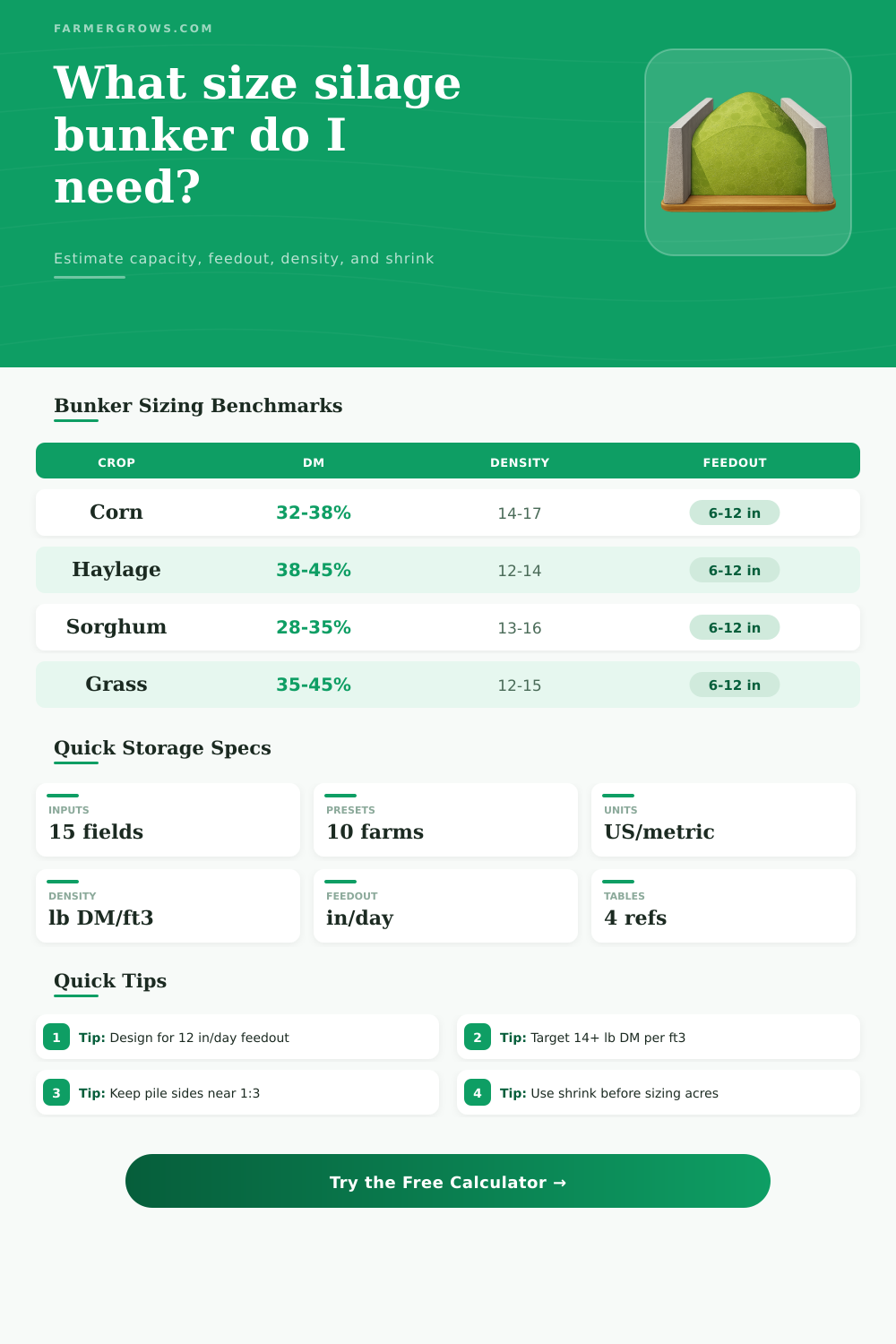
| Corn silage | 32% to 38% | 14 to 17.3 lb DM/ft³ | 40 to 44 lb/ft³ at 35% DM | 10% to 15% when packed and covered well |
| Alfalfa haylage | 38% to 45% | 12.3 to 14 lb DM/ft³ | 30 to 36 lb/ft³ depending on DM | 10% to 18%, higher if too dry |
| Forage sorghum | 28% to 35% | 13 to 16.5 lb DM/ft³ | 38 to 45 lb/ft³ at common moisture | 10% to 18%, watch seepage if wet |
| Grass silage | 35% to 45% | 12 to 15 lb DM/ft³ | 30 to 40 lb/ft³ by chop and wilt | 12% to 20%, manage oxygen exposure |
| Earlage or snaplage | 35% to 45% | 16 to 19 lb DM/ft³ | 42 to 52 lb/ft³ by kernel and cob mix | 8% to 14% with tight seal |
| Feedout condition | Minimum removal | Design target | Risk if slower | Face practice |
|---|---|---|---|---|
| Warm weather | 6 in/day | 12 in/day | Heating, yeast growth, and extra face loss | Keep a smooth, tight face and uncover only the next feed area. |
| Cool weather | 4 to 6 in/day | 8 to 12 in/day | Oxygen exposure still increases spoilage over time | Use narrower bunkers for small groups or winter-only crops. |
| High moisture forage | 6 in/day | 8 to 12 in/day | Seepage and poor fermentation if harvested too wet | Monitor runoff and preserve pad drainage. |
| Dry or porous forage | 8 in/day | 12 in/day | More air space and faster aerobic deterioration | Use heavier packing and thinner fill layers. |
| Rough disturbed face | More than 6 in/day | 12 in/day | Added loss from cracks, gouges, and loose feed | Feed all loosened silage and avoid undercutting. |
| Safety or packing item | Reference value | Use in planning | Why it matters |
|---|---|---|---|
| Settled depth for walled bunker | Wall height x 0.85 | Use when level-filled to estimate practical feed face area | Fresh forage settles after filling and fermentation. |
| Drive-over pile side slope | 1 vertical to 3 horizontal | Enter 3.0 for side slope in pile mode | Gentler slopes reduce rollover risk while packing. |
| Minimum bunker width | At least 2x tractor width | Keep most lanes 17 to 18 ft or wider | Tractors need overlap passes to pack edges and walls. |
| Packing tractor weight | 800 lb per ton/hr delivered | Compare available weight with harvest delivery rate | Fast delivery needs more packing weight or more tractors. |
| Wall overfill caution | Do not exceed wall sides | Keep working height within wall and loader limits | Wall edges and high faces create serious overturn and avalanche hazards. |
Before filling: Match bunker width to daily feed demand, not only harvest volume. A huge face that moves slowly can lose more dry matter than a smaller bay opened later.
Before packing: Compare tractor weight with the tons delivered each hour. If trucks arrive faster than the pack tractor can cover thin layers, density usually suffers first.
When you are planning a bunker for feed storage, the size of the bunker will determines both how many feed you can store and how much feed you will lose. If the bunker is too small, you will run out of feed prior to the spring season begin. If the bunker is too large, the face of the bunker will be to wide which allows air to reach the stored feed and causes the silage to spoil.
These three factors must be balance with one another to determine the success of the bunker that is constructed for feed storage. After entering the parameter for the herd size, daily dry matter intake, feeding period, and bunker dimensions into the calculator, the calculator will provide results for the reader. The calculator will show if the face removal rate will remain in a safe zone, as well as the number of days that the stored feed will last after accounting for shrink.
How to plan a feed bunker
Each parameter impact the outcome of the calculation. For example, if the shrink rate is increased, the farmer will have to store more tons of feed in the bunker to allow for the same number of feeding days for the herd. Additionally, if the density of the dry matter is lowered, the dry matter will be present in a larger volume of the bunker which could lead to the face removal rate falling outside of the required parameter to prevent spoilage of the stored silage.
The target rate for face removal is often set at a range of six to twelve inch per day. This target may change with the time of year. The calculator will allow you to input the face removal rate that you will use for your bunker to determine whether you will need to move too much or too little feed each day.
For example, if the calculated rate of face advancement drops to six inches or less during warm weather season, the calculator will alert the operator of the risk of spoilage of the stored feed. Slow face advancement indicates that air can reach the feed which can lead to the loss of dry matter from the silage. Bunkers of different shape will have different amount of usable volume.
For example, a straight wall bunker with a crown allows for the feed to be packed more dense than a drive-over pile of silage. Because drive-over pile require gentler side slopes, more pad width will be required to store the same amount of tons of silage. Both of these bunker shapes can be selected in the calculator so that you can compare the results.
These results will allow the farmer to decide whether to build a new bay or to widen the existing silage pad to store the harvested silage. Density and shrink are two factor that will determine the amount of land that must be harvested for the silage that will be stored in the bunker. Silage tends to reach a density of fourteen to seventeen pounds of dry matter per cubic foot of volume.
Haylage tends to have a more lower density than silage. If a density lower than that of silage is entered into the calculator, the calculator will calculate the size of the bunker to be larger than the size of the bunker that will actualy be needed to store the amount of silage that is calculate by the tool. Additionally, if the shrink of the silage is not accounted for in the calculation, there will not be enough silage for the herd to feed due to the loss of dry matter that occurs in the storage of silage.
It is also important to consider the packing weight of the silage relative to the rate at which the hay is harvested. For example, if the tractor delivers the hay to the silage bunker at a faster rate than the tractor can cover the silage with thin layer of hay, the density of the hay will be low. The calculator will allow the farmer to compare the weight of the tractor to the target weight to determine whether a second machine is required or if the hay is to be deliver at peak hours.
The process of choosing a bunker will compare the daily requirement for hay to the feed that can be removed from the bunker. The calculator will allow for this comparison prior to any construction of the bunker or pad. Based off the calculations that are performed in the calculator, various farm management decision can be made.