
So you plant a couple of apple trees out back, and lo and behold, they flower in May with all those beautiful white blossoms. The bees buzz around, but then the tree that was loaded with fruit has no fruit on it at all. Why? An apple tree is generaly not self-fertile, meaning it require a genetic partner to set fruit. And that partner must be flowering at the same time. One blooms in early April and the next blooms a month later in late May; this leaves the bees with nowhere to go. Timing.
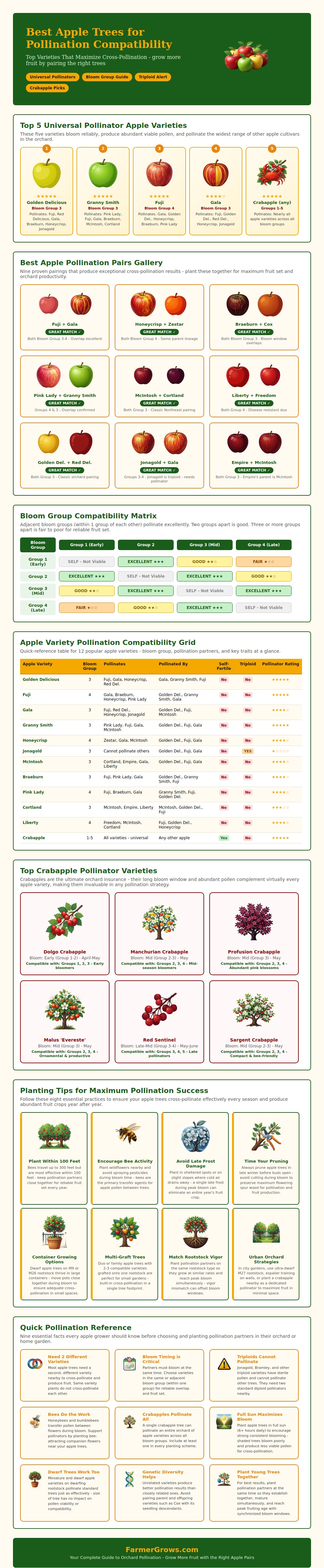
To eliminate any guesswork about which varieties will pair, the chart categorizes them by bloom window. To make sure the flowers blooms at the same time, you want your tree to be in a nearby group, often separated by only one number on the scale. Commonly recommended ones includes Golden Delicious and Granny Smith, which make great pollinators (lots of viable pollen) and is called universal donors for many cultivars. If you don’t know where to begin, plant either of those, and you’ll do fine; they’re good matches with lots of different partner.
How to Choose Apple Tree Partners for More Fruit
Others ranked high in terms of reliable production: Fuji and Gala. But some popular varieties, such as Honeycrisp, is not good pollen donors. Though they may flower heavily and produce a lot of fruit set, there is not much fruit to pick. Plan to plant Honeycrisp, but combine it with a good pollen donor (such as Gala or Golden Delicious), or else you won’t have many fruits even though your tree blooms heavily.
A pitfall for the not-quite-beginner is the triploid varieties. These include trees like the Jonagold, which produce no good pollen (and thus can’t fertilize another tree at all). They may get some from someone else, but won’t give any of it back. That means if your only partner is Jonagold and you try to grow it, chances are slim. You’ll be better off with at least two different diploid close by. Even though there’s a good chance a diploid will pollinate another diploid, the odds of success drop when there’s only one of each type. It’s one reason why sometimes the yield is small in those home gardens where folks only have one pair. Don’t make that mistake; check the compatibility grid first before you dig hole.
As if this weren’t enough, there’s the “insurance policy” of the crabapples. They have a heavy pollen load and a long bloom window. They can cross-pollinate almost any apple, no matter which group it fits into. And if you’re having trouble finding compatible pollination partners for those strange heirloom apples, just plant a crabapple. Fill in the blanks where standard varieties may fall short: among the earliest, and latest.
Location (besides biology) is everything. Pollinators; especially bees, is key helpers for moving pollen, and bees generally focus their efforts in certain areas. Planting your pollination partners no more than a football field apart greatly improves fruit set. If pesticides are sprayed at all, never do it while plants are in bloom, since these kill the very insects you want working for you. Sowing wildflower strips near the trees will further attract bees to roam the orchard.
And then there’s weather (always!). A late frost hitting just as blooms open may ruin a years crop. This is why locations with some protection from the elements (slopes where cold air can drain off), for instance; helps protect precious blossoms.
Finally, plan your layout to match rootstock vigor, too. If you plant a standard tree next to a dwarf tree, both might be at different stages of maturity after several seasons, meaning that their bloom time will eventually drift apart. If you match rootstocks, they’ll grow in sync.
If you have a small urban garden, multi-graft trees is a solution. You put two compatible varieties on the same root system. This means there are no spacing issues and they stay close together.
It’s all in who you know: You need to manage relationships between trees, rather than just individual plant. Know your bloom groups; avoid planting sterile pollen traps. Know your bloom groups; avoid planting sterile pollen traps. Make the connections so bees can do their thing. Flying from blossom to blossom carrying the promise of a large crop. Plan carefully; the rest of your orchard will reward you with bushels.