Freesia Bulb Bloom Time Calculator
Estimate when freesia corms will flower, when to plant for a target date, and how many stems to expect from pots, benches, or garden beds.
Freesias are cool-season corms. This planner estimates a practical bloom window from average growing temperature, corm grade, light, prechilling, and setting. Weather, cultivar, and storage history can shift real bloom dates.
Freesia Bloom Estimate
Results combine freesia cool-season timing with corm grade, light, prechilling, and growing setting.
| Average growing temp | Typical bloom timing | Plant habit | Best use |
|---|---|---|---|
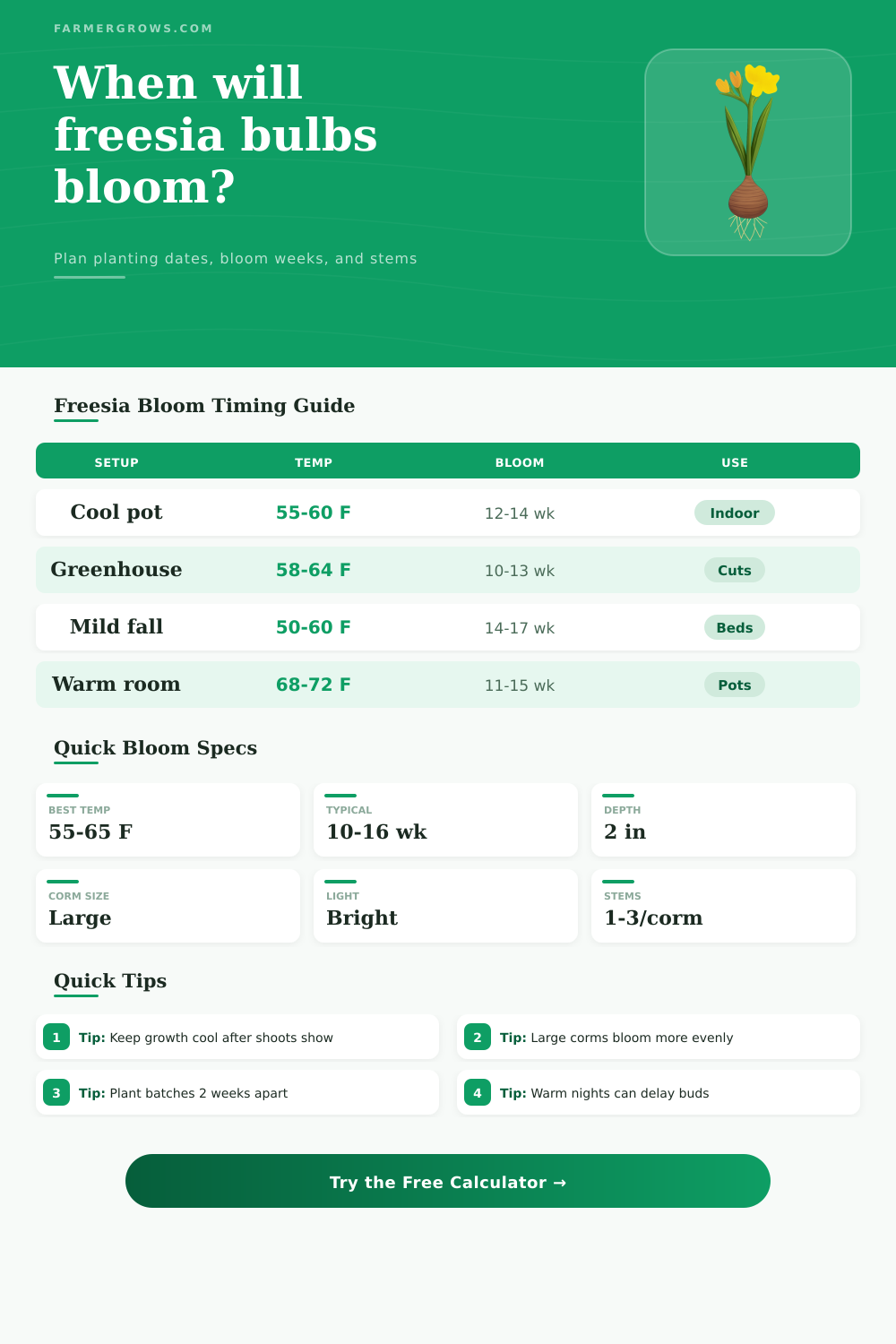
| 48 to 52°F | 14 to 17 weeks | Slow, sturdy foliage | Long greenhouse crop, outdoor mild winter beds |
| 53 to 57°F | 12 to 15 weeks | Strong stems, good bud set | Cut flower benches and event crops |
| 58 to 64°F | 10 to 14 weeks | Balanced speed and quality | Pots, greenhouse forcing, bright indoor growing |
| 65 to 72°F | 11 to 15 weeks | Faster leaves, more stretch risk | Short indoor forcing with careful light |
| Above 72°F | Unreliable | Heat stress can delay or reduce bloom | Avoid for planned flowering |
| Corm grade | Timing effect | Expected stems | Planning note |
|---|---|---|---|
| Jumbo 7 cm+ | About 1 week earlier | 2 to 3 stems per corm | Best for event work and strong pots |
| Large 6 to 7 cm | Baseline timing | 1 to 2 stems per corm | Good balance of reliability and density |
| Medium 5 to 6 cm | About 1 week later | 1 stem per corm | Plant more densely for full displays |
| Small 4 to 5 cm | 1 to 2 weeks later | 0 to 1 stem per corm | Better for growing on than exact blooms |
| Mixed saved corms | Variable | Mixed stem count | Use a wider bloom window and buffer |
| Goal | Typical plant date | Likely bloom | Setup |
|---|---|---|---|
| Late winter cut stems | Early November | Late January to February | Cool greenhouse, large corms |
| Spring patio pots | January to February | April to May | Bright frost-free pot culture |
| Mild-zone garden bloom | Autumn | Late winter to spring | Outdoor bed with frost protection |
| Market bouquet run | Every 2 weeks | Rolling harvest | Bench or crate succession |
| Indoor winter pot | September to October | December to February | Cool room, strong light |
| Condition | Timing effect | Quality effect | Grower action |
|---|---|---|---|
| Four to six weeks cool storage | Can tighten timing | More even sprouting | Keep corms dry and ventilated |
| Low winter light | Adds several days | Weak, leaning stems | Move brighter or add grow light |
| Warm nights above 65°F | Can delay bud quality | Stretch and fewer usable stems | Vent, shade roots, or cool the room |
| Deep planting over 3 inches | Slower emergence | Usually not needed in pots | Use 1.5 to 2.5 inches of cover |
For event blooms: plan the first open flowers before the event date, not on it. Freesia racemes keep opening after the first florets show color.
For stronger stems: keep growth bright and cool after shoots emerge. Warm, dim conditions may still bloom, but stems are often softer and later.
When bulbs is planted for a specific time and place, such as for a wedding, they bring a certain kind of anxiety: you don’t want freesias to open at the end of February or even early March when the wedding photographs arrive. No problem; those corms will obey the calendar, right? Wrong. Not at all.
Freesias are sensitive to not just the amount of light but also its quality, and to thermal time. Where you plant them (a factor that changes your temperature) and how cool you keep the area after the shoots push up also affects your actual bloom date. Enter your corm size and your average temperatures into the calculator above, and let it crunch the numbers. Then you won’t have to guess how long it takes for those blooms to unfold. How many weeks until the first one appear.
How to Time Your Freesia Blooms
That’s why temperature, your primary tool, comes into play: Cool season freesias don’t like it hot, but they do appreciate light. For predictable timing, keep them in a spot that averages around fifty five to sixty four degrees fahrenheit. Anything warmer then that and bulbs will start rushing to grow foliage. The result is floppy stems before blooms even open, which are caused by air that is too warm. In fact, indoor growers frequently fail because they sit their pots in front of a south facing window or heater with no way to cool down. Result? The bloom usually lasts for a three-week window instead of everything opening at once. This results in a wide bloom rather than a tight one, with flower appearing unevenly throughout that time. Keeping things cool will narrow that window considerably.
That said: Light’s important, too (and probably more so). No one likes a leggy thing, and yes, bright light helps prevent that. Why? Because a plant spending energy stretching out to get more light won’t be setting buds…yet. When you start in low or moderate light indoors (as you would in winter months), the tool accounts for this by adding a few days to your estimate. A little variable, but when you’re dealing with set-in-stone dates, every day counts. Whatever the warmth of your soil, the plant will bloom no sooner then its light allows you to make it do.
The size of the corm itself add an extra element of unpredictability. Larger ones have greater stores of energy. They progress faster at each stage of growth, with several stem per bulb. By contrast, small (or mixed) saved corms tend to be unpredictable. They might start growing a bit late or may not even flower in their first year, instead saving energy for the next one. Invest in reliability by using larger grade corms. You’ll see from the chart on the page how much it will pay off. Depending on size, jumbo bulbs can advance your timing a week or so relative to medium ones.
The pro’s secret to prolonging harvest? Succession planting means planting a few corms every couple of weeks, rather than all at once. That way, even if one batch doesn’t come in as planned, the timing might overlap with a later-planted batch. This could have happen because it didn’t get enough light early on or had a late start with cool weather. It also means a steady stream of stems, not just a big load all at once. With the calculator, you can plan for multiples, enter several batches, and let it show you the duration (first cut to last) of the total bloom time.
Another thing people often neglect is soil depth. When planted too deeply, the shoot has further to emerge and will do so far more slowly. In a pot or on a greenhouse bench, two inches of covering is generally best. That’s enough to stabilize the corm without smothering it. Outside in beds, where frost protection may be a concern, you’ll need to plant deeper (but slower).
Getting freesias to bloom is all about planning: setting expectations against reality. No magic formula will perfectly account for weather fluctuations, shifting light levels, or quality of the corms you’ve got in hand. To be on the safe side, add a cushion of five to seven days to whatever bloom date estimate you make. That’s assuming that something somewhere (and it always does) will delay slightly.
It’s all about probability, not perfection, and you’re trying to sow enough bulbs soon enough so at least some will actualy hit the mark, while others fall just behind. Sow them under favorable circumstances; maintain brightness and coolness; then let the heat required for growth unfold as it will.