Pasture Consumption Calculator
Estimate daily herd dry matter demand, usable forage, grazing days per paddock, acres needed for a planned move, and rotation pressure for cattle, sheep, goats, horses, and mixed herds.
Use measured pasture mass when you have it. This calculator treats pasture as dry matter, then applies utilization so trampling, fouling, selectivity, and protected residual stay out of the animal ration.
Pasture Consumption Results
Results use animal body weight, dry matter intake, measured pasture mass, utilization, paddock area, planned graze period, rest period, seasonal growth, and your selected buffer.
| Animal class | Typical DMI | Example weight | Daily intake | Planning note |
|---|---|---|---|---|
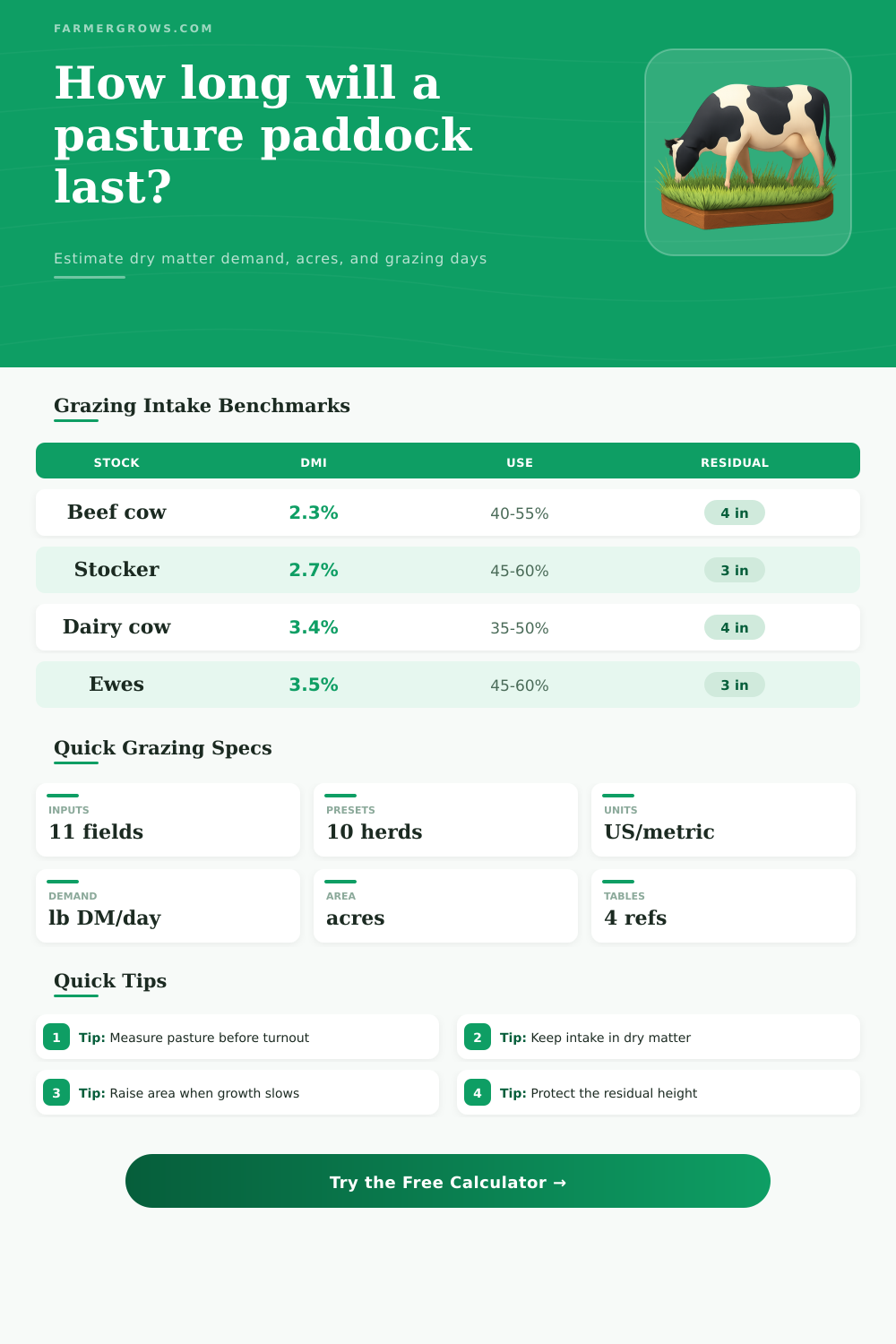
| Dry beef cow | 2.0% to 2.2% body weight | 1,200 lb | 24 to 26 lb DM | Lower range when mature, dry, and moderate condition |
| Lactating beef cow | 2.3% to 2.7% body weight | 1,200 lb | 28 to 32 lb DM | Use higher values for peak milk or thin cows |
| Growing stocker | 2.5% to 3.2% body weight | 650 lb | 16 to 21 lb DM | High-quality pasture often raises intake and gain |
| Lactating dairy cow | 3.0% to 4.0% body weight | 1,350 lb | 41 to 54 lb DM | Total ration intake may exceed pasture intake alone |
| Ewe with lambs | 3.2% to 4.0% body weight | 170 lb | 5.4 to 6.8 lb DM | Small paddocks help manage selective grazing |
| Goat, meat or dairy | 3.0% to 4.5% body weight | 120 lb | 3.6 to 5.4 lb DM | Browse preference can reduce grass utilization |
| Mature horse | 1.5% to 2.5% body weight | 1,100 lb | 17 to 28 lb DM | Use turnout control for easy keepers or lush pasture |
| Grazing method | Usual utilization | Residual target | Best use | Risk if pushed |
|---|---|---|---|---|
| Continuous grazing | 25% to 35% | 4 to 6 in cool-season | Low labor, large pastures, variable fields | Patch grazing and lower regrowth |
| Simple rotation | 35% to 50% | 3 to 5 in cool-season | Weekly or multi-day paddock moves | Long stays reduce quality and recovery |
| Management intensive | 45% to 60% | 3 to 4 in cool-season | Daily to three-day moves with rest control | Needs water, fence, and close observation |
| Strip grazing | 55% to 75% | Protect species target | High allocation control or stockpiled forage | Overgrazing if back fence is missing |
| Native range | 25% to 45% | 6 to 8 in for tall natives | Long-rest systems and drought planning | Slow recovery after heavy use |
| Pre-graze mass | Utilization | Usable DM per acre | Beef cow days per acre | 650 lb stocker days per acre |
|---|---|---|---|---|
| 1,200 lb DM/ac | 35% | 420 lb DM/ac | 15 cow-days at 28 lb | 23 stocker-days at 18 lb |
| 1,800 lb DM/ac | 45% | 810 lb DM/ac | 29 cow-days at 28 lb | 45 stocker-days at 18 lb |
| 2,400 lb DM/ac | 50% | 1,200 lb DM/ac | 43 cow-days at 28 lb | 67 stocker-days at 18 lb |
| 3,000 lb DM/ac | 55% | 1,650 lb DM/ac | 59 cow-days at 28 lb | 92 stocker-days at 18 lb |
| 3,600 lb DM/ac | 45% | 1,620 lb DM/ac | 58 cow-days at 28 lb | 90 stocker-days at 18 lb |
| Season or forage | Growth rate | Metric equivalent | Rest period cue | Field note |
|---|---|---|---|---|
| Cool-season spring flush | 40 to 80 lb DM/ac/day | 45 to 90 kg DM/ha/day | 18 to 28 days | Increase paddock size only if animals cannot keep up |
| Cool-season summer slump | 10 to 30 lb DM/ac/day | 11 to 34 kg DM/ha/day | 30 to 45 days | Lower stocking pressure before residual is damaged |
| Cool-season fall regrowth | 20 to 50 lb DM/ac/day | 22 to 56 kg DM/ha/day | 25 to 40 days | Useful for rebuilding cover after dry weather |
| Warm-season bermuda | 40 to 90 lb DM/ac/day | 45 to 101 kg DM/ha/day | 14 to 28 days | Responds quickly to heat, moisture, and nitrogen |
| Stockpiled pasture | 0 to 10 lb DM/ac/day | 0 to 11 kg DM/ha/day | Use allocation, not regrowth | Plan from standing inventory rather than daily growth |
Forage inventory: Clip-and-weigh, pasture stick readings, or plate meter readings are better than guessing. Keep the input as dry matter per acre, then var utilization protect the residual.
Rotation pressure: If calculated paddock days are longer than the planned move, either reduce area, increase stocking density, or expect more trampling and lower pasture quality by the end of the graze.
It’s one of those questions that seems simple but has no easy answer. How much grass lasts? I turn my animals out into a paddock and ask myself “how long is this going to last?”
The problem is that there are four things occurring simultaneous: utilization, pasture mass, intake and than regrowth. This means that answer changes as the stocking density changes and the weather change.
How Long Does Grass Last?
Any grazing plan revolve around dry matter intake, and this is why the calculator requires percentage of bodyweight instead of pounds/head. Animals don’t consume green weight; they consume the dry portion of the plant. Typically, a mature lactating beef cow will run about 2.4 percent of her bodyweight. Stocker cattle may be higher because their metabolism is still building frame as they grow. However, this make a big difference fast. A hundred head could mean half a day longer or less in the paddocks just from a couple tenths of a percent difference.
The second lever people miss are utilization. Not everything that stands will be consumed by animals. Some is trampled, some is fouled and some need to remain standing to regrow. This also comes into play because not everyone graze the same way. We have an option on our calculator to enter a percent to account for that. Continuous systems typicaly land in the lower thirties. Back fence daily systems can hit the mid fifties or higher depending on how well you respect the residual target. Push the use too hard, and the next go-around won’t fare as well.
But pasture isn’t static. It has a growth rate. So the tool ask for that input in the rest period as well. A spring flush on cool-season pastures can be accumulating fifty pounds of dry matter per acre per day. The same field may be adding just fifteen in the summer slump. Adding a rest interval result in a calculation of expected new growth before re-introducing the animals. This helps determine if your current paddock size will still work when the season changes.
From there, area calculations flow naturaly. By knowing how much usable forage is on each acre and the herd’s daily requirement, you can easily calculate how many acres are needed to achieve desired graze length. It’s helpful because it requires a decision to be made before turning animals out. If the calculated number of needed acres is larger than your allotted paddocks, then you’ll know if you need to increase the size of a paddock, reduce the grazing duration, or recognize that expected regrowth will be delayed.
Another variable that the calculator doesn’t account for are seasonal factors. For instance, drought will reduce not only the amount of standing mass but also the rate at which it regrows. Too much moisture may prevent animals from accessing any forage despite plenty of growth. Goats and sheep is selective grazers, so they tend to remove the best quality stuff first, which can mean effective utilization is different than the percentage you plugged into the calculator. This is why measuring on plate meters or pasture sticks trumps eyeballing it.
To avoid getting lost in a sea of math, the practical habit is to use the calculator as a checkpoint for planning. Not the end of it. Plug in what you’ve got based off today’s measurement. Next, go out into the field and eyeball regrowth and leftover height before you make the next move. If these two match, pasture condition will slowly improve and rotation pressure will remain manageable.
You should of checked the grass first.