Haylage Horse Feed Calculator
Convert a horse's dry-matter forage target into daily as-fed haylage, meal weights, bale use, hay equivalent, and sugar plus starch exposure.
Haylage is wetter than cured hay, so the scale weight must be converted through dry matter before ration decisions make sense. Use forage analysis when available, and consult a veterinarian or qualified equine nutritionist for horses with laminitis, EMS, PPID, ulcers, colic history, kidney disease, dental problems, pregnancy complications, or any medical feeding case.
Haylage Feeding Results
Results use body weight, selected forage dry-matter rate, haylage moisture, other forage credit, and feeding waste.
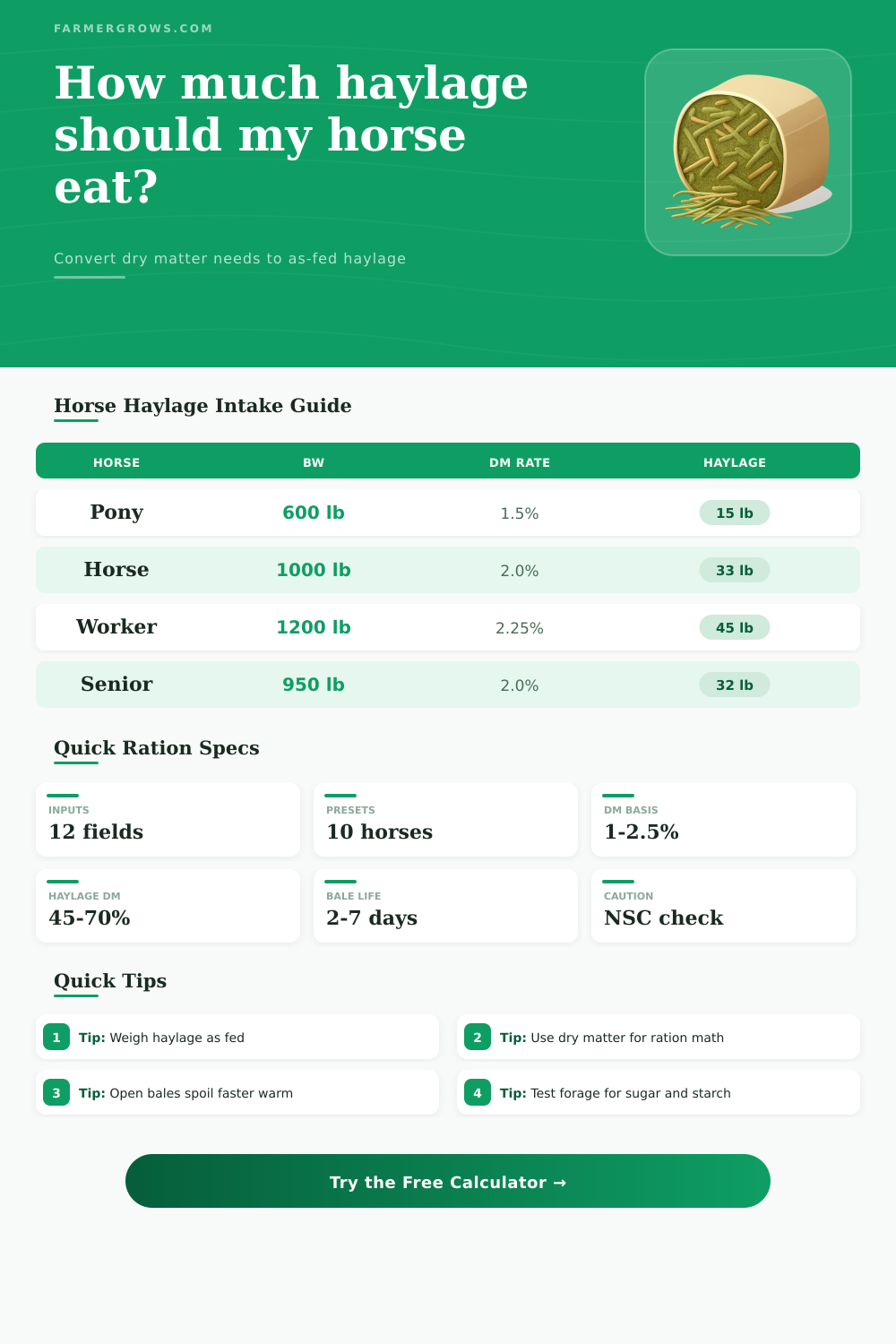
| Horse body weight | 1.5% DM forage | 2.0% DM forage | 2.5% DM forage | 60% DM haylage as fed at 2% |
|---|---|---|---|---|
| 500 lb pony | 7.5 lb DM | 10.0 lb DM | 12.5 lb DM | 16.7 lb as fed |
| 750 lb cob or small horse | 11.3 lb DM | 15.0 lb DM | 18.8 lb DM | 25.0 lb as fed |
| 1,000 lb average horse | 15.0 lb DM | 20.0 lb DM | 25.0 lb DM | 33.3 lb as fed |
| 1,200 lb large horse | 18.0 lb DM | 24.0 lb DM | 30.0 lb DM | 40.0 lb as fed |
| 1,500 lb draft type | 22.5 lb DM | 30.0 lb DM | 37.5 lb DM | 50.0 lb as fed |
| Haylage dry matter | Moisture level | As-fed needed for 20 lb DM | Hay equivalent at 90% DM | Feeding note |
|---|---|---|---|---|
| 70% DM | 30% water | 28.6 lb | 22.2 lb hay | Drier, closer to wrapped hay |
| 60% DM | 40% water | 33.3 lb | 22.2 lb hay | Common horse haylage estimate |
| 55% DM | 45% water | 36.4 lb | 22.2 lb hay | Weighing matters more |
| 50% DM | 50% water | 40.0 lb | 22.2 lb hay | Check fermentation and hygiene |
| 45% DM | 55% water | 44.4 lb | 22.2 lb hay | Heavy wet feed-out, short open-life |
| Opened bale situation | Practical open-life target | Risk signal | Storage action |
|---|---|---|---|
| Small bale, cool weather | 4 to 7 days | Dry edges, stable smell | Keep tight, shaded, and clean |
| Large bale, cool weather | 3 to 5 days | Heating core or white mold | Feed out quickly after opening |
| Warm or humid weather | 2 to 3 days | Sweet-sour change, slime, heat | Use smaller bales or more horses |
| Damaged wrap or air leak | 0 to 2 days | Visible mold, butyric odor | Do not feed spoiled sections |
| Very wet baleage | 2 to 4 days | Fast aerobic spoilage | Open only what can be used |
| Ration conversion | Formula | Example | Why it matters |
|---|---|---|---|
| Dry matter target | Body weight x intake % | 1,000 lb x 2% = 20 lb DM | Matches nutrient requirements on a DM basis |
| Haylage as fed | DM needed / haylage DM fraction | 20 / 0.60 = 33.3 lb | Wet forage weighs more than hay |
| Waste-adjusted offer | Clean intake / (1 - waste) | 33.3 / 0.92 = 36.2 lb | Allows for leftovers and feeder loss |
| Hay equivalent | Haylage DM / 0.90 | 20 / 0.90 = 22.2 lb hay | Compares haylage against cured hay |
| NSC load | Haylage DM x NSC % | 20 x 10% = 2.0 lb NSC | Screening flag for sugar and starch risk |
| Sugar and starch situation | NSC on forage analysis | Caution level | Feeding response |
|---|---|---|---|
| Healthy maintenance horse | Under 12% | Usually workable | Balance with body condition and workload |
| Easy keeper or overweight | 10% to 12% | Watch carefully | Use slow feeders and track weight tape |
| EMS, PPID, insulin dysregulation | Near 10% or lower | Veterinary plan | Use tested forage and professional guidance |
| Laminitis history | Near 10% or lower | High caution | Do not guess from label averages |
| Unknown analysis | Not tested | Uncertain | Sample forage before making medical decisions |
Dry matter first: A 33 lb haylage ration at 60% dry matter gives the same dry forage as about 22 lb of 90% dry hay. Moisture changes the scale weight, not the horse's dry matter requirement.
Open bales carefully: Discard moldy, hot, slimy, or foul-smelling haylage. Once oxygen reaches the bale, spoilage can accelerate, especially in warm weather or damaged wrap.
Feeding haylage to horses require a specific calculation. Haylage contains more water than hay. When feeding haylage to horses, the bale will weigh more than hay bales.
However, because haylage contains more water, it dont contain as much dry forage as hay do. The increased weight of haylage come from the increased moisture content of haylage when it is wrapped. Because the moisture content of haylage changes an amount of dry matter haylage contains, a calculation of the dry matter percentage of the haylage is necessary before feeding to horse to ensure the horse is receiving the correct amount of nutrition.
How to calculate how much haylage to feed a horse
If haylage and hay of the same weight are fed to the horse, the horse could either be underfed or overfeed. The dry matter percentage of haylage is a critical number to determine the amount of haylage the horse will need to eat. A mature horse that does not perform any work need 2% dry matter of the horses weight.
However, a working horse or a mare that is nursing her foals will require a higher percentage of dry matter. An easy keeper will require a lower percentage of dry matter. A haylage calculator is available that will allow the person to adjust the dry matter percentage.
The calculator will display the weight of haylage the horse will need to eat daily to meet its dry matter requirement. The calculator will also show how many day the opened bale of haylage will last. Once the person cuts the plastic wrapping to allow the haylage to be fed to the horse, the haylage will begin to spoilage from exposure to air and oxygen in the environment.
Another factor to consider before feeding haylage to a horse is waste and refusal. If haylage is ignored and the horse refuse to eat all of the haylage, the wasted haylage could amount to an extra bale of haylage every week. Including an allowance for waste in the haylage calculations will show the difference between the weight of the haylage offered and the weight of the haylage the horse eats.
Additionally, you can credit the other forage in the ration in the calculations to avoid counting the same dry matter twice when haylage and other hay are fed together. The sugar and starch content of haylage is another factor that can cause metabolic trouble in horses. The sugar and starch content in haylage can vary due to the grass content in the haylage and the fermentation process of the haylage.
The Non-Structural Carbohydrate (NSC) field in the haylage calculator can be used to calculate the total amount of sugar and starch the horse will consume. If the haylage contains too much sugar and starch, the horse will develop metabolic trouble. In this case, you can purchase haylage with less sugar or the feeding schedule for haylage meals can be adjust.
Another important factor to consider is bale size and the open life of the haylage. Large bales of haylage may seem more cost-effective when bought at a higher price per pound. However, the increased size of the bale also mean that the haylage will spoil before it is finished if the climate in which the bale is stored is warm.
The expected use of haylage in a barn daily can be compared with the safe open-life target of the haylage. If the haylage will last longer than the safe open-life target, the haylage will spoil and must be discard. Calculating the haylage requirement for the horse is necessary because haylage is a different product than hay.
Haylage requires a different conversion for weight compared to hay. Haylage spoils at a different timeline compared to hay, and haylage requires a different check for the sugar content than hay does. By calculating each of these factor, the person caring for the horse will have a more clearer idea of how many pounds of haylage to feed the horse daily.
The haylage ration will be closer to the nutritional requirements of the horse.