Straw Coverage Calculator
Estimate straw bales, loose volume, dry matter weight, and practical coverage for garden mulch, new seed, winter protection, and erosion-control spreading.
Choose depth mode for loose straw mulch around crops or beds. Choose rate mode for seeding and erosion jobs where straw is specified in pounds per 1,000 square feet.
Straw Coverage Results
Results update after calculation.
| Settled depth | 1 yd³ covers | 1 m³ covers | 40 lb wheat bale covers | Best use |
|---|---|---|---|---|
| 1 in / 2.5 cm | 324 ft² | 129 m² | 166 ft² before settling | Very light soil splash cover |
| 2 in / 5 cm | 162 ft² | 64.5 m² | 83 ft² before settling | Seedling rows and light weed shade |
| 3 in / 7.6 cm | 108 ft² | 43 m² | 55 ft² before settling | Common vegetable bed mulch |
| 4 in / 10 cm | 81 ft² | 32.3 m² | 42 ft² before settling | Heavy summer mulch or paths |
| 6 in / 15 cm | 54 ft² | 21.5 m² | 28 ft² before settling | Winter garlic, potatoes, or crowns |
| Job type | Typical straw rate | Tons per acre | 40 lb bale covers | Field note |
|---|---|---|---|---|
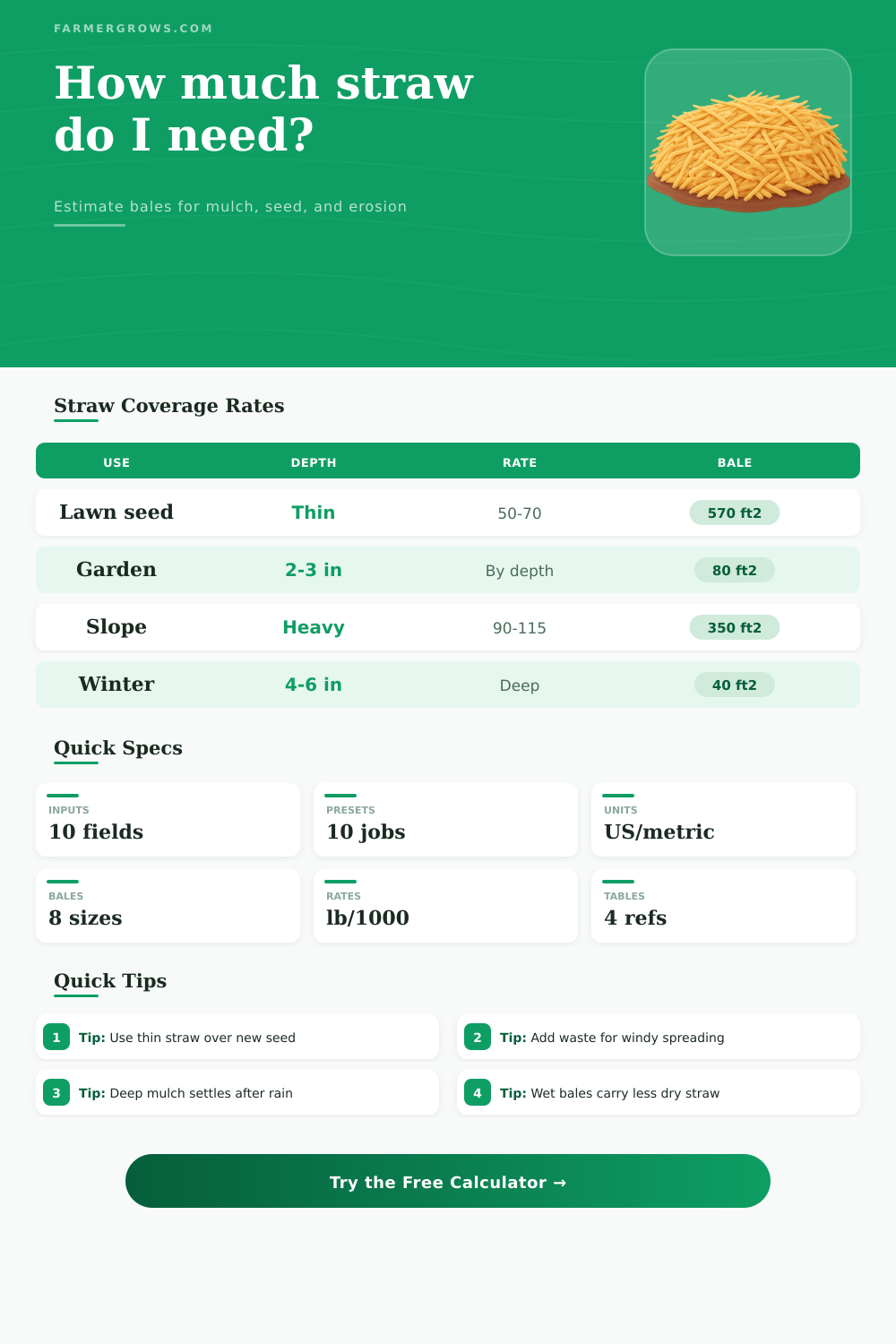
| New lawn seed, light cover | 50 lb per 1,000 ft² | 1.09 ton/ac | 800 ft² | Soil should remain partly visible. |
| New lawn seed, standard | 70 lb per 1,000 ft² | 1.52 ton/ac | 570 ft² | Good for even broadcast cover. |
| Temporary erosion cover | 90 lb per 1,000 ft² | 1.96 ton/ac | 445 ft² | Use more on rough seedbeds. |
| Steep slope or swale | 115 lb per 1,000 ft² | 2.50 ton/ac | 348 ft² | Crimp or tack where runoff risk is high. |
| Very heavy protection | 140 lb per 1,000 ft² | 3.05 ton/ac | 286 ft² | Use only where seedlings can still emerge. |
| Bale or roll | Typical size | Typical weight | Dry matter at 15 percent moisture | Approx. lawn seed coverage at 70 lb/1,000 ft² |
|---|---|---|---|---|
| Small square | 14×18×36 in | 40 lb | 34.8 lb | 497 ft² |
| Heavy small square | 16×18×36 in | 55 lb | 47.8 lb | 683 ft² |
| Three-string square | 16×23×44 in | 100 lb | 87 lb | 1,242 ft² |
| Round 4×5 | 4 ft wide, 5 ft diameter | 600 lb | 522 lb | 7,453 ft² |
| Round 5×6 | 5 ft wide, 6 ft diameter | 1,100 lb | 956 lb | 13,665 ft² |
| Large square 3×3×8 | 3×3×8 ft | 800 lb | 696 lb | 9,938 ft² |
| Large square 3×4×8 | 3×4×8 ft | 1,150 lb | 1,000 lb | 14,286 ft² |
| Large square 4×4×8 | 4×4×8 ft | 1,500 lb | 1,304 lb | 18,634 ft² |
| Adjustment | Typical factor | Calculator effect | Use when | Planning note |
|---|---|---|---|---|
| Dry cured straw | 10 percent moisture | Most bale weight counts as dry straw | Clean indoor-stored bales | Best for predictable bale counts. |
| Damp stored straw | 25 percent moisture | More handled weight for the same dry matter | Bales feel cool, heavy, or clammy | Open and fluff before thick mulch. |
| Normal loose settling | 20 percent depth loss | Adds loose volume in depth mode | Most garden mulch jobs | A 3 in target starts near 3.75 in loose. |
| Chopped or wet settling | 35 percent depth loss | Adds more loose volume in depth mode | Short stems, rain, foot traffic | Check crowns after the first watering. |
| Wind and edge waste | 10 to 20 percent | Adds dry straw after main calculation | Slopes, ditches, paths, or crimping | Use the high end for rough erosion work. |
Depth jobs: Spread straw loose and fluffy, then water it in before judging final coverage. A target 3 inch mulch commonly needs extra loose volume because stems collapse and knit together.
Seed jobs: Avoid smothering new seed. For lawns, the usual visual target is a thin straw cover where soil is still visible through the stems.
Straw is a material that people often use on farms and within garden, but many people incorrectly perform the task of determining the amount of straw that is required for a particular project. The amount of straw that is required for a specific job is dependent upon the purpose for which that straw will perform it’s intended function. For instance, lawns require only thin layer of straw to aid in the germination of seeds, but garlic bed require much thicker layers of straw to provide winter insulation to the roots of the plants.
If you dont calculate the amount of straw that you need for your project, you may either order too little or too much straw. A calculator is a tool that can help you to determine the volume, the weight, and the number of bale of straw that you will need for your project. The goal that you establish for your project will determine the amount of straw that you need to use.
How Much Straw Do You Need
For instance, if you are planning to seed a lawn, you will need to use a thin layer of straw in order to allow the sprouts to reach the sunlight that it require in order to germinate. However, if you are planting in a garden, you will require a deeper layer of straw to aid in the germination process. Additionally, if your ground features slope, you will require more straw to prevent the wind from being displaced from the area that you planted in.
Finally, if you are planting bulb that will winter in your ground, you will require a thick layer of straw to insulate the roots from the winter ground temperatures. Each of these different goal will require a different amount of straw, yet the calculator can take into account each of these different requirement. The shape of the area that you plan to cover with straw can also have an impact upon the amount of straw that you need.
If the area that you wish to cover is not in the shape of a perfect rectangle, you may need to calculate the square footage of that area. For example, a circular area will have a different amount of square footage compared than a triangular area of the same size in relation to the area that you wish to cover with straw. Small error in the area that you calculate can have a major impact upon your requirement for straw to cover an entire orchard or roadway.
Once you calculate the square footage of the area that you plan to cover, you will need to take into account the type of straw that you will use. Straw that is made from wheat, oat, and barley product will have different weight due to there densities. Additionally, the moisture content of the straw will play a major factor in the weight of the straw bale; damp straw will weigh more than dry straw.
In addition to the factor discussed above, you should also account for the settling and movement of straw. Straw will settle after it rains, straw will settle if people walk on it, and the wind can displace straw. Thus, you should account for these factor in calculating how much straw you will need for your project.
A straw calculator can ask you to account for straw settling and waste, ensuring that the number of bale of straw that you calculate is the number that you will actualy need for your project. The size of the bale of straw that you use will also impact your calculation. A person can carry small square bale of straw, but a tractor can better transport large round bale.
Calculators will show the number of bale of straw of any size that is required for your project, as well as ask you to select the number of whole bale of straw that are required. Since straw is sold in whole bale, this will help to make sure that you do not purchase a fraction of a bale of straw. Additionally, the calculator will show the volume of the straw in cubic yard, which is another factor that will be of help to those purchasing bulk amount of straw.
In addition to the factor described above, there are a number of other factor in the real world that will impact the amount of straw that you will need for your project. For instance, ground that contains many weed requires more straw to prevent the weed from growing up through the straw. Slopes that face the wind will require more straw to prevent it from being blown away from the area in which it will germinate.
Finally, damp straw will require a different amount of straw than dry straw that has been stored outside. A calculator will provide you with a mathematical figure for the amount of straw that you need. However, actual inspection of the ground in which you will place the straw will help you to determine the actual amount of straw that is required for your project.
Thus, the calculator and its measurement combined with an inspection of the area to be covered will provide the best estimate of the amount of straw that will be required for your project.